










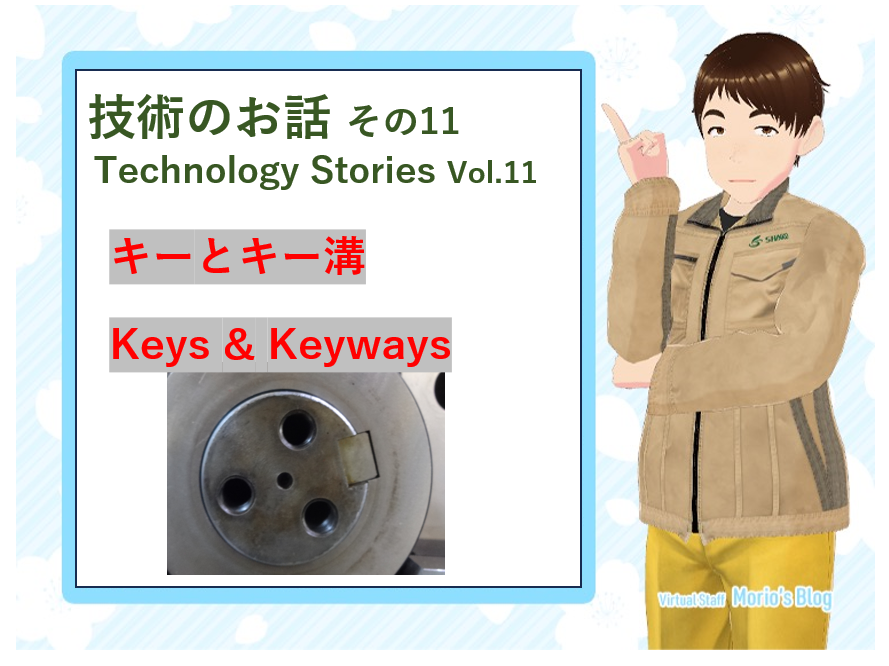
その11:キーとキー溝
あっ、もりおです。こんにちは。今年の夏も暑くなるそうですね。皆さん、お体くれぐれも大切にしましょうね。
今回は、送り軸における「キー」の役割と品質上のポイントについて説明します。
「キー」とは、回転軸と回転部品を接続し、トルク伝達を助ける小さな部品です。
製品品質上、特に重要な送り軸の場合、「キー」が使われる場所は、おおむね以下の2ケ所です。
A:モーター(原動部)からのギアと送り軸が接続される回転の起動部分
B:送り軸先端の送りローラ(加工ツール)を取り付ける部分
形状は、軸側と取付部品側で寸法が異なり、四角、凸型、その他特殊なものも含め、様々な形状があります。
キーの役割
1.トルクの伝達:
・モーターや他の動力源から生成されるトルクを、軸を通じて他の部品(この場合は送りローラ)に効率的に伝達することです。
キーが適切に機能しない場合、部品間でスリップが発生し、機械が正常に動作しない原因となります。
2.位置決め
・キーは、取り付けられる部品を正確な位置に保持される役割もあります。これにより、機械の精度と再現性が保証されます。
3.取り付けと取り外しの容易さ
・キーを使用することで、ギアを軸に対して容易に取り付けられ、必要に応じて取り外しができるようになります。
これにより、保守・修理や送りロールの交換が容易になります。
もっとも、取り外しがしやすければよいというものではなく、以下の記述をご参照ください。
品質上のポイントと当社での取り組み
1.材質と設計
・キーは、耐摩耗性と強度が求められるため、高品質な鋼や合金鋼で作られます。材質が適切でないと、摩耗や破損が起こりやすくなります。
もちろん、キーとキー溝の設計は、使用される機械の特性や負荷条件に合わせて適切に選定される必要があります。
間違ったタイプのキーを使用すると、性能不足や故障のリスクが高まります。例えば、軸に対するキーの数によって、
材質だけでなく、熱処理方法や荷重均等分配、中心ズレ防止などのきめ細かな設計を行います。
送り軸側も、前回までに述べましたように、高速回転や停止・再駆動の多い、負担の大きい使用ですので、
軸の材質にこだわるだけでなく、浸炭焼入れして、軸表面をキーよりも硬くなるように設定しています。
また、特に負荷の高い場所では、キーではなく、スプライン化(歯状の溝)する場合もあります。
2.寸法精度と組立て技術
・キーがあれば、軸側には、キー溝(キーを受け入れる溝)もあり、その寸法精度が非常に重要です。
寸法が正確でないと、キーの嵌合い不良が発生し、トルク伝達能力が低下したり、過度の摩耗や損傷を招くことがあります。
キーやキー溝幅の寸法公差は軸側とボス側(取付部品側)で異なり、一般的には新JIS規格のキー材を使用しますが、
場所的に、交番荷重(大きさや方向が繰り返し変動する荷重)が大きるので、ガタつきが出たり、使用限界が早くなる恐れがあります。
当社では、JIS規格よりも厳しく、特注品のキー材を使用した上で、1/100mm台の寸法を管理しています。
部品加工時も、通常は熱処理前に仕上げ加工を行うことが多いのですが、熱処理による形状変化を防ぐために、
協力企業さんにお願いして、熱処理後(当然硬くなるので加工が難しくなります)に、ダイヤモンドエンドミルや放電加工で最終仕上げを行ってもらいます。
ちなみに、毎年秋に会社の駐車場で、協力企業さんを招待して、BBQパーティーをやるのですが、
協力企業さんは、「新興さんの部品は大変!」と、うれしそうに語ってくれるそうです。
このBBQ、もちろん社員が肉を焼いたり、手料理をふるまったりするのですが、
協力企業さんも、ご家族を連れて来られたりして、結構楽しみにしてくれているそうです。
ぼくも、この秋は精一杯働きますよ!
さらに、組立時の仕上げ工程で、1品1品、1/1000mm単位の調整を行います。
その際、キー側をやや大きめにして、嵌合いを強くします。接触面の仕上げは特に重要で、手作業ではなく、機械を使った仕上げにより、
滑らかで、凹凸のないような面にします。嵌め合いの奥部分と手前部分で、微妙に仕上げ度合いに差を付けます。
このように、部品仕上げや嵌め込みには、高い組立て技術が必要になります。
送りロールは、ばねの線径により、交換を行う部品ですので、ギア部分ほどの強い嵌め合いではないのですが、
それでも、お客様からは「嵌めにくい」と言われたりすることもあります。
実際、ぼくも研修の時、ほんの少し斜めに嵌めてしまったのか、抜くのに四苦八苦した苦い経験があります。
送り精度と耐久性のために、ギリギリを狙っている部分と解釈頂ければありがたいです。
では、また次回を楽しみにしててくださいね。
Vol.11: Keys and Keyways
Hello, I’m Morio! This summer is forecasted to be very hot. Everybody, take care of yourself and stay healthy!
Today, I would like to explain the role and quality points of the “key” in the feed shaft of our machines. A “key” is a small part that connects a rotating shaft to a rotating component, aiding in the transmission of torque. In terms of product quality, especially for important feed shafts, the “key” is generally used in the following two places:
A: The parts where the gears from the motor (drive unit) connect to the feed shaft. This is where the rotation starts.
B: The parts at the end of the feed shafts where the feed rollers (processing tools) are attached.
There are various shapes of keys, including square, convex, and other special forms, which vary in dimensions between the shaft side and the component side.
Roles of the Key
1.Torque Transmission:
The key efficiently transmits the torque generated by the motor or other power sources through the shaft to other components (in this case, the feed roller). If the key does not function properly, slippage can occur between components, causing the machinery to malfunction.
2.Positioning:
The key also plays a role in ensuring that the attached components are held in the correct position. This ensures the precision and repeatability of the machine’s operation.
3. Ease of Installation and Removal:
Using a key allows gears to be easily mounted on the shaft and removed as needed. This facilitates maintenance, repairs, and the replacement of the feed rollers.
However, ease of removal does not always mean “better”. Please refer to the following for more details.
Quality Points and Our Commitments
1. Material and Design:
Keys are made from high-quality steel or alloy steel to withstand wear and breakage because they require resistance to abrasion and strength. Of course, the design of the key and the keyway must be appropriately selected based on the characteristics and load conditions of the machinery being used. Using the wrong type of key can increase the risk of performance deficiencies and failures. For example, the number of keys on a shaft can dictate not only the material used but also detailed designs such as heat treatment methods, load distribution, and prevention of misalignment.
2.Dimensional Accuracy and Assembly Techniques:
The presence of a key also means there is a keyway on the shaft side, and the dimensional accuracy of this keyway is crucial. Inaccurate dimensions can lead to poor fit of the key, reducing torque transmission capacity and causing excessive wear or damage. While we generally use key materials that meet the new JIS standards, the load conditions at specific locations, especially where the load changes in size and direction frequently, may lead to premature wear or play in the fitting.
At our company, we manage dimensions to tighter tolerances than JIS standards, using custom-ordered key materials and controlling dimensions with 1/100mm range.During the machining of parts, finishing is often done before heat treatment. However, to prevent any deformation due to the heat treatment, we ask our partner suppliers to perform the final finishing after the heat treatment (Of course, the parts become harder and more difficult to be processed.). So they use diamond end mills or electrical discharge machining to meet our request..
By the way, every autumn, we host a BBQ party in our company parking lot and invite our partner companies. They often say with a smile that “working with Shinko’s parts is much more challenging than other customers’ parts!” This BBQ is a special occasion where our employees cook meat and serve homemade dishes. Our partners look forward to the party, often bringing their families along. I’m really looking forward to working hard this fall too!
Furthermore, during assembly, each piece is adjusted with 1/1000mm range. The key side is made slightly larger to ensure a tight fit, and the finishing of the contact surfaces is crucial, performed with machines for smoothness without irregularities, with slight differences in the finish between the deeper and more superficial parts of the fit. Such detailed finishing and fitting require high-level assembly skills.
The feed rollers, being replaceable parts depending on the wire diameter in spring making, do not need as strong a fit as the gear parts, but there can be feedback from customers about difficulty in fitting. I personally struggled to remove a slightly misaligned feed roller during my training, a tough lesson in the precision and durability we aim for in our designs.
I hope this detailed explanation helps you understand the critical role and intricate details involved in designing and manufacturing the key components of our machinery.
Stay tuned and Look forward to my next blog!