











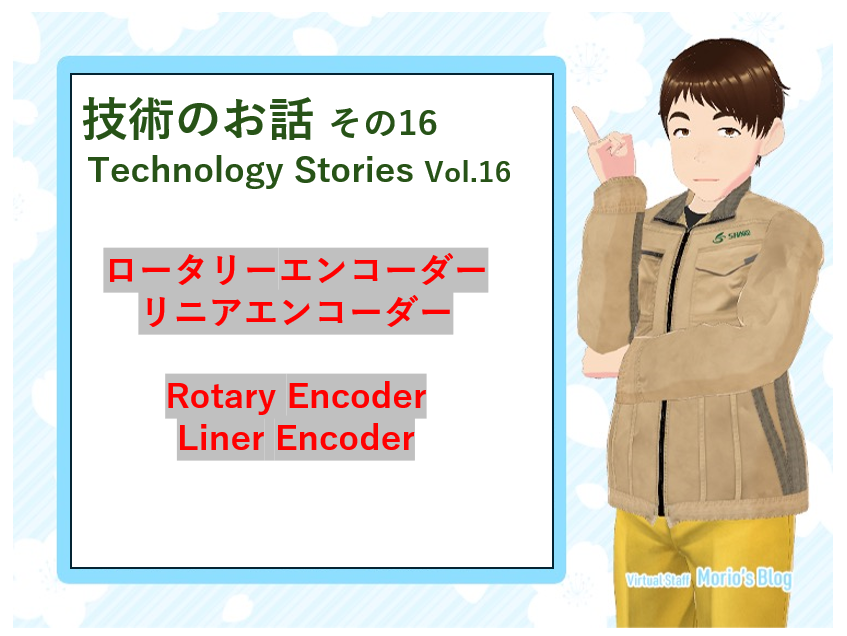
その16 エンコーダー3 ロータリーエンコーダーとリニアエンコーダー
こんにちは、もりおです!
今日はエンコーダーの第3回です。その種類と各々の特徴を掘り下げてご紹介しますね。エンコーダーとは、主に位置や速度の測定に利用され、機械の動きを正確に制御するために不可欠なコンポーネントですが、一般に、2つのタイプがあります。1つは回転運動を測定するロータリーエンコーダー、もう1つは直線運動を測定するリニアエンコーダーです。なお当社製品では、ロータリーエンコーダーのみが使用されています。
ロータリーエンコーダー(回転運動)
機能と用途:
ロータリーエンコーダーは軸の回転運動を測定し、角位置、速度、および方向を決定します。このタイプのエンコーダーはモーター制御やロボティクス、その他回転動作を伴う多くの機械で広く用いられています。
働き:
ロータリーエンコーダーにはディスクまたはコードホイールが装備されており、多くのスリットが等間隔で配置されています。ディスクが回転すると、これらのスリットがセンサーの前を通過し、光センサーは遮断される光と通過する光の変化を捉えて電気信号に変換します。この信号から回転の速度や角度が計算されます。
リニアエンコーダー(直線運動)
機能と用途:
リニアエンコーダーは直線的な運動を精密に測定するために使用されます。これは、例えばCNC機械や3Dプリンターのスライドやテーブルの移動を追跡する際に活躍します。このエンコーダーにより、ツールや作業部品の位置をリアルタイムで正確に知ることができ、高精度な製造が可能になります。
働き:
リニアエンコーダーは、スケールとセンサーヘッドから構成されます。スケールには細かい目盛りが施されており、センサーヘッドがこれを読み取りながら移動します。この動きにより直線運動の位置情報が計測され、そのデータはデジタル信号に変換されて機械の制御システムに送られます。
両者の比較
動きのタイプ:
ロータリーエンコーダーは回転運動を測定し、リニアエンコーダーは直線運動を測定します。
アプリケーション:
ロータリーエンコーダーは回転軸の動きを正確に制御するために適していて、リニアエンコーダーは直線的な位置決めが必要な場面で使用されます。
このように、ロータリーエンコーダーとリニアエンコーダーは、それぞれ独自の機能を持ち、異なるタイプの運動を測定するために設計されています。どちらを選ぶかは、必要とされる精度と動作のタイプによって異なります。
※本文は、生成AIを使って作成しています。
Vol.16 Encoders No.3 Rotary Encoder & Linear Encoder
Hello, it’s Morio here!
Today marks the third installment of our series on encoders, where I delve into the types and specific features of these crucial components. Encoders are primarily used for measuring position and speed, essential for precise control of machinery movements. Generally, there are two types of encoders: rotary encoders, which measure rotational movements, and linear encoders, which measure linear movements. At our company, we exclusively use rotary encoders.
Rotary Encoder (Rotational Movement)
Function and Use:
Rotary encoders measure the rotational movement of a shaft and determine its angular position, speed, and direction. This type of encoder is widely used in motor control, robotics, and other machinery involving rotational actions.
Operation:
Rotary encoders are equipped with a disk or code wheel that has many slits evenly spaced. As the disk rotates, these slits pass in front of a sensor, and the light sensor captures changes in light—either blocked or passed through—converting these changes into electrical signals. From these signals, the rotation speed and angle are calculated.
Linear Encoder (Linear Movement)
Function and Use:
Linear encoders are used to precisely measure linear movement, such as tracking the movement of slides or tables on CNC machines or 3D printers. This encoder ensures real-time, accurate positioning of tools and workpieces, enabling high-precision manufacturing.
Operation:
Linear encoders consist of a scale and a sensor head. The scale is marked with fine graduations, over which the sensor head moves, reading these markings. This movement measures the linear motion’s position information, which is then converted into digital signals and fed back to the machine’s control system.
Comparison of the Two Types
Type of Movement:
Rotary encoders measure rotational movements, while linear encoders measure linear movements.
Applications:
Rotary encoders are suitable for precisely controlling the movement of rotating shafts, whereas linear encoders are used in scenarios where precise linear positioning is needed.
Thus, rotary and linear encoders each possess unique functionalities and are designed to measure different types of movements. The choice between them depends on the required precision and type of motion needed for specific applications.
#This blog is made by using generative AI.