










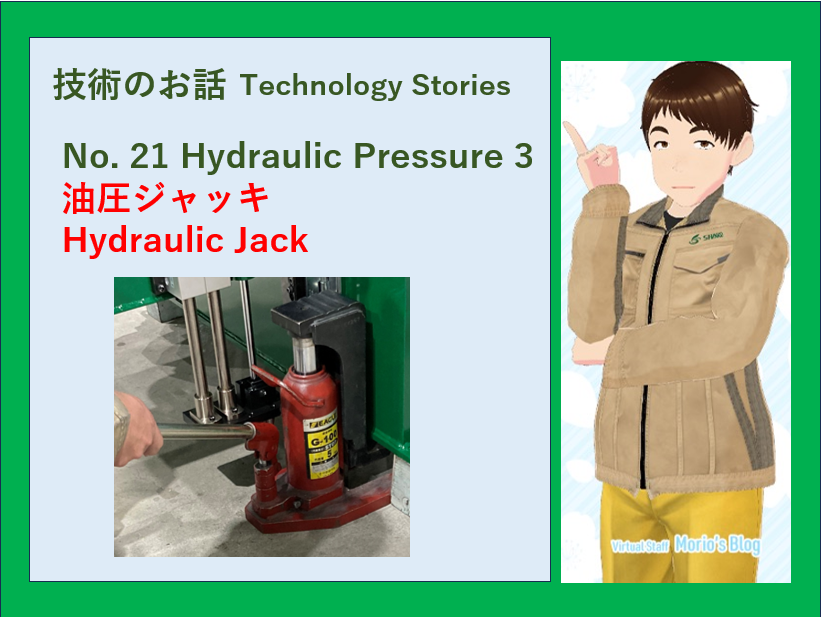
No.21 油圧3 油圧ジャッキ
もりおです!
前回は、油圧機器の基本となる「パスカルの原理」についてお話ししました。今回は、その原理がどのように実際の機械に応用されているのか、「油圧ジャッキ」を例にして、仕組みを詳しく見ていきたいと思います!
油圧ジャッキってどんなもの?
・工場や整備工場などでよく見かける「ジャッキ」。車を持ち上げるときや、大きな機械の組み立て時などに活躍します。この小さな機械が、どうして何トンもの重さを軽々と持ち上げることができるのでしょうか?
答えは、そう、「油圧の力」!
ジャッキのレバーを何回も上下させると、少しずつ持ち上がりますよね?この動作の中で、油圧の力がどのように働いているのか、詳しく説明していきます。
油圧ジャッキの構造と機能部品
油圧ジャッキは、主に以下の部品で構成されています。
ポンプ(手動レバー)
・レバーを上下させることで油を圧送し、圧力を発生させる役割を担います。
オイルタンク(リザーバータンク)
・作動油(オイル)を蓄えるためのタンクで、圧送される油を供給します。
チェックバルブ(逆止弁)
・一度送られたオイルが逆流しないようにする部品で、ジャッキが確実に上昇するための重要な役割を果たします。
シリンダー(油圧シリンダー)
・圧力を受けてピストンを押し上げる部分。ここが動くことで荷重が持ち上がります。
ピストン
・シリンダー内で直接動作する部分で、オイルの圧力を受けて上下に動きます。
排油バルブ(リリースバルブ)
・オイルを戻すことでピストンを下げ、ジャッキを元の位置に戻す役割を担います。
<油圧ジャッキの仕組み?
・油圧ジャッキの内部には、「シリンダー」「ピストン」「油(作動油)」が入っています。ジャッキを操作すると、以下のような流れで力が伝わっていきますでは、これらの部品が連携して力を生み出しています。
レバーを押し下げる
・レバーを押し下げると、ポンプが作動し、小さなシリンダー内のピストンがオイルを押しオイルが加圧されます。
このとき、オイルは圧縮されず、力がそのまま伝わります。
オイルの移動
・押されたオイルはパイプを通じて、大きなシリンダーへ移動します。
パスカルの原理により、小さなシリンダーで加えた圧力はそのまま大きなシリンダーにも均等に伝わりチェックバルブがあるため、オイルが逆流せず、しっかりと圧力が伝達されます。
ピストンが押し上げられる
・大きなシリンダーは、小さなシリンダーの数倍の面積を持っているため、その分大きな力が生まれます。
例えば、小さなシリンダーで10kgの力をかけたとき、大きなシリンダーの面積が5倍なら、50kgの力を発生させることができるのでます!
この動作を繰り返すことでジャッキアップ!
・レバーを何度も上下させることで、徐々に持ち上げることができます。
上げた後は排油バルブを開いてオイルを戻すと、ゆっくりと下降します。
レバーを何度も上下させることで、徐々に持ち上げることができます。
上げた後はバルブを開いてオイルを戻すと、ゆっくりと下降します。
まとめ
油圧ジャッキは、「小さな力を大きな力に変換する」優れた仕組みを持っています。これは「パスカルの原理」を活用したもので、工場だけでなく、車の修理、建築現場、さらには遊園地のアトラクションの一部にも応用されています。
それでは、また次回をお楽しみに!
※本ブログは、生成AIを活用して作成しています。
No.21 Hydraulics 3 Jack
Hi, Morio!
Last time, I wrote about “Pascal’s principle,” the basis of hydraulic equipment. This time, I’ll take a closer look at how this principle is applied to actual machines, using a “hydraulic jack” as an example!
What is a hydraulic jack?
– “Jacks” are often seen in factories and repair shops. They are used to lift cars and assemble large machines. How can this small machine lift several tons of weight with ease?
The answer is, yes, the power of hydraulics!
If you move the lever of a jack up and down repeatedly, it will lift up little by little, right? We will explain in detail how hydraulic power works in this action.
Structure and functional parts of a hydraulic jack
A hydraulic jack is mainly composed of the following parts.
Pump (manual lever)
– It is responsible for pumping oil by moving the lever up and down and generating pressure.
Oil tank (reservoir tank)
– A tank for storing hydraulic oil (oil), which supplies the oil to be pumped.
Check valve (non-return valve)
-A part that prevents oil once pumped from flowing back, and plays an important role in ensuring that the jack rises reliably.
Cylinder (hydraulic cylinder)
-The part that pushes up the piston under pressure. When this part moves, the load is lifted.
Piston
-A part that operates directly within the cylinder, which moves up and down under the pressure of the oil.
Oil drain valve (release valve)
-It lowers the piston by returning the oil, and plays the role of returning the jack to its original position.
How does a hydraulic jack work?
-The inside of a hydraulic jack contains a “cylinder,” “piston,” and “oil (hydraulic oil).” When you operate the jack, the force is transmitted in the following manner. In this case, these parts work together to generate force.
Pushing down the lever
-When the lever is pushed down, the pump is activated and the piston in the small cylinder pushes the oil, pressurizing it.
At this time, the oil is not compressed and the force is transmitted as is.
Movement of oil
-The pressed oil moves through the pipe to the large cylinder.
According to Pascal’s principle, the pressure applied by the small cylinder is transmitted evenly to the large cylinder, and because there is a check valve, the oil does not flow back and the pressure is transmitted firmly.
The piston is pushed up
-The large cylinder has an area several times larger than the small cylinder, so a larger force is generated.For example, when a force of 10 kg is applied to the small cylinder, if the area of the large cylinder is 5 times larger, a force of 50 kg can be generated!
Hydraulic jacks makes use of “Pascal’s Principle” and are applied not only in factories, but also in car repairs, construction sites, and even some amusement park attractions.
Stay tuned for next time!
*This blog was created using generative AI.