










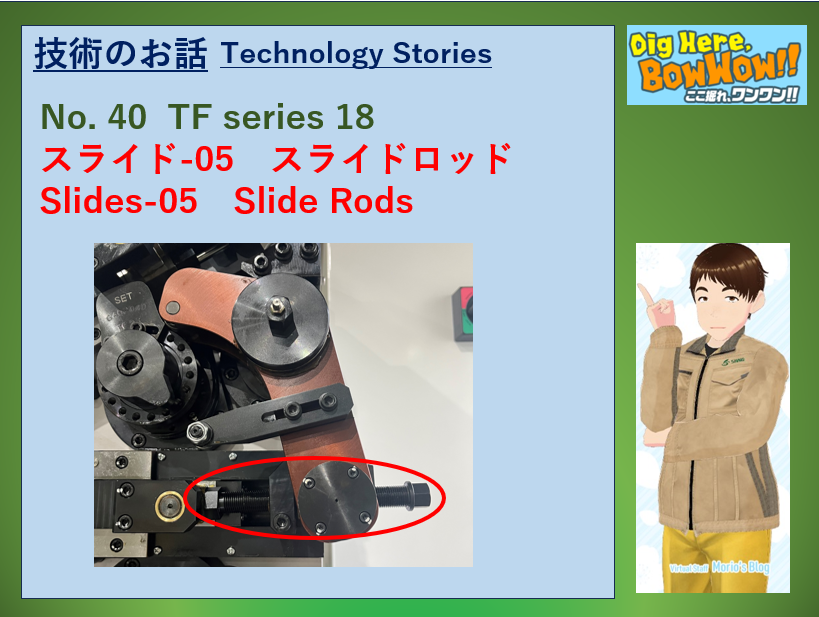
No.40 TF-18 スライド-05 スライドロッド
🐾こんにちは、もりおです!
TFスライド編、今回のテーマは――
✨TFシリーズの“スライドロッド”✨
普段あまり表に出ない部品ですが、
実はここ、TFの耐久性と精度を支える超重要パーツなんです!
今日は、このスライドロッドの技術を、
現場目線でじっくりご紹介していきますね🐾
🔧 スライドロッドって何をしている部品?
まずは役割から。
TFシリーズの加工スライドには、
切断やフック起こしなどの動作がありますよね。
そのスライドを
カムからの力で前後に動かすための“動力伝達部品”
それがスライドロッドです。
つまり――
🟢 カムの動き
↓
🟢 スライドレバー
↓
🟢 スライドロッド
↓
🟢 加工スライド(切断・フック起こし)
という、
動力の橋渡し役なんです!
ここがズレると、
切断精度もフック精度も全部狂ってしまいます。
まさに要(かなめ)ですね。
🧩 スライドロッドは3つの部品で構成
構造としては、次の3つの部品で成り立っています。
| 部品名 | 役割 |
| 🔩 スライドロッド | 加工スライドと直結する棒状部品 |
| 🔧 スライドナット | スライドレバーと連結する |
| 📍 ロッド調整ピン | 位置・精度を調整する重要部品 |
スライドロッドは
加工スライド側に連結され、
スライドナットは
スライドレバー側に連結されます。
この2つをつなぐことで、
回転運動 → 直線運動
が正確に伝達されるんです。
📏 驚くべき精度要求!
さて、ここからが本題です。
TFのスライドロッドは、
ただの棒ではありません。
なんと――
🎯 振れ精度
0.01〜0.05mmの振れ公差
で製作されています。
これはもう、
髪の毛よりもずっと細いレベルの世界…!
🔬 なぜそこまで厳しいの?
理由はシンプル。
ガタを出さないため
そして
耐久性を保つためです。
スライドは、
1分間に数十回、
20年程使えば、1億回くらい動きます。
もし微小なガタがあると――
・衝撃が一点に集中
・摩耗が急激に進む
・精度が落ちる
という悪循環に入ってしまうんです。
だから最初から
徹底的に高精度で作る。
これがTFの考え方です。
🛠 スライドロッドの精度はJIS1級以上!
スライドロッドが通る部分――
・調整ピン
・スライドナット
・ナット穴
・平行度
これらもスライドロッドの精度を損なわないよう
精密に設計されているんです!
さらに――
🔩 ネジピッチ
1.5mm(細目)
通常より細かいピッチにすることで、
微調整精度を極限まで高めています。
🧠 組立にも熟練技術が必要!
スライドナットのロッド貫通穴は、
割り位置(締結位置)も含めて
非常に精密に作られていますが、
機能を最大限発揮させるのは、組立にも熟練の技術が必要になってきます。
ここ、まさに
職人技の領域ですね✨
🐾 まとめ:見えないところにTFの本気
スライドロッドは
外からはほとんど見えません。
でも――
✔ ガタを出さない
✔ 強い耐久性を維持
✔ 繰返し精度を守る
そのすべてを支える、
TFの核心パーツなんです。
ばね加工は、
1回動けば終わりではなく、
繰返し繰返し、同じ動きを精密に続ける世界。
その裏で、
こうした超精密な連結機構が
静かに働いているんですね。
ぼくも現場で見たとき、
「ここまでやるんだ…!」
と、ちょっと感動しました。
それではまた次回、
「ここ掘れ、ワンワン!!」でお会いしましょう🐾
※本ブログは、生成AIを活用して作成しています。
No.40 TF-18 Slide-05 Slide Rods
🐾 Hello, this is Morio!
In our TF Slide Series, today’s theme is—
✨ The “Slide Rods” of the TF Series ✨
It’s not a part that usually stands out.
But in reality, this component plays a critical role in supporting the durability and precision of TF machines!
Today, I’ll walk you through the technology behind the slide rod from a hands-on, shop-floor perspective 🐾
🔧 What Do the Slide Rods Actually Do?
Let’s start with its role.
In the TF Series processing slides, we have operations such as cutting and hook forming.
The component that transmits force from the cam to move the slide back and forth—
That’s the slide rods.
In other words:
🟢 Cam motion
↓
🟢 Slide lever
↓
🟢 Slide rod
↓
🟢 Processing slide (cutting / hook forming)
It acts as the bridge that transfers power.
If this alignment shifts even slightly,
cutting precision and hook accuracy will both be affected.
It truly is a key component.
🧩 The Slide Rod Consists of Three Parts
Structurally, it is composed of the following three components:
| Part Name | Role |
|---|---|
| 🔩 Slide Rod | Rod-shaped component directly connected to the processing slide |
| 🔧 Slide Nut | Connects to the slide lever |
| 📍 Rod Adjustment Pin | Critical component for position and precision adjustment |
The slide rod connects to the processing slide side,
while the slide nut connects to the slide lever side.
By linking these two,
rotational motion → linear motion
is transmitted accurately and reliably.
📏 Remarkable Precision Requirements
Now, here comes the important part.
The TF slide rod is not just an ordinary rod.
It is manufactured with a runout tolerance of 0.01–0.05 mm.
That’s a level far finer than the thickness of a human hair…
We’re talking about extremely precise engineering.
🔬 Why So Strict?
The reason is simple:
To prevent play (backlash)
and to maintain long-term durability.
A slide moves dozens of times per minute.
Over 20 years of operation, it can move roughly 100 million times.
If even a tiny amount of play exists:
– Impact forces concentrate at one point
– Wear accelerates rapidly
– Precision gradually deteriorates
This creates a negative cycle.
So instead of fixing problems later,
TF philosophy is to build it with uncompromising precision from the beginning.
🛠 Precision Beyond JIS (Japanese Industrial Standards) Class 1
The components surrounding the slide rod—
– Adjustment pin
– Slide nut
– Nut bore
– Parallelism of related parts
All are carefully designed to ensure they do not compromise the slide rod’s precision.
And there’s more—
🔩 Thread pitch: 1.5 mm (fine pitch)
By using a finer-than-standard pitch,
micro-adjustment capability is dramatically improved.
🧠 Assembly Requires Skilled Craftsmanship
The through-hole in the slide nut—
including its split-clamp position—is manufactured with extreme precision.
However, to fully realize its performance,
skilled assembly work is absolutely essential.
This is truly the realm of craftsmanship ✨
🐾 Summary: TF’s Serious Commitment, Hidden from View
The slide rod is almost invisible from the outside.
But it supports everything:
✔ Preventing backlash
✔ Maintaining high durability
✔ Protecting repeatability precision
It is truly one of the core components of the TF Series.
Spring processing isn’t about moving once and stopping.
It’s about repeating the same precise motion again and again, millions of times.
Behind that reliability,
these ultra-precise linkage mechanisms are quietly doing their job.
When I first saw this up close on the shop floor,
I honestly thought—
“Wow… they really go this far.”
And that’s what TF engineering is all about.
See you next time on
“Dig Here, Bowow!!” 🐾
This blog was created with the help of Generative AI.