









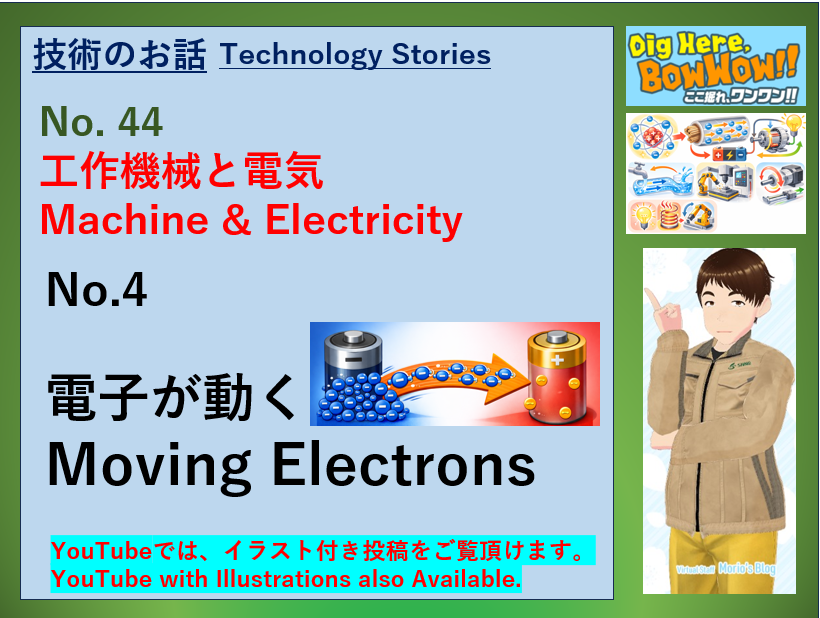
工作機械と電気 No.4 電子が動く
わかば:
やっほー!
原子には陽子と電子があって、
陽子がプラスで、電子がマイナスっていうのは理解できたけど、
“マイナス側”とか“プラス側”ってどういうこと?
もりお:
ちょっとややこしいよね。
すごくシンプルに言うと、
マイナス側は、電子が多い側。
プラス側は、電子が少ない側。
わかば:
えっ、そもそも原子の中では、陽子(プラス)と電子(マイナス)のバランス取れてるんだよね?
もりお:
そう。ふつう、物の中には
プラスの性質を持つ陽子とマイナスの性質を持つ電子が、だいたい釣り合っているんだ。
だから、いつもは特にプラスでもマイナスでもない感じなんだよ。
でも、何かのきっかけでバランスがくずれることがある。
「プラスの物質」「マイナスの物質」があるっていうより、
“電子の数のバランスがくずれてる状態”を見て、
マイナス側とかプラス側って言ってるんだ。
わかば:
バランスがくずれてる状態?
もりお:
そう。電子で考えると、
電子が集まり気味になった方が、マイナス側。
電子が減り気味になった方が、プラス側。
“側”っていうのは、電池の端っこでもいいし、部品の一部分でもいいし、線の片方でもいい。
電子の多い方・少ない方を区別してる言い方なんだ。
わかば:
なるほど。
じゃあさ、その差って、何で生まれるの?
最初から同じなら、そのままでよくない?
もりお:
そこが今日の大切なところだね。
差が生まれるのは、“電子を移動させるしくみ”があるからなんだ。
わかば:
電子を移動させるしくみ?
もりお:
うん。
たとえば電池の中では、材料どうしの反応で、
電子が片方にたまりやすくなる。
すると、
たまった方はマイナス側、
減った方はプラス側になる。
これで差ができるんだ。
わかば:
ほぉ。
じゃあ、電池が勝手にプラスとマイナスを作ってるって感じ?
もりお:
うん、かなりそう。
電池は、もともと同じだったバランスを、
わざと少しくずしているんだ。
だから差が生まれるんだよ。
わかば:
わざとくずす?
もりお:
そう。
たとえば、同じ大きさの2つの部屋に50人ずついたら、あまり動かないよね。
でも、片方に70人、もう片方に30人になったらどう?
わかば:
そりゃ70人の方は、めっちゃ混んでるから、
何人か移動したくなる!
もりお:
そうそう。
この70人と30人の差みたいなものが、電気でいうプラスとマイナスの差なんだ。
電子が多い側は“混み気味”。
電子が少ない側は“空き気味”。
だから、電子は動きたくなるんだ。
わかば:
うわ、急にわかりやすくなった!
じゃあマイナス側って、電子が混んでる側なんだね。
電子は動きたがり屋だったしね。
もりお:
うん、陽子(プラス)は動かないから、電子(マイナス)が動く。
しかも電子どうしは、同じマイナスだから近づきすぎるのがあまり好きじゃない。
だから、電子が多いところでは、
「ちょっと多いな、出たいな」ってなりやすいんだ。
わかば:
で、プラス側は電子が少ないから、入りやすい?
もりお:
その通り。
だから、
マイナス側は押す感じ、
プラス側は受け入れる感じ
になるんだ。
この差があるから、電子が動き始めるんだよ。
わかば:
なるほどねー。
でも、電池じゃなくても差ってできるの?
もりお:
できるよ。
たとえば、こすった下じきが髪の毛を引きつけたりするよね。
あれも、こすることで電子の片寄りができて、差が生まれてるんだ。
ただ、今回は工作機械の電気の話だから、
まずは、“電池や電源が差を作る”と思っておくとわかりやすいかな。
わかば:
あっ、あれもそうなんだ。昔よく遊んだなぁ。
マイナス側とかプラス側っていうのは、
電子の数が同じじゃなくなった結果なんだね?
もりお:
うん、まさにそれ。
マイナス側=電子が多い側
プラス側=電子が少ない側
そして、その差は、
電池や電源のしくみで電子が片寄ることで生まれる。
わかば:
なるほどー!
「プラスとマイナス」って、電子の多い少ないなんだね。
もりお:
うん、それが土台だね。
今日のポイントをまとめると、
・マイナス側とプラス側は、電子の多い側と少ない側のこと
・電子は、差があると。多い側から少ない側に動こうとする
・差が生じるのは、電池や電源が電子を少し片寄らせるから
わかば:
よし、今日はそこ覚えた!
もりお:
いいね。
この土台がわかると、次の話もぐっと入りやすくなるよ。
次回は、「電池」についてだね。
わかば:
OK!!
※今回のタイトルは、「押す力と引く力」の予定でしたが、内容を踏まえて変更しています。
※本ブログは、生成AIを活用して作成しています。
Machine & Electricity No.4 Moving Electrons
Wakaba:
Ciao!
I get that atoms have protons and electrons,
and that protons are positive while electrons are negative,
but what exactly do “the negative side” and “the positive side” mean?
Morio:
Yeah, it’s a little confusing.
Put very simply,
the negative side is the side with more electrons.
The positive side is the side with fewer electrons.
Wakaba:
Wait, but inside an atom,
the protons (positive) and electrons (negative) are balanced, right?
Morio:
That’s right. Normally, inside matter,
the positively charged protons and the negatively charged electrons are roughly balanced.
So usually, it doesn’t really feel especially positive or negative.
But sometimes that the balance gets disturbed for some reason.
It’s not so much that there is a “positive material” or a “negative material.”
Rather, when the balance in the number of electrons is disturbed,
we describe that state as the negative side or the positive side.
Wakaba:
A state where the balance is disturbed?
Morio:
Exactly. Thinking in terms of electrons,
the side where electrons have gathered more is the negative side.
The side where electrons have decreased is the positive side.
And “side” can mean the end of a battery, part of a component, or one side of a wire.
It’s just a way of distinguishing between the side with more electrons and the side with fewer electrons.
Wakaba:
I see.
Then why does that difference happen?
If they start out the same, why don’t they just stay that way?
Morio:
That’s the key point today.
A difference appears because there is a mechanism that moves electrons.
Wakaba:
A mechanism that moves electrons?
Morio:
Yep.
For example, inside a battery, reactions between materials
make it easier for electrons to collect on one side.
Then,
the side where they collect becomes the negative side,
and the side where they decrease becomes the positive side.
That’s how the difference is created.
Wakaba:
Ohhh.
So it’s kind of like the battery creates positive and negative on its own?
Morio:
Yeah, pretty much.
A battery intentionally disturbs a balance
that was originally even.
That’s why a difference appears.
Wakaba:
It intentionally disturbs it?
Morio:
Exactly.
For example, if there are 50 people in each of two rooms of the same size,
people probably won’t move around much, right?
But what if one room has 70 people and the other has 30?
Wakaba:
Then the room with 70 people would feel super crowded,
and some of them would want to move!
Morio:
Exactly.
That difference between 70 and 30
is like the difference between positive and negative in electricity.
The side with more electrons is the “crowded” side.
The side with fewer electrons is the “less crowded” side.
So electrons start wanting to move.
Wakaba:
Wow, that suddenly makes it way easier to understand!
So the negative side is the side where electrons are crowded together.
And electrons do like to move around.
Morio:
Right. Since protons (positive) don’t move, electrons (negative) do.
And because electrons all have the same negative charge,
they don’t really like getting too close to one another.
So when there are too many electrons in one place,
it becomes easier for them to feel,
“There are too many of us here. I want to get out.”
Wakaba:
And on the positive side, since there are fewer electrons,
it’s easier for electrons to go in?
Morio:
Exactly.
So,
the negative side feels like it pushes,
and the positive side feels like it receives.
Because that difference exists, electrons start to move.
Wakaba:
I see.
But can a difference happen even without a battery?
Morio:
It can.
For example, when you rub a plastic sheet or ruler and it attracts hair, right?
That happens because rubbing creates an uneven distribution of electrons,
which creates a difference.
But since we’re talking about electricity in Machine here,
it’s probably easiest for now to think of batteries and power supplies as things that create the difference.
Wakaba:
Oh, so that’s the same idea too. I used to play with that a lot.
So “the negative side” and “the positive side”
are the result of the number of electrons no longer being the same, right?
Morio:
Yes, exactly.
Negative side = the side with more electrons
Positive side = the side with fewer electrons
And that difference
is created when electrons become unevenly distributed
by the mechanism of a battery or a power supply.
Wakaba:
I see!
So “positive and negative” really comes down to whether there are more or fewer electrons.
Morio:
Exactly. That’s the foundation.
To sum up today’s key points:
* The negative side and the positive side are the side with more electrons and the side with fewer electrons.
* When there is a difference, electrons try to move from the side with more electrons to the side with fewer electrons.
* That difference appears because a battery or power supply causes electrons to become slightly unevenly distributed.
Wakaba:
Alright, that’s what I’m remembering today!
Morio:
Nice.
Once you understand this foundation, the next topic will make a lot more sense.
Next time, we’ll talk about batteries.
Wakaba:
OK!!
Note: The original title planned for this episode was “Pushing Force and Pulling Force,”
but it has been changed to better match the content.
Note: This blog was created with the hepl of generative AI.