




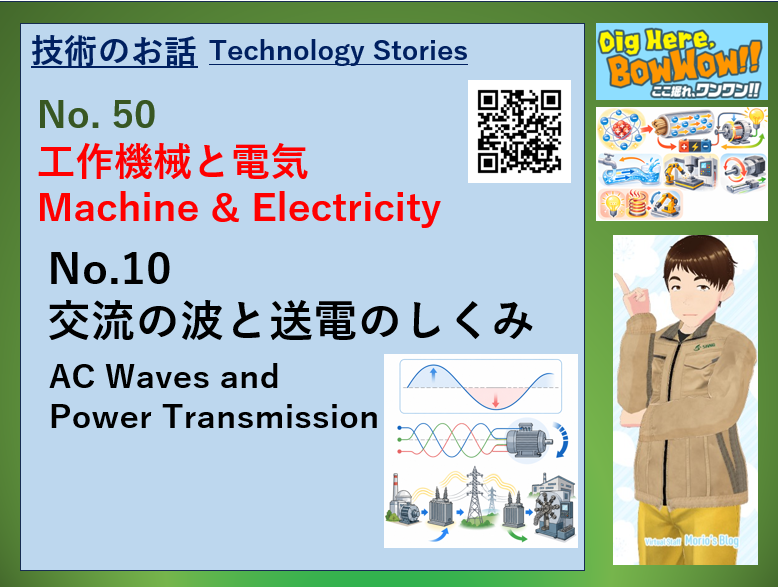
工作機械と電気 No.10 交流の波と送電のしくみ
わかば:
やっほー!わかばだよ!
「工作機械と電気」編も第10回だね。
もりお:
前回は、直流は一方通行、交流は行ったり来たりする電気、って話をしたよね。
今回は、交流について、もっと深掘りするよ。
わかば:
よしっ。
交流は、プラスっぽい方とマイナスっぽい方が入れ替わるって話だったよね。
もりお:
そこ、大事なポイントだね。
でも、ここで勘違いしやすいことがある。
わかば:
なになに?
もりお:
交流は、プラスとマイナスが突然パチン!と切り替わるわけじゃないんだ。
わかば:
え、そうなの?
プラス、マイナス、プラス、マイナスって、スイッチみたいに切り替わるのかと思ってた。
もりお:
そう思うよね。
でも実際の交流は、もっとなめらか。
電圧が少しずつ強くなって、弱くなって、ゼロになって、今度は反対向きに強くなる。
そんなふうに、波みたいに変化しているんだ。
わかば:
波みたい?
もりお:
そうそう。
交流の電圧は、上がったり、下がったり、反対向きになったりする。
だから「いきなり反転」じゃなくて、「なめらかに波打ちながら反転」しているイメージだね。
わかば:
へぇ、プラスとマイナスが、波の流れの中で変わるんだ。
もりお:
その通り。
電圧がプラス側に大きくなって、また小さくなって、ゼロを通って、今度はマイナス側に大きくなる。
このくり返しが交流なんだ。
わかば:
ゼロを通るってことは、その瞬間は押す力がなくなるの?
もりお:
いいところに気づいたね。
1本の波だけを見ると、そう。
でも、工場で使う大きな電気では、そこをうまく補うしくみがあるんだ。
わかば:
え、どうやって?
もりお:
波を1つだけじゃなく、複数使うんだ。
工場の動力では、「三相交流」という電気がよく使われる。
わかば:
三相交流?
新しい言葉が出てきた!
もりお:
難しく考えなくてOK。
三相交流は、タイミングをずらした3つの交流の波を使う電気、ってイメージでいいよ。
わかば:
タイミングをずらした3つの波?
なるほど、1本の波だけだと力が小さくなるタイミングがあるけど、3本あれば助け合えるんだ。
もりお:
そういうこと。
三相交流は、3つの波が少しずつタイミングをずらしている。
だから、モーターをなめらかに回しやすいんだ。
わかば:
工作機械のモーターにも関係ある?
もりお:
もちろん。
工場の機械では、三相交流がよく使われる。
モーターを力強く、なめらかに回しやすいからね。
わかば:
ばね加工機も、送りとか切断とか、いろんな働きがあるから、
動きが不安定だと、ばねの形や精度にも影響しちゃうもんね。
もりお:
そう。
機械の中では、サーボモーターや制御装置が、動きのタイミングを細かく調整している。
その入口にある大きな電気として、交流が大事な役割を持っているんだ。
わかば:
交流って、ただ行ったり来たりしてるだけじゃないんだね。
波の形とか、波の数とか、けっこう奥が深い。
もりお:
そうなんだ。
そして、もう1つ大きな特徴がある。
交流は、電圧を変えやすい。
わかば:
前にも少し出たね。
電圧を変えやすいと、何がいいんだっけ?
もりお:
電気を遠くまで送るときに便利なんだ。
発電所から工場や家庭まで電気を送ると、途中の電線でロスが出る。
せっかく作った電気が、熱になって逃げてしまうんだ。
わかば:
そっか。それはもったいないね。
もりお:
そう。
そこで、遠くへ送るときは電圧を高くする。
電圧を高くすると、同じ電力を送るときに流れる電流を小さくできる。
電流が小さくなると、電線でのロスを減らしやすいんだ。
わかば:
ちょっと難しいけど、
遠くへ送るときは高い電圧にした方がムダが少ない、ってこと?
もりお:
それでOK。
イメージとしては、高速道路に乗せて一気に遠くまで運ぶ感じ。
遠くへ送るときは高い電圧。
使う場所の近くまで来たら、使いやすい電圧に下げる。
わかば:
発電所から来る電気を、そのまま家庭や工場で使うわけじゃないんだ。
もりお:
そう。
途中で電圧を上げたり下げたりしている。
このとき活躍するのが、変圧器。
わかば:
変圧器って、電圧を変える機械?
もりお:
その通り。
交流は、この変圧器を使って電圧を変えやすい。
だから、発電所から遠くまで送って、最後に使いやすい電圧に下げる、というしくみに向いているんだ。
わかば:
交流が送電に向いているって、そういう意味だったんだね。
もりお:
うん。
交流は波のように変化する。
三相交流では、複数の波を使って安定した力を出しやすい。
さらに、変圧器で電圧を変えやすい。
これが交流の大きな特徴だね。
わかば:
なんか、交流ってチームプレーが得意な電気って感じ。
もりお:
いい表現だね。
1つの波だけじゃなく、複数の波で支え合う。
高い電圧にして遠くへ送り、使う場所では電圧を下げる。
まさに、役割分担とチームプレーだね。
わかば:
じゃあ、工作機械に来る電気も、そうやって送られてきた交流なんだ。
もりお:
そう。
工場に届いた交流を、機械の中で必要に応じて使う。
モーターを動かしたり、直流に変えて制御装置やセンサーを動かしたりする。
わかば:
交流は外から来る大きな力。
直流は中で細かく制御する力。
そんな感じかな?
もりお:
かなりいいね。
もちろん実際の機械の中身はもっと複雑だけど、まずはそのイメージでOK。
わかば:
今日のまとめ、いってみよ!
もりお:
交流は、プラスとマイナスが突然切り替わるのではなく、電圧が波のようになめらかに変化する。
その波は、強くなったり、弱くなったり、向きが反対になったりする。
工場でよく使われる三相交流は、タイミングをずらした3つの波で、力を安定させやすい。
交流は変圧器で電圧を変えやすく、遠くまで送るのに向いている。
遠くへ送るときは高い電圧にしてロスを減らし、使う場所では使いやすい電圧に下げる。
工作機械は、そうして届いた交流を、モーターや制御に合わせてうまく使っている。
わかば:
よし、わかった!
交流は、ただ行ったり来たりするだけじゃなくて、波のように動いて、複数の波で安定して、電圧を変えながら遠くまで届くんだね。
もりお:
そうそう。
次回は、交流を直流に変えるしくみを見ていこう。
工作機械の中で、電気がどう変身しているかが見えてくるよ。
わかば:
おー、電気の変身!
次回も楽しみ!
※本ブログは生成AIを活用して作成しています。
Machine & Electricity No. 10 AC Waves and Power Transmission
Wakaba:
Ciao, it’s Wakaba!
The “Machine & Electricity” series has reached Episode 10!
Morio:
Last time, we talked about how direct current flows in one direction, while alternating current(AC) goes back and forth.
This time, let’s dig a little deeper into AC.
Wakaba:
Alright!
We said that in AC, the plus-like side and minus-like side switch places, right?
Morio:
That’s an important point.
But there is something that people often misunderstand here.
Wakaba:
What is it?
Morio:
In AC, plus and minus do not suddenly switch like “click!”
Wakaba:
Really?
I thought it switched like plus, minus, plus, minus, just like a switch.
Morio:
That’s easy to imagine.
But actual AC is much smoother.
The voltage gradually becomes stronger, then weaker, then reaches zero, and then becomes stronger in the opposite direction.
It changes like a wave.
Wakaba:
Like a wave?
Morio:
Exactly.
AC voltage rises, falls, and then changes direction.
So instead of suddenly reversing, it reverses smoothly while moving like a wave.
Wakaba:
Oh, so plus and minus change within the flow of the wave.
Morio:
That’s right.
The voltage becomes larger on the plus side, then smaller, passes through zero, and then becomes larger on the minus side.
This repetition is AC.
Wakaba:
If it passes through zero, does that mean there is a moment when the pushing force disappears?
Morio:
Good catch.
If you look at just one wave, yes.
But for the large power used in factories, there is a clever way to support that.
Wakaba:
How?
Morio:
By using more than one wave.
For factory power, electricity called three-phase AC is often used.
Wakaba:
Three-phase AC?
That’s a new term!
Morio:
No need to make it difficult.
Just imagine three AC waves with slightly different timing.
Wakaba:
Three waves with different timing?
So if one wave becomes weaker, the other waves can help out.
Morio:
Exactly.
In three-phase AC, three waves are shifted slightly from each other.
That makes it easier to rotate motors smoothly.
Wakaba:
Does that relate to machine tool motors too?
Morio:
Of course.
Factory machines often use three-phase AC.
It helps motors rotate powerfully and smoothly.
Wakaba:
Spring Machines also have many movements, like feeding and cutting.
If the motion becomes unstable, it could affect the spring shape and accuracy.
Morio:
Exactly.
Inside the machine, servo motors and control devices finely adjust the timing of movement.
As the large electrical power at the entrance of the machine, AC plays an important role.
Wakaba:
So AC is not just electricity going back and forth.
The wave shape and the number of waves are pretty deep.
Morio:
That’s right.
And AC has another major feature.
It is easy to change voltage.
Wakaba:
We touched on that before.
Why is it useful to change voltage?
Morio:
It is useful when sending electricity over long distances.
When electricity is sent from a power plant to factories and homes, some energy is lost in the wires.
The electricity turns into heat and escapes.
Wakaba:
That’s a waste.
Morio:
Exactly.
So when electricity is sent far away, the voltage is increased.
When the voltage is high, the current can be made smaller while sending the same amount of power.
When the current is smaller, it is easier to reduce losses in the wires.
Wakaba:
That’s a bit hard, but basically, using high voltage for long-distance transmission reduces waste, right?
Morio:
That’s right.
As an image, it’s like putting electricity on an expressway and sending it far away at once.
For long-distance transmission, the voltage is raised.
When it gets close to where it will be used, the voltage is lowered to a safer and more usable level.
Wakaba:
So electricity from a power plant is not used directly in homes and factories.
Morio:
Right.
The voltage is raised and lowered along the way.
The device that does this is called a transformer.
Wakaba:
A transformer is a machine that changes voltage?
Morio:
Exactly.
AC voltage is easy to change using transformers.
That is why AC is suitable for sending electricity far away and then lowering the voltage before it is used.
Wakaba:
So that’s what it means when people say AC is good for power transmission.
Morio:
Yes.
AC changes like a wave.
In three-phase AC, multiple waves make it easier to produce stable power.
And with transformers, AC voltage can be changed easily.
These are major features of AC.
Wakaba:
AC sounds like electricity that is good at teamwork.
Morio:
Nice way to put it.
Instead of relying on just one wave, multiple waves support each other.
Voltage is raised to send electricity far away, and lowered when it is used.
It really is teamwork and role-sharing.
Wakaba:
So the electricity coming into machine tools also arrives that way.
Morio:
Exactly.
The AC that reaches a factory is used inside machines as needed.
It can drive motors, or be converted into DC to operate controllers and sensors.
Wakaba:
AC is the big power that comes from outside.
DC is the power used inside for fine control.
Is that the right image?
Morio:
That’s a very good image.
Of course, the inside of a real machine is more complex, but that is a great starting point.
Wakaba:
Let’s wrap it up!
Morio:
AC does not suddenly switch between plus and minus.
Its voltage changes smoothly like a wave.
The wave becomes stronger, weaker, and then changes direction.
Three-phase AC, often used in factories, uses three waves with shifted timing to make power more stable.
AC voltage is easy to change with transformers, so it is suitable for long-distance transmission.
When sending electricity far away, the voltage is raised to reduce losses.
Near the place where it is used, the voltage is lowered to a usable level.
Machine tools use the AC that arrives at the factory in ways that match motors and control systems.
Wakaba:
Got it!
AC doesn’t just go back and forth.
It moves like a wave, becomes stable through multiple waves, and reaches far away by changing voltage.
Morio:
Exactly.
Next time, let’s look at how AC is converted into DC.
We’ll see how electricity transforms inside machine tools.
Wakaba:
Wow, electricity transforms!
I’m looking forward to the next episode!
Note: This blog was created with the hepl of generative AI.