







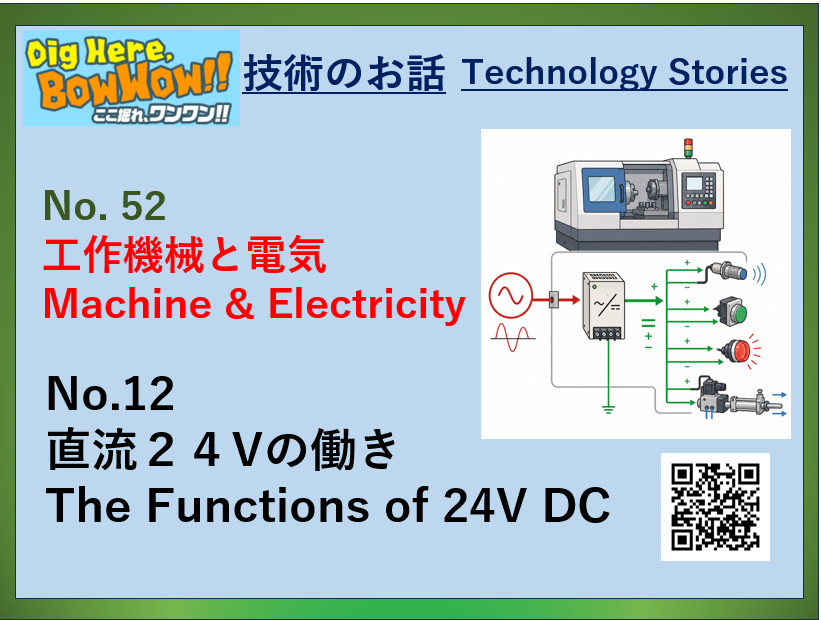
工作機械と電気 No.12 直流24Vの働き
わかば:
やっほー!わかばだよ!
もりお:
今回は、工作機械の中でよく使われる
直流24Vの話だよ。
工作機械の中では、200Vをそのまま全部に使っているわけじゃないんだ。
わかば:
直流24V?
交流200Vからは、だいぶ小さくなったね。
100Vとかじゃダメなの?
もりお:
ポイントは、安全性と使いやすさだね。
200Vや100Vは、
人にとって危ない電圧になることがある。
わかば:
たしかに。
ビリッときたら怖いもんね。
もりお:
モーターみたいに大きな力がいるところでは、
200Vを使ったりするけど
24Vは低めだから、比較的扱いやすい電圧として使われることが多いんだ。
わかば:
モーターはパワー要りそうだもんね。
もりお:
そう。
でも、センサーやボタン、ランプみたいなところには、
もっと扱いやすい電気が使われる。
わかば:
それが直流24V?
もりお:
その通り。
工作機械の中では、
直流24Vがかなり活躍してるんだ。
わかば:
直流って、
電気が同じ向きに流れるやつだよね?
もりお:
そう。
直流は、電気の流れる向きが一定。
プラスとマイナスの向きが決まっている電気だね。
わかば:
交流200Vを、
どうやって直流24Vにするの?
もりお:
工作機械の中に、
電源装置っていう部品があるんだ。
制御盤の中に入っていることが多いね。
わかば:
電源装置?
もりお:
うん。
交流200Vを受け取って、
直流24Vに変えてくれる部品。
わかば:
電気の変換係ってこと?
もりお:
まさにそれ。
交流200Vを、
センサーやボタンが使いやすい24Vに変えているんだ。
24Vは、比較的低い電圧だから、
制御用の電気として使いやすい。
わかば:
制御用ってなに?
さっき言ってたセンサーやランプやボタンのこと?
もりお:
そう。機械に、
「動いていいよ」
「止まって」
「ここに材料があるよ」
みたいな情報を伝えるための電気だね。
わかば:
なるほど!
力仕事じゃなくて、連絡係みたいな感じ?
もりお:
いいね。
直流24Vは、機械の中の連絡係。
信号をやりとりする電気なんだ。
たとえばセンサーが材料を見つけたら、
「材料あり!」って信号を出す。
わかば:
センサーが、オンとかオフとかってやつね。
24Vはそういう仕事してたんだ。
もりお:
24Vが出ている状態をオン、
出ていない状態をオフ、
みたいに見ることが多い。
わかば:
おお、意外とシンプル!
もりお:
もちろん中身は奥が深いけど、
まずはオンかオフかで考えるとわかりやすい。
わかば:
ボタンも24Vなの?
もりお:
多いね。
操作ボタンを押すと、
24Vの信号がつながる。
わかば:
ボタンを押すと、
電気の道がつながるってこと?
もりお:
そうそう。道がないと、電気が流れないって話あったよね。
スタートボタンなら、
「スタートしていいよ」という信号が制御装置に届く。
わかば:
制御装置って、
機械の頭脳みたいなところ?
もりお:
そうだね。
PLCとか呼ばれることもある。
わかば:
PLC?
もりお:
PLCは、機械の動きを判断する制御装置。
かんたんに言うと、機械の司令塔だね。
ボタンやセンサーからの24V信号を見て、
次に何をするか判断しているんだ。
詳しくは、いずれ扱おう。
わかば:
じゃあ、ランプは?
もりお:
ランプも24Vで点くものが多い。
制御装置から24Vが出ると、ランプが点灯する。
わかば:
たとえば、
運転中ランプとか、異常ランプとか?
もりお:
そう。
「運転中だよ」
「停止中だよ」
「異常が出たよ」
みたいな状態を、人に知らせる役目だね。
わかば:
24Vって、めっちゃ働き者じゃん。
もりお:
そうなんだよ。
目立たないけど、超重要。
わかば:
でもさ、
200Vから24Vに変えるなら、
電気の強さが弱くなるってこと?
もりお:
電圧は低くなるね。
でも、役割が違うんだ。
200Vは、モーターを動かすようなパワー担当。
24Vは、情報を伝える信号担当。
工作機械では、
大きな力を出す部分と、
細かく判断する部分がある。
わかば:
その細かく判断する部分で、
24Vが使われているんだね。
もりお:
そう。
センサー、ボタン、ランプ、リレー、電磁弁なんかにも使われる。
わかば:
リレー?わたしが運動会で得意だったやつ?
でも、ここでどういう関係があるの?
それに、電磁弁?
もりお:
そっちのリレーじゃないよ。
ここでいうリレーは、電気で動くスイッチ。
わかば:
電気でスイッチを押す感じ?
もりお:
そんなイメージでOK。
小さな信号で、別の電気の回路をオン・オフする。
わかば:
じゃあ電磁弁は?
もりお:
電気で空気の流れを切り替える部品。
エアシリンダを動かすときなんかに使う。
わかば:
空気の道を切り替える係か。
もりお:
そう。
それも24Vの信号で動くことが多い。
わかば:
工作機械の中って、
電気だけじゃなくて空気も使ってるんだね。
もりお:
うん。
電気で判断して、
モーターや空気の力で動かす。
そんな組み合わせが多いんだ。
わかば:
24Vがちゃんと働かないと、
どうなるの?
もりお:
センサーの信号が入らなかったり、
ボタンを押しても反応しなかったり、
ランプが点かなかったりする。
わかば:
あー、それは困る!
もりお:
しかも、信号が正しく伝わらないと、
機械が次の動作に進めないこともある。
わかば:
機械が、
「え、今どういう状態?」って迷う感じ?
もりお:
そうそう。
だから24Vは、機械の会話を支える電気とも言えるね。
わかば:
機械の会話?
もりお:
たとえば、
センサーが「材料あり」
ボタンが「スタートしたい」
制御装置が「じゃあ動こう」
ランプが「運転中だよ」
って会話してるイメージ。
わかば:
なるほど。
24Vは、その会話の言葉みたいなものなんだ。
もりお:
いい表現だね。
電気の信号で、機械の中の部品同士がやりとりしている。
わかば:
でも、24Vって低い電圧なら、
触っても絶対安全なの?
もりお:
そこは注意。
24Vは比較的安全な電圧だけど、
絶対に安全とは言い切れない。
わかば:
え、そうなの?
もりお:
機械の中には200Vもあるし、
電源を切っても部品に電気が残っている場合もある。
わかば:
うわぁ、怖い。勝手に触っちゃダメだね。
もりお:
もちろん。
点検や修理は、正しい知識と手順が大事。
わかば:
24Vだから大丈夫っしょ、
みたいなのはダメってことね。
もりお:
そう。
そこは油断しない。
電気は便利だけど、扱い方を間違えると危ない。
わかば:
今回のまとめをすると、
工場から来るのは交流200V。
もりお:
その200Vを、電源装置で直流24Vに変える。
わかば:
そして24Vは、
センサー、ボタン、ランプ、リレー、電磁弁なんかに使われる。
もりお:
そう。
モーターを動かすパワー担当ではなく、
信号を伝える連絡係。
わかば:
センサーが見つける。
ボタンが伝える。
制御装置が判断する。
ランプが知らせる。
もりお:
そのやりとりを支えているのが直流24V。
わかば:
工作機械の中で、
24Vって地味だけど超大事なんだね。
もりお:
そう。
工作機械は、強い力だけで動いているんじゃない。
小さな信号の積み重ねで、正しく動いているんだ。
わかば:
なんか、機械の見方が変わってきた!
次に機械を見るとき、
ランプとかボタンの裏で、
24Vががんばってると思って見るよ!
えっと、次のテーマは何だっけ?
もりお:
次は、ちょっと話題を変えて、別の話をしてみよう。
エジソンと、そのライバルの物語。
直流と交流にも関係する話なんだ。
わかば:
えー、誰だろ?
楽しみだね♪
※本ブログは生成AIを活用して作成しています。
Machine & Electricity No.12 The Function of 24V DC
Wakaba:
Ciao, Hey there! It’s Wakaba!
Morio:
This time, we’re going to No.12 DC 24V
24V DC, which is often used inside Machines.
Inside a Machine, not everything uses 200V as it is.
Wakaba:
24V DC?
That’s a lot smaller than 200V AC.
Why not use 100V or something?
Morio:
The key points are safety and ease of use.
200V and 100V can sometimes be dangerous voltages
for people.
Wakaba:
True.
Getting shocked would be scary.
Morio:
For parts that need a lot of power, like motors,
200V may be used.
But 24V is lower, so it is often used as a voltage
that is relatively easy to handle.
Wakaba:
Yeah, motors sound like they need power.
Morio:
Exactly.
But for things like sensors, buttons, and lamps,
electricity that is easier to handle is used.
Wakaba:
And that’s 24V DC?
Morio:
That’s right.
Inside a machine tool,
24V DC plays a big role.
Wakaba:
DC means
electricity flows in the same direction, right?
Morio:
Right.
With DC, the direction of electricity stays constant.
The plus and minus sides are fixed.
Wakaba:
How do you change
200V AC into 24V DC?
Morio:
Inside Machine,
there is a part called a power supply.
It is often located inside the control box.
Wakaba:
A power supply?
Morio:
Yes.
It receives 200V AC
and changes it into 24V DC.
Wakaba:
So it’s like the electricity conversion person?
Morio:
Exactly.
It changes 200V AC
into 24V, which is easier for sensors and buttons to use.
Since 24V is a relatively low voltage,
it is easy to use as control power.
Wakaba:
What does “control power” mean?
Is it for the sensors, lamps, and buttons
you mentioned earlier?
Morio:
That’s right.
It is electricity used to send information to the machine,
like
“Go ahead and move,”
“Stop,”
or
“There is material here.”
Wakaba:
I see!
So it’s not doing the heavy lifting.
It’s more like a messenger?
Morio:
Nice one.
24V DC is like a messenger inside the machine.
It is electricity used to exchange signals.
For example, when a sensor detects material,
it sends a signal saying,
“Material detected!”
Wakaba:
So that’s the sensor turning on or off, right?
I didn’t know 24V was doing that kind of job.
Morio:
In many cases,
when 24V is present, it is seen as ON.
When 24V is not present, it is seen as OFF.
Wakaba:
Oh, that’s simpler than I expected!
Morio:
Of course, the details can get deep,
but it is easier to understand if you first think of it
as ON or OFF.
Wakaba:
Are buttons also 24V?
Morio:
Often, yes.
When you press an operation button,
the 24V signal is connected.
Wakaba:
So when you press the button,
the path for electricity is connected?
Morio:
Exactly. We talked before about how electricity cannot flow
without a path.
With a start button, for example,
a signal saying “It’s okay to start”
is sent to the control device.
Wakaba:
Is the control device
kind of like the brain of Machine?
Morio:
Yes.
It may also be called a PLC.
Wakaba:
PLC?
Morio:
A PLC is a control device
that decides how Machine should move.
Simply put, it is like the command center of the machine.
It looks at 24V signals from buttons and sensors
and decides what to do next.
We’ll cover it in more detail someday.
Wakaba:
Then what about lamps?
Morio:
Many lamps also turn on with 24V.
When the control device outputs 24V,
the lamp lights up.
Wakaba:
For example,
an operation lamp or an alarm lamp?
Morio:
Exactly.
They tell people Machine’s status,
like
“Running,”
“Stopped,”
or
“An error has occurred.”
Wakaba:
24V is such a hard worker!
Morio:
It really is.
It doesn’t stand out much,
but it is super important.
Wakaba:
But if you change 200V into 24V,
does that mean the electricity becomes weaker?
Morio:
The voltage becomes lower.
But the role is different.
200V is the power side, used for things like moving motors.
24V is the signal side, used to send information.
In a machine tool,
there are parts that produce strong force
and parts that make detailed decisions.
Wakaba:
So 24V is used in the parts
that make those detailed decisions.
Morio:
Exactly.
It is used for sensors, buttons, lamps, relays,
solenoid valves, and so on.
Wakaba:
Relays?
Like the relay race I was good at on sports day?
But what does that have to do with this?
And what’s a solenoid valve?
Morio:
Not that kind of relay.
Here, a relay means a switch operated by electricity.
Wakaba:
Like electricity pressing a switch?
Morio:
That image works.
A small signal turns another electrical circuit
on or off.
Wakaba:
Then what is a solenoid valve?
Morio:
It is a part that uses electricity
to switch the flow of air.
It is used when operating things like air cylinders.
Wakaba:
So it switches the path of air.
Morio:
Exactly.
That is also often operated by a 24V signal.
Wakaba:
Inside Machine,
it’s not just electricity.
Air is used too.
Morio:
Yes.
Electricity makes the decisions,
and motors or air power create the movement.
That kind of combination is common.
Wakaba:
What happens if 24V does not work properly?
Morio:
Sensor signals may not come in,
buttons may not respond when pressed,
or lamps may not light up.
Wakaba:
Oh, that would be a problem!
Morio:
And if signals are not transmitted correctly,
the machine may not be able to move on
to the next operation.
Wakaba:
So Machine gets confused, like,
“Huh? What state am I in right now?”
Morio:
Exactly.
That’s why 24V can also be called the electricity
that supports Machine’s communication.
Wakaba:
Machine’s communication?
Morio:
For example,
the sensor says, “Material detected.”
The button says, “I want to start.”
The control device says, “Okay, let’s move.”
The lamp says, “Now running.”
That is the kind of conversation happening inside.
Wakaba:
I see.
So 24V is like the language
used in that conversation.
Morio:
That’s a good way to put it.
Machine parts communicate with each other
through electrical signals.
Wakaba:
But if 24V is a low voltage,
does that mean it is completely safe to touch?
Morio:
That is where we need to be careful.
24V is a relatively safe voltage,
but we cannot say it is absolutely safe.
Wakaba:
Really?
Morio:
There is also 200V inside the machine,
and even after the power is turned off,
electricity may remain in some components.
Wakaba:
Whoa, that’s scary.
So we should never touch things without permission.
Morio:
Exactly.
Inspection and repair require
the right knowledge and the right procedure.
Wakaba:
So thinking,
“It’s only 24V, so it’s fine,”
is no good.
Morio:
Right.
Never let your guard down.
Electricity is useful,
but it can be dangerous if handled incorrectly.
Wakaba:
So, to summarize this time,
the electricity coming from the factory is 200V AC.
Morio:
That 200V is changed into 24V DC
by the power supply.
Wakaba:
And 24V is used for
sensors, buttons, lamps, relays, solenoid valves,
and so on.
Morio:
Exactly.
It is not the power side that moves motors.
It is the messenger that sends signals.
Wakaba:
The sensor detects.
The button tells.
The control device decides.
The lamp informs.
Morio:
And 24V DC supports all of that communication.
Wakaba:
Inside machine tools,
24V may not stand out,
but it is super important.
Morio:
Exactly.
Machine tools do not move only with strong power.
They move correctly through the accumulation
of many small signals.
Wakaba:
I feel like the way I see machines has changed!
Next time I look at a machine,
I’ll imagine 24V working hard
behind the lamps and buttons!
So, what’s the next theme again?
Morio:
Next time, let’s change the topic a little
and talk about something different.
It is the story of Edison and his rival.
It is also connected to DC and AC.
Wakaba:
Whoa, who could it be?
I’m looking forward to it♪
“`
Note: This blog was created with the hepl of generative AI.