








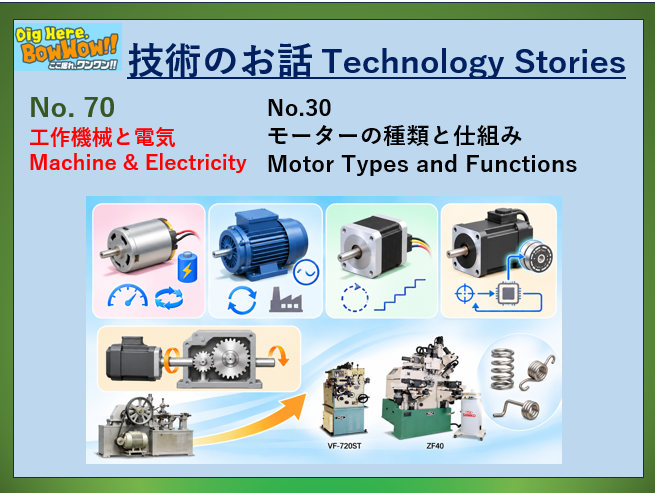
工作機械と電気 No. 30 モーターにはどんな種類があるの? モーターの得意技と、回転を伝える仕組み
わかば:
やっほー、わかばです♪
これまで、磁石や電磁石、モーターが回る仕組みや構造について勉強してきたよね。
モーターとも、だいぶ仲良くなれたけど、まだまだ奥が深いよね。
もりお:
そのとおり。
モーターといっても、実はいろいろな種類があるんだ。
それぞれ特徴があって、使う目的によって選ばれているんだよ。
わかば:
どんな種類があるの?
もりお:
今日は代表的なモーターを4つ紹介しよう。
① DCモーター
② インダクションモーター(誘導モーター)
③ ステッピングモーター
④ サーボモーター
わかば:
4種類もあるんだね!
ACモーターとDCモーター
わかば:
そういえば、以前、直流と交流について勉強したよね。
DCモーターって、直流で動くモーターのこと?
もりお:
そのとおり!
第9回で勉強したように、DCは直流、ACは交流のことだったね。
モーターにも、直流を利用するDCモーターと、交流を利用するACモーターがあるんだ。
わかば:
じゃあ、さっきの4種類は、どう分かれるの?
もりお:
例えば、インダクションモーターはACモーターの一種なんだ。
でも、サーボモーターにはACサーボとDCサーボがあるんだよ。
わかば:
えっ、そうなの?
もりお:
ACとDCは電気の種類による分類だけど、
サーボはモーターを精密に制御する仕組みに着目した呼び方なんだ。
だから、分類の仕方が少し違うんだよ。
わかば:
なるほど。モーターにもいろいろな分け方があるんだね。
① DCモーター ~身近な働き者~
もりお:
まずはDCモーター。
乾電池で動くおもちゃなどにも使われている、身近なモーターだね。
わかば:
小学校の理科の実験で使ったことがあるかも!
もりお:
そうだね。
基本的なブラシ付きDCモーターは、電圧を変えることで回転速度を調整できるんだ。
電流の向きを逆にすると、回転方向も逆になるんだよ。
ただし、ブラシという部品が摩耗するので、
長く使うにはメンテナンスが必要になることもあるんだ。
わかば:
構造が比較的簡単で、速度も変えやすいんだね。
② インダクションモーター ~丈夫で長持ち~
もりお:
次はインダクションモーター。
日本語では誘導モーターというんだ。
交流で動くモーターで、工場の機械などに広く使われているよ。
わかば:
どんな特徴があるの?
もりお:
構造が比較的簡単で、丈夫で長持ちすることだね。
連続して回転させる用途にも適しているんだ。
一般的なインダクションモーターの回転速度は、交流電気の周波数と深い関係があるんだよ。
わかば:
周波数って、50Hzとか60Hzのことだよね。
もりお:
そうそう。
SHINKOの昔のばね加工機、700STでもインダクションモーターを使っていたんだ。
当初は変速機で回転速度を調整していたけど、
後にはインバーターで電気的に速度を変えられるようになったんだよ。
わかば:
インバーターって、前にも扱ってなかったっけ?
どんな装置だっけ?
もりお:
それは、エンコーダーだよ(技術ブログ全体の9~14)。
名前はちょっと似てるけど、全然違う物。
エンコーダーは、後でも出てくるけど、モーターの回転を検出する装置だったよね。
一方、インバーターは、交流の周波数などを変えて、モーターの回転速度を調整する装置なんだ。
モーターそのものを変えなくても、動かし方を変えることで、機械を進歩させることができたんだよ。
わかば:
へぇ~、面白そう!
もりお:
次回は、このインバーターについて、SHINKOの700STを例に詳しく勉強しよう。
③ ステッピングモーター ~少しずつ正確に動く~
もりお:
次はステッピングモーター。
電気信号に合わせて、決まった角度ずつ回転するモーターなんだ。
わかば:
ステップって、階段のステップみたいだね。
もりお:
そうだね。
例えば、1回の信号で1.8度回転するモーターなら、200回の信号で1回転する計算になるんだ。
わかば:
へぇ~!
回転する角度を決められるんだね。
もりお:
そうなんだ。
プリンターや小型の位置決め装置などにも使われているよ。
ただし、負荷が大きすぎると、指令どおりに回転できず、位置がずれてしまうことがあるんだ。
これを「脱調」というんだよ。
わかば:
なるほど。細かく動かすのが得意だけど、苦手なこともあるんだね。
④ サーボモーター ~思いどおりに動かす~
もりお:
最後はサーボモーター。
現在のSHINKOのばね加工機でも、たくさん使われているモーターだよ。
わかば:
いよいよ主役の登場だね!
もりお:
サーボモーターは、回転速度や回転位置、回す力を精密に制御するのが得意なんだ。
わかば:
でも、ステッピングモーターも回転位置を決められるんだよね?
もりお:
そうだね。
サーボモーターの大きな特徴は、エンコーダーなどを使って、実際にどれだけ回転したかを確認しながら動かすことなんだ。
わかば:
エンコーダーは以前にも勉強したよね!
もりお:
そうそう。
エンコーダーからの情報を利用して、目標と実際の動きに違いがあれば、修正するように制御するんだよ。
これを「フィードバック制御」というんだ。
わかば:
「フィードバック制御」って、安川電機さんとの打合せでも出てきた。
この速さが、モーターの性能にとって、すごく重要なんでしょ?
もりお:
そうなんだ。
ただ速く動けばいいというわけではなくて、指令に対して、どれだけ速く、正確に、安定して動けるかが大切なんだ。
これを「応答性」というんだよ。
わかば:
なるほど!
命令するだけじゃなくて、実際の動きを確認しながら、素早く調整しているんだね。
もりお:
そういうこと。
だから、ワイヤーを決まった長さだけ送ったり、加工ツールを決まった位置に動かしたりするのに適しているんだよ。
SHINKOでも、700ELではワイヤー送りにサーボモーターを採用し、その後のSEではカム軸もサーボ化されたんだ。
わかば:
モーターが進歩したことで、ばね加工機のできることも増えていったんだね!
モーターの回転を伝える減速機
わかば:
ところで、モーターって、回転する速さだけじゃなくて、回す力も大切なんだよね?
もりお:
そうだね。
回転させる力のことを「トルク」というんだ。
モーターの回転を機械に伝えるときには、減速機という装置を使うことも多いんだよ。
わかば:
減速機? 回転を遅くするの?
もりお:
そうなんだ。
例えば、歯車を組み合わせて、回転速度を5分の1にすると、回す力は理想的には5倍になるんだ。
わかば:
へぇ~!
回転が遅くなる代わりに、力が大きくなるんだね。
もりお:
そういうこと。
ただし、実際には摩擦などの損失があるから、ぴったり5倍にはならないけどね。
ちなみに、回転速度を変える装置には「変速機」もあるんだ。
減速機は速度を落とす装置だけど、変速機は速度の比率を変える装置なんだよ。
わかば:
昔の700STには、変速機が使われていたんだよね。
もりお:
そうだね。
ただし、現在でもサーボモーターと減速機を組み合わせることは多いんだ。
モーターの回転をどう制御するかと、その回転を機械にどう伝えるかは、どちらも大切なんだよ。
モーターの種類と工作機械の進歩
わかば:
今日は、モーターにもいろいろな種類があって、それぞれ得意なことが違うってわかったよ。
もりお:
そうだね。
丈夫で回し続けるのが得意なモーター、決まった角度ずつ動くモーター、位置や速度を精密に制御できるモーター。
必要な性能やコスト、使う環境によって、適したモーターを選ぶことが大切なんだ。
わかば:
SHINKOの機械も、昔はインダクションモーターで、今はサーボモーターが中心なんだよね。
もりお:
そうなんだ。
でも、モーターが変わっただけじゃないんだよ。
モーターを動かすための制御装置も進歩して、複数のモーターを同時に動かしたり、複雑な加工をしたりできるようになったんだ。
わかば:
うわぁ~、難しそう!
これからは、モーターをどうやって思いどおりに動かすのかを勉強するんだね。
もりお:
そのとおり!
次回は、モーターの回転速度を変える仕組みについて勉強しよう。
SHINKOの700STを例に、変速機による機械的な速度調整から、インバーターによる電気的な速度制御へと進化した理由を考えてみよう。
わかば:
昔の機械がどう進歩してきたのかもわかりそうで楽しみだなぁ♪
それじゃあ、また次回ね!
<もりおのひとこと>
あっ、もりおです。
モーターにも、いろいろな種類があるんですね。
丈夫で働き者、細かい動きが得意、力持ち……。
何だか、人間の個性みたいですね(笑)。
SHINKOのばね加工機も、時代とともにモーターや制御技術が進歩してきました。
でも、昔の機械が劣っていたというわけではありません。
限られた技術の中で、ギアやカムを工夫して複雑な動きを作り出していたんです。
そして今は、複数のサーボモーターを自在に動かして、複雑な加工を実現しています。
方法は変わっても、目指しているのは同じ。
「どうすれば、思いどおりのばねを作れるか」
これからは、そんなSHINKOの技術の歩みも振り返りながら、モーターや制御の仕組みを勉強していきたいと思います。
※このブログは、生成AIを活用して作成しています。
Machine & Electricity No. 30 What Types of Motors Are There? ~Different Motors, Different Strengths: How Rotation Is Transmitted~
Wakaba:
Ciao, it’s Wakaba♪
So far, we’ve learned about magnets, electromagnets,
and how motors work and what they’re made of.
I feel like we’ve gotten to know motors pretty well,
but there’s still so much more to discover!
Morio:
That’s right.
There are actually many different types of motors.
Each has its own characteristics,
and different motors are chosen for different purposes.
Wakaba:
What kinds are there?
Morio:
Today, let’s look at four representative types of motors.
① DC Motors
② Induction Motors
③ Stepper Motors
④ Servo Motors
Wakaba:
Wow, four different types!
AC Motors and DC Motors
Wakaba:
Come to think of it,
we learned about direct current and alternating current before, didn’t we?
Does a DC motor run on direct current?
Morio:
Exactly!
As we learned in Episode 9,
DC stands for Direct Current, and AC stands for Alternating Current.
There are DC motors that use direct current and AC motors that use alternating current.
Wakaba:
So how do those four types fit into these categories?
Morio:
For example, an induction motor is a type of AC motor.
But servo motors can be either AC servos or DC servos.
Wakaba:
Really?
Morio:
AC and DC classify motors by the type of electricity they use,
while the term “servo” refers to how precisely a motor’s movement is controlled.
So we’re actually looking at motors from slightly different perspectives.
Wakaba:
I see! There are different ways to classify motors.
① DC Motors ~Familiar Little Workhorses~
Morio:
Let’s start with DC motors.
They’re familiar motors used in things like battery-powered toys.
Wakaba:
I think I used one in a science experiment back in elementary school!
Morio:
You probably did!
With a basic brushed DC motor,
you can adjust its rotational speed by changing the voltage.
And if you reverse the direction of the current,
the motor rotates in the opposite direction.
However, a component called a brush gradually wears down,
so maintenance may be necessary over time.
Wakaba:
So they’re relatively simple in construction and easy to control in terms of speed.
② Induction Motors ~Tough and Long-Lasting~
Morio:
Next are induction motors.
These motors run on alternating current and are widely used
in factories and industrial machinery.
Wakaba:
What makes them special?
Morio:
They’re relatively simple in construction, durable, and long-lasting.
They’re also well suited for continuous operation.
The rotational speed of a typical induction motor
is closely related to the frequency of the AC power supply.
Wakaba:
Frequency? You mean things like 50 Hz and 60 Hz, right?
Morio:
Exactly!
SHINKO’s older spring-making machine, the 700ST, also used an induction motor.
At first, its rotational speed was adjusted using a mechanical variable-speed transmission.
Later, an inverter made it possible to adjust the speed electrically.
Wakaba:
Haven’t we talked about inverters before?
What exactly do they do again?
Morio:
You’re thinking of encoders! (Blog No. 9-14)
The names sound a little similar,
but they’re completely different devices.
We’ll come back to encoders later,
but remember that they’re devices used to detect motor rotation.
An inverter, on the other hand, adjusts a motor’s rotational speed
by changing the frequency and other characteristics of the AC power supplied to it.
So even without changing the motor itself,
changing how it’s controlled made it possible to improve the machine.
Wakaba:
Wow, that sounds interesting!
Morio:
Next time, we’ll take a closer look at inverters, using SHINKO’s 700ST as an example.
③ Stepper Motors ~Precise Movement, One Step at a Time~
Morio:
Next up are stepper motors.
These motors rotate by a fixed angle in response to electrical signals.
Wakaba:
“Step”—like taking steps up a staircase?
Morio:
That’s right!
For example, if a motor rotates 1.8 degrees for each signal pulse,
it takes 200 pulses to complete one full revolution.
Wakaba:
Wow!
So you can control exactly how far it turns!
Morio:
That’s the idea.
Stepper motors are used in printers and small positioning devices, among other applications.
However, if the load becomes too heavy,
the motor may fail to rotate as commanded, causing its position to shift.
This is called “losing steps.”
Wakaba:
I see. They’re good at making small, precise movements, but they have their limitations too.
④ Servo Motors ~Moving Exactly as Commanded~
Morio:
Finally, let’s talk about servo motors.
These are used extensively in SHINKO’s current spring-making machines.
Wakaba:
Here comes the star of the show!
Morio:
Servo motors are excellent at precisely controlling rotational speed, position, and torque.
Wakaba:
But stepper motors can also control rotational position, can’t they?
Morio:
Yes, they can.
One of the key features of a servo motor is that it uses an encoder or another feedback device
to check how much the motor has actually rotated while it’s operating.
Wakaba:
We’ve learned about encoders before!
Morio:
Exactly!
Using information from the encoder, the control system compares the actual movement with the target
and makes corrections whenever there’s a difference.
This is called “feedback control.”
Wakaba:
“Feedback control” came up in our meetings with Yaskawa Electric, too.
The speed of that feedback is really important for motor performance, isn’t it?
Morio:
That’s right.
It’s not just about moving quickly.
What’s important is how quickly, accurately, and smoothly the motor can respond to commands.
This is known as “responsiveness.”
Wakaba:
I see!
So instead of just receiving commands,
the motor’s actual movement is constantly monitored, and adjustments are made quickly.
Morio:
Exactly.
That’s why servo motors are well suited for feeding wire
by a specified length or moving forming tools to precise positions.
At SHINKO, we first adopted a servo motor for wire feeding on the 700EL.
Later, with the SE series, we also introduced servo control for the cam axis.
Wakaba:
As motors advanced, SHINKO’s spring-making machines became capable of doing more and more!
Gear Reducers ~Transmitting Motor Rotation~
Wakaba:
By the way, when it comes to motors,
rotational speed isn’t the only important thing, right?
The force they produce matters too, doesn’t it?
Morio:
That’s right.
The turning force produced by a motor is called “torque.”
When transmitting motor rotation to a machine,
we often use a device called a gear reducer.
Wakaba:
A gear reducer? Does it slow down the rotation?
Morio:
Exactly.
For example, if you use gears to reduce the rotational speed to one-fifth,
the output torque can theoretically become five times greater.
Wakaba:
Wow!
So you get more turning force in exchange for a lower rotational speed!
Morio:
That’s right.
Of course, in reality, there are losses due to friction and other factors,
so the torque won’t increase by exactly five times.
There’s also another device called a variable-speed transmission.
A gear reducer lowers rotational speed,
while a variable-speed transmission allows the speed ratio to be changed.
Wakaba:
The old 700ST used a variable-speed transmission, didn’t it?
Morio:
That’s right.
But even today, gear reducers are often used together with servo motors.
Both how we control motor rotation and how we transmit that rotation to the machine are important.
Motor Types and the Evolution of Machines
Wakaba:
Today I learned that there are many different types of motors,
and each has its own strengths.
Morio:
That’s right.
Some motors are durable and great for continuous operation.
Others are good at moving in fixed steps,
while still others can precisely control position and speed.
It’s important to choose the right motor
based on the required performance, cost, and operating environment.
Wakaba:
SHINKO’s machines used induction motors in the past,
but today servo motors play the main role, right?
Morio:
Exactly.
But it’s not just the motors that have changed.
The control systems that drive them have also advanced,
making it possible to move multiple motors simultaneously
and perform more complex forming operations.
Wakaba:
Whoa, that sounds complicated!
So from now on, we’re going to learn
how to make motors move exactly the way we want them to?
Morio:
That’s right!
Next time, we’ll explore how motor speed can be changed.
Using SHINKO’s 700ST as an example,
we’ll look at why Machines evolved from mechanical speed adjustment
using variable-speed transmissions to electrical speed control using inverters.
Wakaba:
I’m excited! It sounds like we’ll also learn how machines have evolved over the years♪
See you next time!
<Morio’s Note>
Oh, hi! Morio here.
There really are all kinds of motors, aren’t there?
Some are tough and hardworking, some are good at delicate movements,
and others are real powerhouses…
They’re almost like people, each with their own personality! (LOL)
SHINKO’s spring-making machines have also evolved over the years,
along with advances in motors and control technology.
But that doesn’t mean older machines were inferior.
With the technology available at the time,
engineers cleverly combined gears and cams to create complex movements.
Today, we can precisely coordinate multiple servo motors to perform sophisticated forming operations.
The methods may have changed, but the goal remains the same:
“How can we make exactly the spring we want?”
From here on, I’d like to look back at SHINKO’s technological journey
as we continue learning about motors and control systems.
Note:This blog is created with the help of generative AI.