












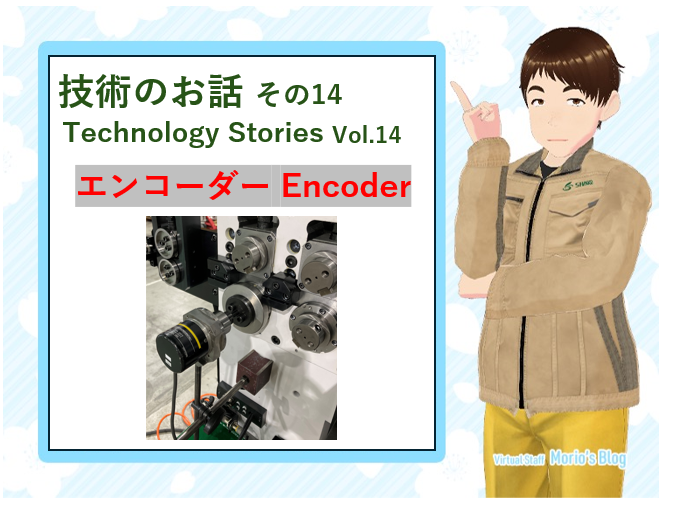
その14 エンコーダー
こんにちは、もりおです!
夏休みは、趣味のコントラバスを抱えて、旅行してきました。
高い所で花火を見て、はしゃいでいる女性がいたけど、僕は高所恐怖症なので、とても無理です。誰だったんでしょうね?
今日はちょっとテクニカルな話をしようと思います。NC化の進んだ工作機械では、とても大切な「エンコーダー」について、掘り下げてみたいと思います。
エンコーダーって、よく聞くし、何となくはわかるのですが、いざ説明しろとなると難しい。ってことで、いろいろ調べました。
エンコーダーは、工作機械がどのように動いているのか、その正確な情報を操るための大切な部品です。
具体的には、位置や速度、動く方向などの運動情報をキャッチし、デジタル信号に変換して制御システムにフィードバックします。
このフィードバックがあるからこそ、機械は正確に動くことができるんですね。
エンコーダーが果たす役割
1.位置検出
・エンコーダーは、例えば、ばね加工機において、送りローラや加工ツールの位置をリアルタイムで把握します。
単独で使われるケースやサーボモーターに内蔵されているケースもあります。これにより、非常に精密な加工が可能になるんですね。
また、製造過程で性能テスト用の検査器具として使われる場合もあります。
2.速度測定
・機械の動作速度を測定し、最適な速度で作業が行えるよう制御します。速度の正確な管理は、生産性の向上に直結します。
3.方向認識
・加工中の機械がどの方向に動いているかを把握し、必要に応じて方向を調整します。これがあるから、複雑な形状の加工も正確に行えるのです。
品質を左右するポイント
1.解像度
・エンコーダーの解像度が高ければ高いほど、より精密な位置情報を提供できます。精密加工には、この高解像度が求められます。
2.信頼性と耐久性
・機械は厳しい環境下で動かされることも多いです。そのため、エンコーダーは振動や温度変化、汚れや水分に強い設計が必要です。
もちろん、乱暴に扱うのはご法度です。製造時にも注意深く、丁寧に組み込んでいきます。
3.応答速度
・特に高速で動作する機械では、エンコーダーが迅速に情報を更新できるかが重要です。遅れがあると、機械の性能に悪影響が出ます。
4.インターフェースと互換性
・エンコーダーはさまざまな制御システムと連携するため、適切なインターフェースの選択が不可欠です。
デジタルやアナログ、フィールドバスなど、ニーズに合ったオプションを選ぶことが大切です。
正確で信頼性の高いエンコーダーは、まさに工作機械の性能を支える柱の一つです。そのため、設計、選定、保守には細心の注意が必要とされます。
Vol.14 Encoder
Hello, it’s Morio! I went on a trip during my summer vacation with my beloved contrabass (double bass).
I saw a woman enjoying fireworks at a high altitude, but since I’m afraid of heights, that’s definitely not for me. I wonder who she was?
Today, I’d like to dive into a somewhat technical topic. In NC (numerical control) machining, an essential component is the “encoder,” and I would like to explore this in detail. We often hear about encoders, and while we roughly understand what they do, explaining them can be a bit tricky. So, I’ve done some research to clarify.
Encoders are crucial parts that control how precisely machining tools operate. Specifically, they capture motion information such as position, speed, and direction, convert it into digital signals, and feed it back to the control system. This feedback enables machinery to operate accurately.
Roles of Encoders
1.Position Detection
Encoders are used to detect the precise position of machine parts. For instance, in a spring-making machine, they can identify the position of feed rollers and various machining tools in real-time. They are also used in performance testing during the manufacturing process.
2.Speed Measurement
Encoders measure the operating speed of machinery, ensuring work is performed at optimal speeds. Accurate management of speed directly correlates with improved productivity.
3.Direction Recognition
Encoders can determine the direction in which machinery is moving. This ensures that parts operate correctly during complex machining tasks.
Points Affecting Quality
1.Resolution
The resolution of an encoder is a critical indicator of its performance. Higher resolution allows for more precise position information, which, in turn, improves machining accuracy.
High-resolution encoders are particularly suited for applications requiring precise machining and high quality.
2.Reliability and Durability
Machines often operate under harsh conditions, making it essential for encoders to withstand vibrations, temperature changes, dirt, and moisture.
Encoders need to be robustly designed to maintain accuracy under these conditions.
3.Response Speed
Especially in high-speed machinery, it is crucial for encoders to update information promptly. Any delay can adversely affect machine performance.
4.Interface and Compatibility
Encoders must be compatible with various control systems. Choosing the right interface, whether digital, analog, or fieldbus, is crucial to meet system requirements.
Accurate and reliable encoders are indeed one of the pillars supporting the performance of machining tools. Therefore, careful attention must be paid to their design, selection, and maintenance to ensure they are always operating in optimal condition.