










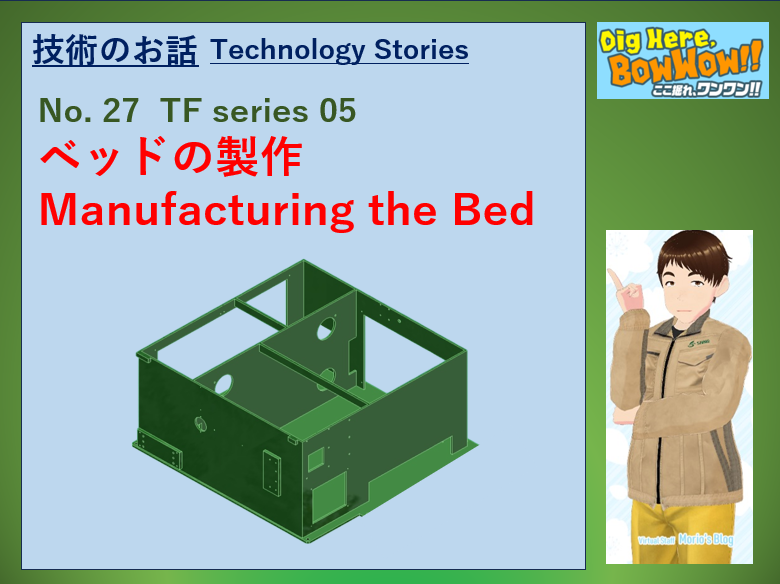
No.27 TFシリーズ05 ベッド製作
もりおです。こんにちは!
TFシリーズのベッド編、今回は「製作編」です!
これまで、ベッドの構造やリブの話をしてきましたが、実際にベッドがどうやって作られているのか、知らないことも多いですよね?
というわけで、今回は**“現場目線”でベッド製作の裏側**をのぞいてみたいと思います!
🛠 ベッドって、どうやって作るの?
TFシリーズのベッドは、鉄板を箱型に溶接して製作されます。
でも、これがまた…
ただ溶接すればいいってものじゃない!
実は、製作中にはたくさんの“気をつけポイント”があるんです。
🔍 鉄板のチェックが第一歩!
まずは、使う鉄板に**“歪み”がないか**をゲージでチェックします。
「材料の段階でゆがんでたら、その上に何を組んでもムダ!」
ここは、まさに**「基本にして最重要」**!
🔥 溶接の順番が命!
ベッドの各部材を溶接していくと、熱によって鉄板が膨張・収縮します。
これによって“歪み”が発生してしまうんです。これは避けられない自然現象なんですが…
だからこそ、「溶接の順番」が大事!
- 対角線上に順番に溶接してバランスを取る
- 左右均等に進めて偏りを防ぐ
などなど、まるでパズルのように考えて作業するんです。
油断すると…
溶接始点の対角が浮き上がってしまうことも…!
🏗 門型ベッドは特に難しい!
2次加工機の門型ベッドでは、さらに注意が必要です。
鉄板を溶接するとき、内側に引き寄せる力が働くので、
油断すると「クイッ」と内側に入り込んでしまうんです。
ここが実は、ベッド製作で一番の難所!
熟練の溶接職人さんの“読み”と“技”が光るポイントです✨
📐 大型ベッドは「四角形」を保て!
ベッド製作では、平行四辺形になってしまう現象が起きがちです。
そこで、仮組時に部品同士の隙間が出てないかを注意深く確認します。
ここは、製作中に何度も測って確認します。
そこで、仮組時に部品同士の隙間が出ていないかを注意深く確認します。
🧰 タップ加工はドリルが命!
ベッドには、部品を取り付けるための**「タップ(ネジ穴)」**を加工します。
このとき、直角度をしっかり出すことが重要です。当社の協力企業さんでは、磁石台付きのボール盤を使って、ベッドに固定させ、直角度を出すようにされているそうです。
このしくみは、タップ穴の垂直性だけでなく、ドリルの破損の減少にも効果的です。
もちろん、ドリルの切れ味には、メンテナンスも重要な職人技です!
道具を大切にするが、ものづくりの始まりですね。
✨ まとめ
TFシリーズのベッドは、ただ頑丈なだけじゃない。
製作の現場では、歪みや熱による影響、部品の精度まで、いろんな工夫と気配りが詰まっているんです!
こうした「見えない技術」が、最終的に
**“ばねを高精度で作り続ける”**ことに直結しているって、すごいことですよね。
それでは、また次回の「ここ掘れ、ワンワン!!」でお会いしましょう🐾
※本ブログは、生成AIを活用して作成しています。
No.27 TF series05 Manufacturing the Bed
Hi, this is Morio!
Welcome to another post in our TF series—this time, we’re diving into the “manufacturing side” of the machine bed!
We’ve already talked about the bed’s structure and the role of ribs, but have you ever wondered how the bed is actually built?
That’s what we’re exploring today—from a real-world, factory-floor perspective!
🛠 So, how is a bed made?
The bed of the TF series is created by welding steel plates into a box-like shape.
But… it’s not as simple as just welding pieces together!
There are a lot of “watch-out points” during the process.
🔍 The first step: Check the steel plates!
Before anything else, we use a gauge to check if the plates are warped.
“If the base material is already distorted, everything you build on top will be off!”
That’s why this step is basic but absolutely critical!
🔥 The welding order is everything!
As we weld each part of the bed together, the heat causes the metal to expand and contract.
This naturally leads to some warping—but that’s where technique comes in!
The order of welding is key to preventing distortions:
- Weld diagonally to balance stress
- Proceed symmetrically to avoid one-sided shrinkage
It’s like solving a puzzle—you really have to think about the sequence.
If you don’t, you might end up with the opposite corner lifting up as you weld. Not good!
🏗 Gantry-style beds are especially tricky!
When it comes to gantry-style beds used in secondary processing machines, things get even more delicate.
As you weld the steel plates, a force pulls them inward.
If you’re not careful, the structure might get pulled in and misaligned.
This is known as the toughest part of bed fabrication—it’s where the skills and intuition of a master welder really shine ✨
📐 For large beds: Keep it square!
Large beds tend to warp into parallelograms if you’re not careful.
That’s why during pre-assembly, we pay close attention to whether any gaps appear between components.
This part requires multiple checks with measuring tools.
We make absolutely sure everything fits snugly—no gaps allowed!
🧰 Tapping holes: The drill makes the difference!
To attach parts to the bed, we need to create tapped holes (threaded screw holes).
What’s crucial here is keeping those holes perfectly perpendicular.
At our partner companies, they use magnetic-base drills to attach firmly to the bed and ensure precision.
This not only helps maintain vertical alignment but also reduces the chance of drill bit breakage.
And of course, the sharpness and maintenance of the drill are part of the craftsmanship too.
Taking good care of your tools—that’s where manufacturing excellence begins!
✨ Summary
The TF series bed isn’t just tough—it’s smartly built.
From avoiding distortions, to heat control, to ensuring the precision of every hole—it’s full of small tricks and thoughtful touches from the factory floor.
These “invisible techniques” are what allow our machines to keep making high-precision springs over the long term.
Isn’t that amazing?
See you next time in another edition of “Dig It, Woof Woof!!” 🐾
This blog is created with the support of generative AI.