










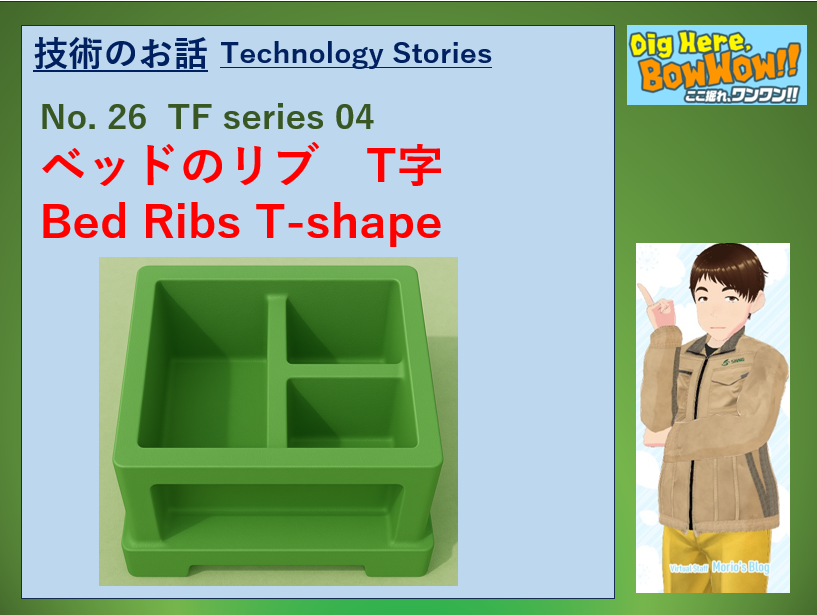
No.26 TF シリーズ04 ベッドのリブ T字
もりおです!
今回は、「工作機械のリブって、なぜ十字じゃなくてT字に配置するの?」というちょっと専門的な話題を、ぼくなりにわかりやすく説明してみたいと思います!
________________________________________
🔧 そもそも「リブ」って何?
「リブ」とは、**機械のベッドやフレームの中に入っている“補強のための仕切り”**みたいなものです。
中が空洞の箱形構造だけではグラグラしやすいので、そこに「板(リブ)」を入れて、剛性を高めたり、ゆがみにくくする役割を持っています。
________________________________________
🔥 溶接するときには「熱」が問題に!
ベッドやフレームは、鉄板を溶接して作ります。
このときに問題になるのが、“熱膨張”によるゆがみです。
鉄は熱を加えると膨張し、冷めると縮みます。
つまり、溶接中に加熱と冷却のくり返しが起きることで、部品が少しずつ曲がったり、ねじれたりしてしまうんです。
これは工作機械にとっては大敵。だって、精度が命ですから!
________________________________________
✖️ 十字型リブは、なぜダメなの?
リブを「+(十字)」の形にしてしまうと…
- 溶接したときに熱が交差する点に集中しやすい
- 熱が逃げにくくなり、膨張・収縮が偏る
- 結果、交差点でひずみや歪みが発生しやすい
つまり、十字にしてしまうと、応力(力の集中)と熱の影響が重なって、ゆがみやすくなるというデメリットがあるんです。
________________________________________
✅ だからT字型に!
一方で、リブを「T字」に配置すると…
- 熱が一方向に逃げやすく
- 材料が無理なく収縮できる
- 溶接によるゆがみを抑えられる
というメリットがあります。
つまり、「T字」は、強度も確保しつつ、熱の影響をやさしく逃がしてあげる、バランスのいい配置なんですね!
________________________________________
✨ まとめ
- 溶接では「熱」が材料にゆがみを与える
- 十字リブは熱が集中して、ゆがみやすい
- T字リブは熱が逃げやすく、ゆがみを抑えられる
こんな小さな工夫が、長く安定して高精度な加工ができる機械づくりにとって、すごく大事なんです!
こうした見えない部分にも、技術者たちの知恵と経験がたっぷり詰まってるんですよ。
それでは、また次回の「ここ掘れ、ワンワン!!」でお会いしましょう🐾
※本文は、生成AIを活用して作成しています。
No.26 TF series 04 Bed Ribs T-shape
Hi, it’s Morio here!
This time, I’d like to explain—hopefully in a simple and easy-to-understand way—one of those slightly more technical topics:
“Why are the ribs inside machine tools arranged in a T-shape instead of a cross?”
🔧 First of all, what are “ribs”?
“Ribs” are reinforcing walls or partitions built inside the bed or frame of a machine.
A hollow box structure by itself can be a bit wobbly, right? So by adding “rib plates” inside, we can increase rigidity and reduce distortion.
🔥 Welding brings the “heat” problem!
The beds and frames of machines are made by welding together steel plates.
And here’s where we run into a big issue: deformation caused by thermal expansion.
Steel expands when heated and contracts when cooled.
So during welding, with all that heating and cooling happening again and again, the parts can gradually bend or twist.
For machine tools, where precision is everything, this kind of distortion is a big problem!
✖️ What’s wrong with cross-shaped ribs?
If you arrange ribs in a “+” (cross) shape…
-
The heat during welding tends to concentrate where the ribs intersect
-
Heat doesn’t escape well, causing uneven expansion and contraction
-
As a result, distortion and stress easily build up at the intersection
In short, using cross-shaped ribs creates hot spots and stress points, making the structure more prone to warping.
✅ That’s why we use T-shaped ribs!
Now, if you arrange ribs in a “T” shape instead…
-
Heat can escape more smoothly in one direction
-
The material can contract naturally without too much stress
-
This minimizes distortion caused by welding
So, a “T” shape is a well-balanced layout that ensures strength while gently letting heat dissipate.
✨ To sum it up:
-
Welding heat can deform materials
-
Cross-shaped ribs concentrate heat, causing warping
-
T-shaped ribs allow heat to escape and reduce distortion
These small design choices are actually super important for building machines that deliver stable, high-precision performance over the long term.
Even in these hidden structural parts, you’ll find the wisdom and experience of skilled engineers packed in tight.
See you next time in another episode of “Dig Here, BOwwow!!” 🐾
This blog is made by using generative AI.