












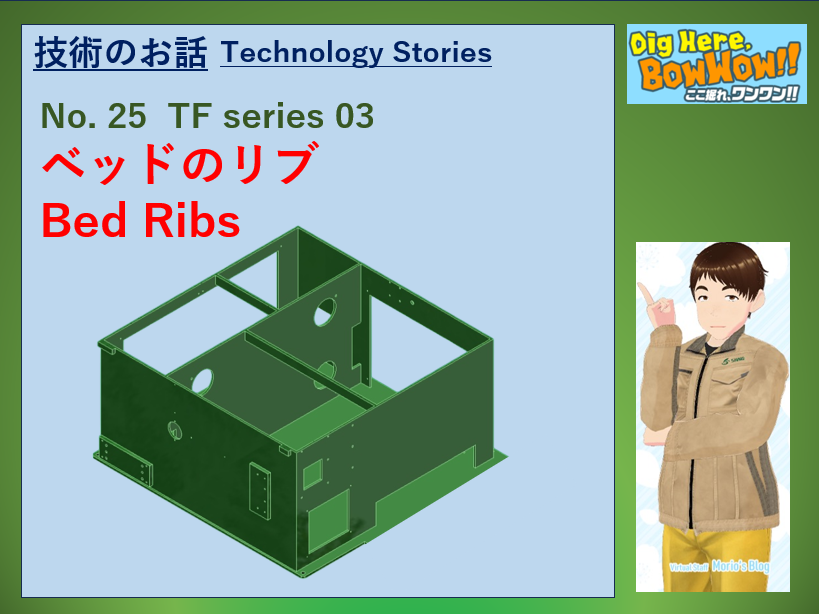
No.25 TF シリーズ03 ベッドのリブ
もりおです。
TFシリーズの3回目。ベッドについては2回目です。
さて、今回は、ベッドの「リブ」について見ていきましょう。
「リブ」とは、ベッド内部に設けられた補強用の構造のことを指します。
ただの箱だとグラグラするけど、中に支えを入れると安定するのと同じですね。
車のボディや建築の鉄骨にも「補強リブ」が使われていますが、
工作機械のベッドにもリブが組み込まれています。
その主な役割は何といっても、「機械の剛性」を高めることです。
「剛性」とは、「外部からの力に対する変形のしにくさ」のことです。
剛性が高いのが当社の売りなんだけど、
それは、加工が安定するっていうこと、
つまり、当社のモットーである
「繰り返し精度」=「高精度なばねを同じ形で生産し続ける技術」
に大きくつながる訳です。
「リブ」に戻りますが、内部に適切に配置することで、
箱型のベッドを「歪みにくくする」「振動を抑える」効果を発揮します。
コストの兼ね合いもあるので、
「いかに効果的に配置するか」
「いかに製造しやすいようにするか」
が設計者の腕の見せ所です。
具体的には、
・上部にフレームが乗る部分には、リブの密度を高める
・ベッド内部にリブを精度高く溶接しやすいような工夫をする
・電装装置が組み込まれるケースがあるので、熱循環及び振動対策にも気を配る
また、機械のサイズによって、ワイヤーライン(ばねが加工される位置)との関係もあり、
大きい機械のベッドは低く、小さい機械のベッドは高くなります。
上に乗るユニットの大きさ・重さも考慮して、
ベッドやリブの厚みや配置を決めることになります。
さて、今回はここまでです。次回も「リブ」について、もっと深掘りしてみますね。
なお、本内容は、Youtubeチャンネル投稿でも公開されています。
投稿以外にも、動画、ショートもたくさんの掲載がありますので、併せて見てくれるとうれしいです。
お楽しみに。
No.25 TF series 03 Bed Ribs
Hi, this is Morio!
This is the third entry in my blog series on the TF Series, and the second one focusing on the bed.
Today, I’d like to talk about something inside the bed that doesn’t usually get much attention: the **“ribs.”**
“Ribs” refer to the reinforcing structures built inside a machine bed.
Think of it like a box—if it’s just hollow, it tends to wobble. But if you put some supports inside, it becomes much more stable.
You’ll find reinforcement ribs in car bodies or building frames too. And yes, they’re also an important part of our machine beds.
Their biggest role Without a doubt is **to increase the rigidity** of the machine.
Now, what’s “rigidity”? It means **how well a structure resists deformation from external forces.**
Our machines are known for having high rigidity, and that directly contributes to **stable spring processing**.
In other words, this links directly to our company’s motto:
> **“Repeat accuracy” = the ability to keep producing high-precision springs in exactly the same shape, again and again.**
Back to the ribs—by placing them properly inside the bed, we can make the box structure **resist distortion** and **suppress vibrations**.
Of course, we also need to consider costs, so the real challenge for our designers is:
– How can we place ribs **most effectively**?
– How can we design them to be **easy to manufacture**?
Some practical design choices include:
– Placing **more ribs near the top**, where the frame will be mounted.
– Designing the inside of the bed to make it **easy to weld ribs accurately.**
– Considering **thermal flow and vibration damping**, especially since electrical components may be installed inside the bed.
Also, depending on the size of the machine, the relationship with the **wire line** (the spring’s processing height) comes into play.
Larger machines tend to have **lower beds**, while smaller ones have **higher beds**.
So, we carefully decide the **thickness and layout** of both the bed and the ribs, taking into account the size and weight of the units mounted above.
That’s all for today!
Next time, I’ll dive even deeper into the world of “ribs” and how they support our machines behind the scenes.
By the way, this content is also available on our YouTube Channel under the “Posts” section.
We’ve also uploaded many videos and Shorts, so I’d be super happy if you checked those out too!
Stay tuned and see you next time!
— Morio 🐾