













No.30 TF-08 フレーム3 リブ
こんにちは、もりおです。
7月には、
プレMF展:1日(火)~4日(金)当社知立センター
MF-TOKYO2025:16日(水)~19日(金)東京ビックサイト
が開催されます。
ぼくたちも参加して、現在準備の真っ最中です。
是非来てくださいね。楽しみにしています。
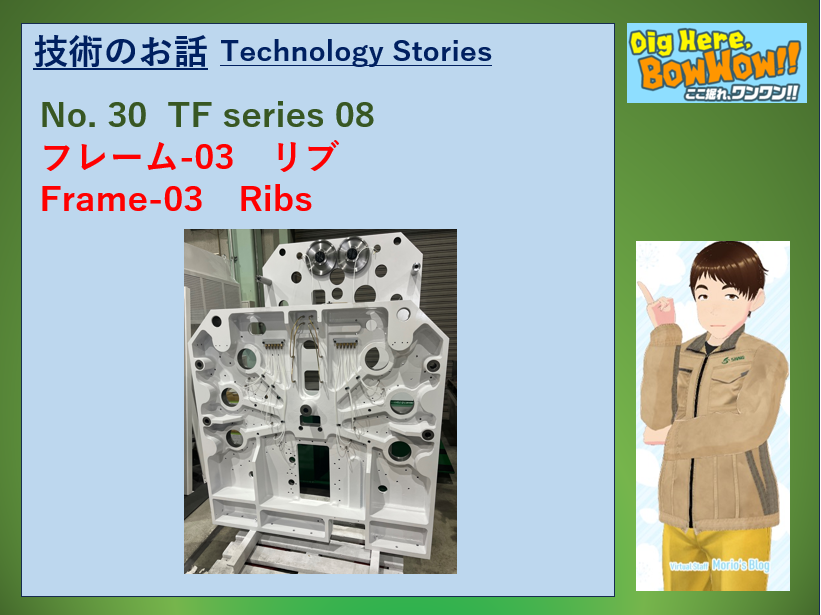
さて、今回は、フレームのリブについて考察してみましょう。
リブとは、元々は肋骨の意味ですが、
工作機械においては、板状または薄肉の部分の強度や耐性を上げるための補強材のことです。
これがなかなか興味深いです。
まず、厚けりゃいいってもんではないそうです
厚いと何が悪いのか?
理由は2つ。
・内部に巣(鋳巣 ちゅうす)が発生しやすくなる
・前回触れた「片状黒鉛」が肥大化して、弱くなる場合が発生する
鋳巣は、溶湯の温度調整不足、脱ガス処理の不十分、型への空気の巻き込み、砂型の通気性の問題などにより
鋳物内部にできる空洞のことで、鋳物の強度や耐性の大敵です。
片状黒鉛も振動減衰性にはいいですが、大き過ぎると、鋳物が弱くなってしまうんですね。
さらに、厚みの均一さとT字構造も重要です。
厚みがバラバラだと、溶湯(鋳型に入れる前の、あの真っ赤な液体状態の鉄)が、
型の中で冷却される速度が違ってしまうので、
残留応力のせいで、亀裂や曲がりが生じやすくなります。
またT字構造にすることで、冷却収縮時のゆがみを防ぐようにします。
それから、角や隅のRも重要です。
角張り過ぎると、砂型が脱落して、巣が発生するケースがありますし、
丸みを付け過ぎても、ひけ巣といって、鋳物の内部(巣)や外部(へこみ)に
比較的大きな欠陥ができやすくなります。
設計の人に聞くと、リブは、配置や形状について、設計段階から、協力企業さんと、溶湯の流し方を含めて、
しっかり相談しているんだそうです。
いやぁ、奥深いなあ。
今日も、工場で、愛おしくなって、思わずなでなでしてしまいました。
では、また次回をお楽しみに。
No.30 TF-08 Frame-3 Ribs
Hello, this is Morio.
In July,
Pre-MF Exhibition: 1st (Tue)-4th (Fri) at our Chiryu Center
MF-TOKYO2025: 16th (Wed)-19th (Fri) at Tokyo Big Sight
will be held.
We will also be participating and are currently in the middle of preparations.
Please come and visit us. We are looking forward to it.
Now, this time, let’s consider the ribs of the frame.
The word “rib” originally meant ribs,
but in machine tools, it is a reinforcing material that increases the strength and durability of plate-like or thin-walled parts.
This is quite interesting.
First of all, it seems that thicker is not always better.
What’s wrong with being thick?
There are two reasons.
・Casting Cavities are more likely to occur inside.
・The “flake graphite” mentioned last time can become enlarged and weaken.
Casting Cavities are cavities that form inside a casting due to insufficient temperature control of the molten metal, insufficient degassing, air being drawn into the mold, and problems with the breathability of the sand mold. They are a major enemy of the strength and durability of castings.
Flake graphite is good for vibration damping, but if it is too large, it weakens the casting.
In addition, uniformity of thickness and a T-shaped structure are also important.
If the thickness is uneven, the molten metal (the red-hot liquid iron before it is poured into the mold) will cool at different rates inside the mold, making it more likely to crack or bend due to residual stress.
The T-shaped structure also prevents distortion during cooling and shrinkage.
The radius of the corners is also important.
If the mold is too angular, the sand mold may fall off and cause the casting cavities,
while if the mold is too rounded, shrinkage cavities, which are relatively large defects inside (cavities) or outside (dents) of the casting, can easily form.
When I asked our machine development designers, they told me that they discuss the placement and shape of the ribs with their partner companies from the design stage,
including how to pour the molten metal.
It’s so deep.
Today at the factory, I felt so much love for the frames that I couldn’t help but stroke them.
So, please look forward to the next time.