









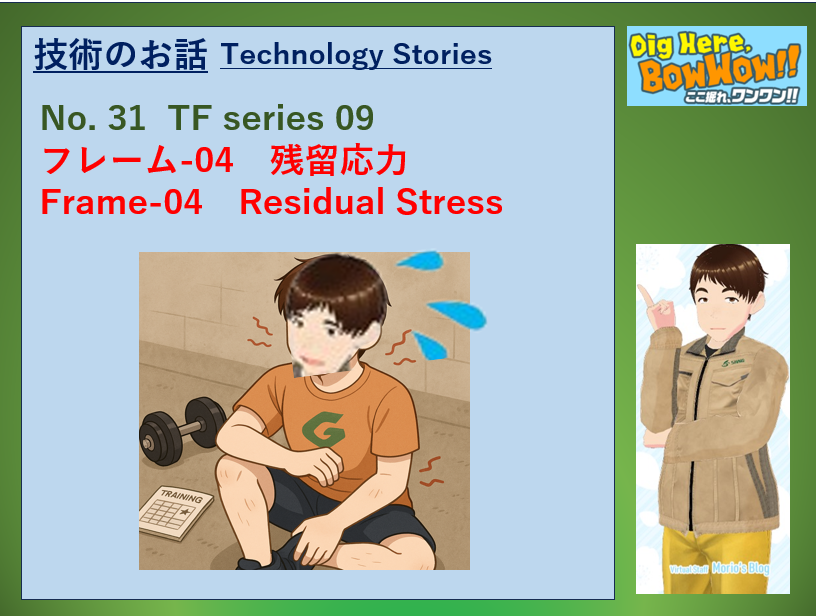
No.31 TF-09 フレーム04 残留応力
はい、もりおです!
またまた暑い季節がやってきましたね。
社員の人に聞くと、肌に刺してくる感じだとか。
バーチャルなぼくたちにはわからないけど、皆さん、体には気を付けてくださいね。
前回のブログ記事に、「残留応力」っていう言葉が登場したのを覚えていますか?
入社してから、よく聞く言葉だけど、何だかよくわからない。
そこで、今回は、この「応力」とか「残留応力」について調べてみました。
ぼくなりに、わかりやすく解説してみますね。
💪 応力ってなに?
まず「応力」っていうのは、物体が力を受けた時に、物体内部に発生する「力」のことです。
例えば、TFシリーズのフレームがばねを加工しているときって、
送りユニット、コイリングユニット、切断ユニットなどからいろんな**「力」**が加わっていますよね?
このときフレームの中では、「おっとっと!」って感じで、
外からの力に耐えるように、内側でギュッと反発する力が発生しているんです。
これが「応力」です!
🧠 残留応力ってなに?
で、もっと厄介なのがこちら。
加工が終わって、外からの力がなくなっても、
物体の中に「力のクセ」みたいなものが残ってしまうことがあります。
これが「残留応力」ってやつです。
🤕 筋肉痛にたとえてみよう!
ここで、人間の体で例えてみましょう!
筋トレをした後って、翌日や翌々日に筋肉痛になりますよね?
あれって、一時的に筋肉に強い力がかかったあと、その影響が中に残ってしまっている状態なんです。
つまり!
・応力 → 筋トレ中にかかってる「負荷」
・残留応力 → 翌日の「筋肉痛」
みたいな関係!
筋肉痛のまま無理して動くとケガしやすいように、
機械も残留応力が残ったまま動かすと、変形や破損の原因になるんです。
🛠 残留応力の影響って?
フレームやベッドのような精密部品に残留応力があると、どうなるか?
・加工中に微妙なゆがみが出る
・組立時に精度が合わなくなる
・長時間使ってるうちに部品の変形やビビリ音が出る
などなど、「繰り返し精度」に大きく影響してしまうんです!
では、TFのフレームの製造工程に踏み込んで、さらに深掘りしてみましょう。
🧱 鋳物フレームはどうやって加工するの?
TFシリーズのフレームは、ねずみ鋳鉄(FC250)を使って、前後2枚構造でできています。
これに穴あけ・面取り・ネジタップ・切削仕上げなど、様々な加工を施していきます。
でも、ここで大切なのが…
「鋳物は加工前から応力がある」ということ!
💥 鋳物には“力の記憶”がある?
鋳物って、ドロドロに溶かした鉄を型に流し込んで固める製法で作りますよね?
でもそのとき、外は先に冷えて、中はゆっくり冷えるという“時間差”が生じます。
その結果、内と外で縮もうとする力(応力)にズレが出て、
金属の中に**「力のクセ(=残留応力)」が残ってしまう**んです。
これ、人間で言うと…
「寝違えて首が痛い!」=変な力が残っている状態ですね。
(ん?この例えは、微妙ですかね?)
🔧 残留応力があると、加工でどうなる?
さあ、ここからが本題!
この状態のまま、穴を開けたり、面を削ったりすると…
🔹 加工中に“反り”や“ゆがみ”が出てくる
🔹 仕上げたあと、時間が経つと変形してくる
🔹 フレームを組み込んだ後、ビビリや異音の原因になる
つまり!
**「しっかり加工したはずなのに、ズレてしまう…」**という事態が起きるんです。
🛠 どうやって防いでいるの?
当社のフレーム加工では、残留応力によるトラブルを防ぐために、
次のような工程の工夫と技術の積み重ねがあります!
✅ 時効処理・熱処理で応力を落ち着かせる
→ 鋳物を長期間自然放置(「枯らす」って言います)したり、
炉でじっくり加熱&冷却(焼きなまし)することで、内部応力をリラックス!
かつては,長期間(数か月~数年)大気中に放置して、自然に応力が消滅するのを待つ方法だったのが、
今では,焼なましの熱処理により急速に応力を除去する方法がとられています。
ねずみ鋳鉄の場合,530℃くらいで3~6h保持後炉冷する、応力除去焼なましが行われているそうです。
✅ 加工順序や固定方法を工夫
→ 例えば、大きな面を先に加工しすぎると、応力のバランスが崩れるので、
「少しずつ削る」「対象の反対側も削る」といった工夫をしています。
✅ 加工中も“歪み”チェック
→ 加工の合間に測定器で直角・平面度を確認しながら進めていきます!
言ってみれば、過度な運動の後のストレッチですね。
🎯 なぜそこまでこだわるの?
それはもちろん!
われわれの技術モットーである
「繰り返し精度」=“高精度なばねを、毎回同じ形で加工できること”**を実現するため!
フレームが微妙にゆがんでいるだけで、
・曲げ位置がズレる
・切断位置がズレる
・コイリングのバランスが崩れる
といった現象が起きるんです。
🐾 まとめ
応力: 外からの力に対抗する「内部の力」
残留応力: 固まったあとも残っている力のクセ
加工時の工夫: 応力を分散する順序・手順・チェック体制
鋳物フレームは“ただ削るだけ”では完成しません。
見えない応力と戦いながら、協力企業の職人さんたちの丁寧な工程があってこそ、最高のばね加工が実現できるんです!
あれっ?ところで、ぼくたちって、暑さは感じないのに、筋肉痛にはなるの?
それではまた、次回の「ここ掘れ、ワンワン!!」でお会いしましょう〜🐾
※本ブログは、生成AIを活用して作成しています。
No.31 TF-09 Frame04 Residual Stress
Hi, it’s Morio!
The hot season is back again!
Some of our coworkers say it feels like the sun is stabbing their skin!
We virtual staff can’t really feel that, but please take good care of yourselves out there!
Do you remember the term “residual stress” from the last blog post?
I’ve heard it a lot since joining the company, but honestly, I didn’t really understand what it meant.
So this time, I looked into it—and I’ll do my best to explain it in a way that makes sense!
💪 What is “stress”?
First off, “stress” in this context refers to the internal force that occurs inside a material when it’s subjected to external forces.
For example, when the frame of a TF series machine is processing a spring,
all kinds of forces are being applied from the feeding unit, coiling unit, cutting unit, etc.
At that moment, inside the frame, it’s like saying “Whoa there!”
An internal counterforce kicks in to resist those external loads.
That internal force is what we call “stress”!
🧠 What is “residual stress”?
Now comes the trickier one.
Even after processing is finished and there are no more external forces,
sometimes a kind of “memory of force” remains inside the material.
That’s what we call “residual stress.”
🤕 Let’s compare it to muscle soreness!
Let’s take a human example.
After you do some muscle training, you feel sore the next day, right?
That soreness is the lingering impact of the force that was applied during exercise.
So basically:
Stress = the strain on your muscles while working out
Residual stress = the soreness you feel the next day
📌 And just like how it’s risky to move with sore muscles,
📌 running a machine with residual stress can lead to deformation or even breakage.
🛠 What happens when residual stress is present?
If precision parts like the frame or bed still contain residual stress, it can cause:
Minor distortions during machining
-Assembly precision issues
-Deformation or strange vibrations after long-term use
In other words, it seriously affects our all-important repeatability!
So let’s dive into the TF frame production process and dig deeper!
🧱 How is a cast-iron frame processed?
TF series frames are made from gray cast iron (FC250) and built with a two-piece (front and back) structure.
They’re then processed with drilling, chamfering, tapping, and precision finishing.
But the key point here is…
Cast iron has internal stress even before machining begins!
💥 Does cast iron have a “memory of force”?
Yup! Cast iron is made by pouring molten metal into molds and letting it solidify.
During this process, the outer parts cool and harden first, and the inner parts cool more slowly.
That time lag causes a mismatch in shrinkage forces between inside and outside,
leaving behind “internal force memory”—aka residual stress.
If we were to humanize it:
“It’s like waking up with a crick in your neck!”
(Hmm… does that analogy work? 😅)
🔧 So what happens during machining?
Here’s the core issue!
If you machine the frame while this internal force still exists…
-You’ll get warping or bending mid-process
-The shape might change over time even after finishing
-Once assembled, it could vibrate weirdly or make strange noises
In short:
You may think it’s perfectly machined, but things still shift later!
🛠 How do we prevent that?
At our company, we take great care to avoid problems caused by residual stress.
Here’s how we tackle it with thoughtful techniques and processes:
✅ Stress relief through aging and heat treatment
→ We leave the cast iron to “rest” for weeks or months (this is called “seasoning”),
or apply heat treatment in a furnace to gradually relieve internal stress.
In the past, people would simply let it sit for months (or even years!)
But nowadays, we use annealing to remove stress more quickly.
For gray cast iron like FC250, it’s common to hold it at about 530°C for 3–6 hours, then let it cool in the furnace.
✅ Careful machining sequence and fixturing
→ If we remove too much material from one side first, it throws off the stress balance.
So we machine gradually, flip sides, and work symmetrically to maintain stability.
✅ In-process distortion checks
→ Between steps, we measure perpendicularity and flatness using measuring tools.
Think of it like stretching after intense exercise—it prevents injuries later!
🎯 Why do we care so much?
Simple!
Because our core mission is to uphold:
Repeatability — the ability to manufacture high quality springs in exactly the same shape, every time!
If the frame is even slightly distorted:
-Bending positions will shift
-Cutting points will drift
-Coiling balance will be thrown off
So yes, we care a LOT!
🐾 Summary
| Term | What it means |
|---|---|
| Stress | Internal force resisting external loads |
| Residual Stress | Lingering internal force after solidifying |
| Machining know-how | Ways to reduce and balance internal force |
Cast-iron frames aren’t just about cutting shapes.
They’re made with careful attention to invisible forces,
thanks to the craftsmanship and experience of our trusted partner technicians.
Hmm… now that I think about it—if we virtual guys don’t feel summer-heat, can we still get muscle soreness? 🤔
See you again next time on
“Dig Here, Bowwow!!” 🐾
This blog was created using generative AI.