











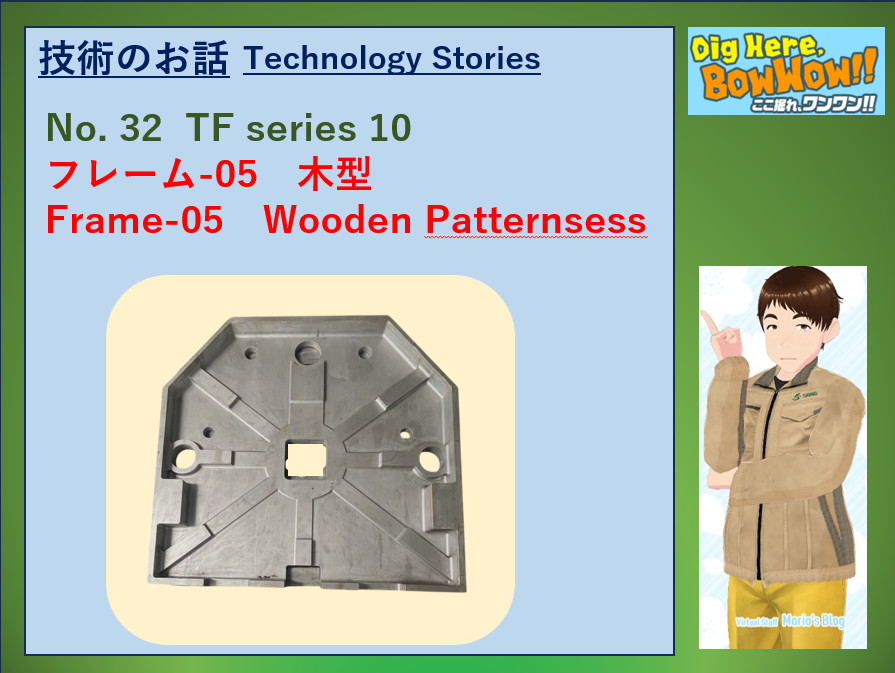
No.32 TF-10 フレーム05 木型
あっ、もりおです。
MF-TOKYO2025にご来場頂き、ありがとうございます。
わかばと僕も、大きな2つのポールで参加してたんですよ。
誰か、気付いてくれた人いたのかな?
では、今回のテーマ「木型」に行きましょう。
鋳物フレームを作るうえで欠かせないのが、この「木型(きがた)」です。
これは、**溶かした鉄を流し込むための鋳型(砂型)をつくるための“元になる型”**であり、
鋳物づくりの“最初の一歩”ともいえる重要工程です。
以下では、「技術的な役割」「材質(木材)」「製作上の注意点」などを、わかりやすく説明します。
🌳 1. 木型ってどんな役割?
木型は、鋳型を作るための“原寸大のモデル”です!
鋳物は、砂でできた「鋳型(いがた)」に溶けた金属を流し込んで作ります。
その鋳型を作るための“形”が木型であり、
木型を砂の中に埋めて、その外周に砂を締め固めることで鋳型が作られます。
そのあと木型を取り出して、できた空洞に金属を流し込むのです。
つまり、木型の精度=鋳物の精度に直結する、非常に重要な工程です。
この木型。CAD/CAMと工作機械を使って作成する物もありますが、
多くは、職人の方が技を駆使して、製作してくれています。すごいですよね!!
実際の製作前には、協力企業の方と、うちの設計・調達の担当者がしっかり打合せをしますよ。
🪵 2. 木型に使われる材料
通常は合板が使われます。
合板のメリットとしては、
・加工しやすい(特に針葉樹系)
・繊維方向を直交させることで、反りやねじれが少ない
といったことが挙げられます。
鋳物の形状や使われ方を考慮して、使う木材の種類を決めているそうです。
※フレーム以外でも、鋳物を使うこともありますよ。
🧠 3. 木型製作の技術的な注意点
木型は単なる「かたち」ではなく、鋳造時のさまざまな物理的要素を見越して作られます。
❗主な注意点は以下の通り:
① 収縮(しゅうしゅく)
金属は冷えると縮むため、あらかじめ大きめに作っておく必要があります。
FC250などのねずみ鋳鉄であれば、一般に1〜1.2%程度の収縮率が考慮されます。
🔍 例)完成品サイズが1000mmなら、木型は1010〜1012mmで作る。
② 抜き勾配(ぬきこうばい)
木型を砂型からスムーズに抜くために、垂直面には1〜2°の傾斜を付けるのが常識。
特にフレームのような高さのある形状では、この“抜けやすさ”が非常に重要。
③ 角部の丸み(R加工)
鋳物は鋭角部分での湯回りが悪く、鋳巣(いす)や割れが発生しやすい。
そのため、木型の角にもあらかじめR(アール)=丸みをつけておく。
④ 寸法公差と仕上げしろ
鋳物は“粗形状”でしか作れないため、後加工(機械加工)用に仕上げしろ(3~5mmなど)を確保する。
木型にそのぶん追加されていないと、図面通りに加工できなくなる。
⑤ 補強リブやコアの形状
フレームには中空部分やリブが多いため、それに応じて中子(なかご)=砂の塊を配置する必要があります。
中子用の“コアプリント”と呼ばれる受け部も、木型に作っておく必要があります。
🛠 4. 木型製作の工程例(大型フレームの場合)
・図面確認・収縮代・抜き勾配の設定
・型板に木材を加工・組み立て
・コアプリントやリブの細部を加工
・表面を塗装・研磨(表面強化)
・検査(寸法、傾きなど)
・完成後、木型保管・メンテナンス
🧾 まとめ
項目 ポイント
木型の目的 鋳型(砂型)をつくるための原寸大モデル
材料 通常は合板が使われる。発泡系もある
技術的注意点 収縮、抜き勾配、角のR、仕上げしろの考慮
寸法精度 鋳物精度のベースとなるため、木型精度が非常に重要
木型管理 湿気・変形に注意して保管、再使用可能な資産でもある
次回も、木型の続編です。
木型模型について深掘りしますよ。お楽しみに♪
※本ブログは、生成AIを活用して作成しています。
No.32 TF-10 Frame05 Wodden Patterns
Hi, it’s Morio! 🐾
Thank you so much for visiting us at **MF-TOKYO 2025**!
Wakaba and I were actually part of the two huge poles at our booth!
…Did anyone notice? 👀
Now then, let’s dive into this post’s topic: **wooden patterns**!
When it comes to making cast iron frames for the TF Series, this step is absolutely essential.
The **wooden pattern** is the “master mold” used to make the **sand mold**,
which in turn is what we pour molten metal into.
In other words, it’s the **very first step** in making castings — and a super important one at that!
Here’s what I’ll be covering today:
* the technical role of wooden patterns
* materials used
* important tips for creating them!
—
## 🌳 1. What’s the role of a wooden pattern?
A wooden pattern is basically a **full-size model** of the part to be cast!
We make castings by pouring molten metal into a sand mold.
To create that sand mold, we press a wooden pattern into the sand and pack it tightly around the shape.
Then, we remove the wooden pattern, leaving behind a cavity where the molten metal will go.
So you see — the **accuracy of the wooden pattern = the accuracy of the final casting**!
Some wooden patterns are made using CAD/CAM and CNC machines,
but many are still handcrafted by skilled artisans using traditional techniques. Amazing, right?
Before pattern-making begins, our engineers and procurement team meet closely with the partner company to plan everything in detail. Teamwork!
—
## 🪵 2. What kind of materials are used?
Most commonly, **plywood** is used.
Why plywood? Because:
* It’s easy to work with (especially softwood-based types)
* The cross-grain structure helps prevent warping and twisting
The type of wood is selected based on the shape and application of the casting.
(Some castings outside of frames use different woods or even foamed materials too!)
—
## 🧠 3. Technical points when making a wooden pattern
A pattern isn’t just a “shape” — it has to account for the **physics of casting**!
Here are some key considerations:
### ① **Shrinkage allowance**
Molten metal shrinks as it cools.
So we need to make the pattern slightly **larger** than the final part.
For gray cast iron like FC250, the shrinkage is about **1–1.2%**.
📏 Example: For a 1000 mm finished part, the pattern would be 1010–1012 mm.
—
### ② **Draft angle**
To remove the pattern from the sand mold smoothly, **vertical faces** need a slight **taper** — usually about **1–2°**.
This is especially important for tall parts like machine frames.
—
### ③ **Fillets (rounded corners)**
Sharp internal corners cause poor metal flow and increase the chance of casting defects like **blowholes** or **cracks**.
So we add gentle **fillets (rounded R edges)** to all the corners.
—
### ④ **Machining allowance**
Castings are rough-shaped and require post-processing (machining),
so the pattern needs to include **extra thickness** (usually 3–5 mm) for that machining.
If that’s missing… the final part can’t be machined to drawing specs! 😱
—
### ⑤ **Ribs and core prints**
Many frame castings have hollow sections or ribs.
We place **cores** (sand inserts) in the mold to create these shapes.
To support the cores, we need **core prints** built right into the pattern.
—
## 🛠 4. Sample process for large frame wooden patterns
1. Review the drawing and apply shrinkage & draft angles
2. Cut and assemble wood onto a pattern board
3. Add detailed features like ribs and core prints
4. Apply paint and polish the surface
5. Measure and inspect (dimensions, flatness, draft angles)
6. Store the pattern carefully (it’s a reusable asset!)
—
## 🧾 Summary
| Topic | Key Points |
| ———— | —————————————————– |
| Purpose | Full-size model to create sand mold |
| Materials | Mostly plywood (sometimes foam or resin) |
| Tech Tips | Shrinkage, draft angles, fillets, machining allowance |
| Precision | Pattern accuracy = casting accuracy |
| Pattern Care | Protect from humidity and warping; reusable asset |
—
Next time, I’ll go even deeper into wooden pattern types!
Stay tuned — we’ll explore **pattern modeling** in more detail! 🐾
See you next time on **”Dig Here, Bowwow!**
※This blog was created with the help of generative AI.