







No.33 TF-11 フレーム06 木型2
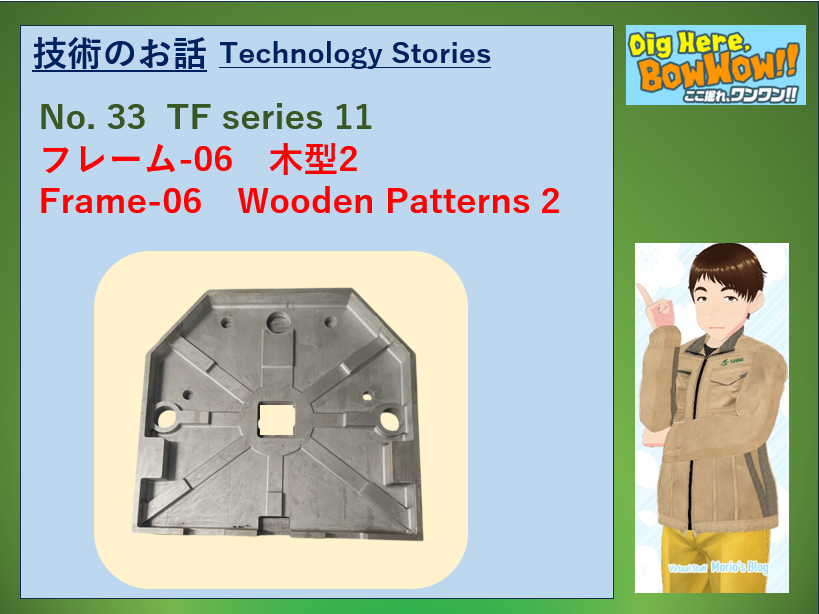
こんにちは、もりおです!
ご挨拶が遅くなってしまいましたが、
暑い中、お忙しい中、皆様、MF-TOKYO2025 新興機械工業ブースにお越し頂き、ありがとうございます。
技術展示も見て頂けましたか?
これからも、当社は、「繰り返し精度の実現」をモットーに、日々技術に向かい合っていきます!!
今回は、前回紹介した「木型」の種類について、もう少し深掘りしていきますよ〜!
テーマは…
✨現型(げんがた)・割り現型(わりげんがた)・常盤(じょうばん)=マッチプレート✨
それぞれどう違うの? どんなメリット・デメリットがあるの?
さらに最近使われることもある「発泡」や「ウレタン」についても比較してみましょう!
________________________________________
🪵 1. 現型(げんがた)とは?
いわゆる“スタンダード”な木型!
✅ 特徴:
• 片面だけの形状をもつ型で、主に手込め(てごめ)の砂型づくりに使われます。
• 木型を砂の上に置いて、上から砂をかぶせて型を作ります。
✅ メリット:
• 構造がシンプルで製作しやすい。
• 一品物や試作向き。
❌ デメリット:
• 型外しが難しい形状には不向き。
• 量産には手間がかかる。
________________________________________
✂️ 2. 割り現型(わりげんがた)とは?
現型を上下や左右に分割できるようにしたタイプ!
✅ 特徴:
• 立体的な形状にも対応可能。
• 分割線(パーティングライン)で上下に分かれている。
✅ メリット:
• 複雑な形でも鋳型を壊さずに型抜きできる。
• 大型品や高さのある部品向き。
❌ デメリット:
• 組み合わせ精度が必要なので、製作がやや難しい。
• 保管時にパーツがバラバラになりやすい。ってことは、ちゃんとパーツ形状を把握して、
個々が行方不明にならないような工夫が必要です。うちも、そこはキッチリ管理してますよ。
________________________________________
📏 3. 常盤(じょうばん)=マッチプレート(パターンプレート)
現型を定盤(アルミなどのプレート)に取り付けた木型!
✅ 特徴:
• 木型がプレートに固定されていて、型締めがしやすい。
• 量産向けに自動成形機などでよく使われる。
✅ メリット:
• 型の精度が高く、量産に最適。
• 中子(なかご)やゲートも一体化しやすい。
❌ デメリット:
• 製作コストが高い。
• 設備が整った工場でないと使いにくい。
________________________________________
🧽 4. 木材 vs 発泡・ウレタン
最近では、発泡素材やウレタン樹脂を使った木型も増えてきました!
それぞれ比較してみましょう。
比較項目 木材(合板など) 発泡素材 ウレタン
加工性 ○(切削・接着しやすい) ◎(とても軽く加工が簡単) ○(機械加工に向く)
精度 ◎(繊維が安定) △(崩れやすいことも) ◎(寸法安定)
重さ △(やや重い) ◎(非常に軽い) ○(軽量)
耐久性 ◎(何度も使える) △(一回きりが多い) ○(ある程度再利用可)
コスト △(やや高め) ○(安い) △(やや高め)
廃棄性 ○(自然素材) △(環境負荷あり) △(処理に注意)
📝 まとめ:
• 木材は長く使えるが、重くて加工に技術が必要。
• 発泡は軽くて安価だが、耐久性がなく使い捨てに近い。
• ウレタンは中間的な存在で、形状精度に優れる。
________________________________________
🐾 まとめ
種類 特徴 向いている用途
現型 単純構造 試作、小ロット
割り現型 分割構造 大型・複雑形状
常盤(マッチプレート) プレート付きで精度◎ 量産品
材質 特徴 メリット デメリット
木材 合板・無垢材など 加工精度が高く耐久性も◎ 重く、加工に技術が必要
発泡 発泡スチロールなど 軽くて安価、加工しやすい 一回使いきりが多い
ウレタン 高発泡樹脂など 精度・加工性のバランス良し コスト高め、処分に注意
________________________________________
それではまた、「ここ掘れ、ワンワン!!」でお会いしましょう〜🐾
※本ブログは、生成AIを活用して作成しています。
No.33 TF-11 Frame05 Wodden Patterns 2
Hi there, it’s Morio!
Today’s blog is a follow-up to the last one about wooden patterns (kigata).
Let’s dive a little deeper into the different types of patterns!
The theme is…
✨Solid Patterns, Split Patterns, and Match Plates!✨
What’s the difference between them? What are their pros and cons?
And hey, let’s also take a look at some of the newer materials like foam and urethane that are being used these days!
🪵 1. What’s a “Solid Pattern”? (Gen-gata )
This is your good ol’ standard wooden pattern.
✅ Features:
- Has a shape on only one side.
- Mainly used for hand-molding sand casting.
✅ Pros:
- Very simple structure, so it’s easy to make.
- Great for one-off parts or prototyping.
❌ Cons:
- Not ideal for complicated shapes that are hard to pull out of the mold.
- Too slow for mass production.
✂️ 2. What’s a “Split Pattern”? (Wari-gen-gata )
A more advanced version of the solid pattern—it can be split into upper and lower halves.
✅ Features:
- Suitable for more complex, 3D shapes.
- Has a parting line to split the pattern cleanly.
✅ Pros:
- You can remove the pattern without breaking the mold, even for tricky shapes.
- Perfect for larger or taller castings.
❌ Cons:
- Requires precise matching of parts—making it trickier to manufacture.
- Since it’s split, the parts can easily get separated or lost, so careful inventory management is a must.
(We’ve got that covered in our shop, don’t worry!)
📏 3. What’s a “Match Plate”? (Jōban )
This one’s a solid or split pattern attached to a metal plate, like aluminum.
✅ Features:
- The wooden pattern is firmly mounted on a flat plate.
- Commonly used with automated molding machines in mass production.
✅ Pros:
- High precision, excellent for making many parts.
- Easy to integrate things like cores and gating systems.
❌ Cons:
- Higher cost to manufacture.
- Requires dedicated equipment, so not for every workshop.
🧽 4. Wood vs. Foam vs. Urethane
Let’s compare the materials used for making these patterns!
| Feature | Wood (e.g. Plywood) | Foam | Urethane Resin |
|---|---|---|---|
| Workability | ○ Easy to cut & glue | ◎ Super easy & light | ○ Good for machining |
| Accuracy | ◎ Stable grain structure | △ Can crumble | ◎ Excellent stability |
| Weight | △ Heavy | ◎ Extremely light | ○ Light |
| Durability | ◎ Reusable many times | △ Often single-use | ○ Reusable to a point |
| Cost | △ Slightly pricey | ○ Cheap | △ A bit expensive |
| Disposal | ○ Natural material | △ Environmental load | △ Handle with care |
📝 Summary:
- Wood is durable and precise, but heavy and needs skill to shape.
- Foam is light and cheap, but not durable—more like a one-time-use material.
- Urethane is somewhere in between: great dimensional accuracy and decent workability.
🐾 Summary Table
| Type | Feature | Best For |
|---|---|---|
| Solid Pattern | Simple one-piece design | Prototypes, small lots |
| Split Pattern | Dividable for complex parts | Large or tall castings |
| Match Plate | Plate-mounted for precision | Mass production |
| Material | Feature | Pros | Cons |
|---|---|---|---|
| Wood | Plywood / solid wood | High accuracy & durability | Heavy, needs skill |
| Foam | Polystyrene, etc. | Light, cheap, easy to cut | Single-use, low strength |
| Urethane | High-density foamed resin | Good precision & reusability | Costly, tricky disposal |
Alrighty, that’s it for now!
See you again in our next episode of “Dig Here, Bowwow!!” 🐾
This blog was created using generative AI.