













No.34 TF-12 フレーム7 木型3
こんにちは、もりおです!
前回のブログで「木型の種類」についてたっぷりお話しましたが、今回はその続編!
いよいよ!
木型がどうやって“砂型”になるのか?
その工程を、実際のイラストとともにご紹介していきますよ〜✨
🏗️ STEP 1:木型の設置(しっかり水平を出す!)
まずは、木型を枠(フラスコ)にセットします!
木型が傾いていると、後工程ですべてがズレてしまうので、ここは大事なポイント。
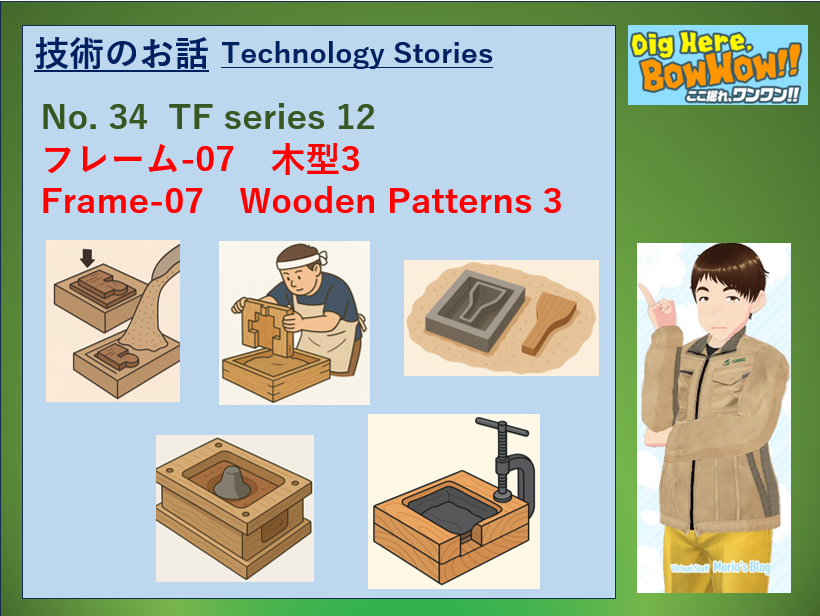
📸 イラスト:木型が枠の中にきれいにセットされている様子(上左)
🏜️ STEP 2:砂を入れる(ていねいに、でも手早く!)
次に、砂を木型にかぶせていきます!
ここで使うのは「鋳物砂(いものずな)」と呼ばれる、粘結性のある砂です。
振動をかけてしっかりと押し固めながら、隙間なく埋めていくのがコツ!
📸 イラスト:砂がどんどん木型にかぶさっていく様子(上中)
🔧豆知識:最近では自動成形機を使うこともありますが、TFのフレームのような一品物は、手込めが中心なんです。
🔄 STEP 3:木型を抜く!(型くずれ注意!)
固め終わったら、そーっと木型を引き抜きます。
これを「抜型(ぬきがた)」って言います。
ちょっとでも雑にやると、砂が崩れてしまってやり直しに…😱
📸 イラスト:木型が砂からきれいに抜かれて、型が残っている状態(上右)
えっ、何でここだけ、形が違うかって?生成AI様に聞いてくださいよ。
💨 STEP 4:中子(なかご)や注湯口の準備
ここで、必要に応じて**中子(中空部の型)や注湯口(溶けた金属を流し込む穴)**をセットします。
これは製品形状や構造によって違うので、設計図面をしっかりチェック!
📸 イラスト:中子がセットされた状態(下左)
🧱 STEP 5:上下型を組み合わせて完成!
最後に、上型と下型をぴったりと合わせて、鋳型が完成!
この合わせ精度も、品質に大きく影響しますよ〜!
📸 イラスト:上下の砂型を合わせてクランプしている様子(下右)
📝 まとめ:砂型づくりって、地味だけど超重要!
砂型づくりは、一見「地味」かもしれませんが、製品の品質を左右する超重要工程!
特にフレームのように、精度も強度も求められる部品では、
木型の精度+砂型の仕上げ+注湯の技術=一発勝負の世界!
それではまた、次回の
**「ここ掘れ、ワンワン!!」**でお会いしましょう〜🐾
次回は…「実際に注湯して、どんな風に鋳物ができあがるのか?」をご紹介予定です!お楽しみに〜!
※本ブログは、生成AIを活用して作成しています。
No.34 TF-12 Frame 7 Wodden Patterns 3
🐾 Hello, it’s Morio here!
In the previous blog, we took a deep dive into the different types of wooden patterns.
Today, it’s time for the next chapter!
🎉 We’re finally getting into…
How does a wooden pattern turn into a sand mold?
Let’s walk through the process—this time with illustrations! ✨
🏗️ STEP 1: Placing the Wooden Pattern (Leveling is key!)
First, the wooden pattern is placed inside a flask (the molding frame).
If the pattern is tilted, everything in the next steps will be misaligned—so this step is super important!
📸 Illustration: The wooden pattern neatly set inside the flask (top-left)
🏜️ STEP 2: Filling the Sand (Carefully—but quickly!)
Next, we cover the pattern with molding sand!
We use “casting sand”, which has good binding properties.
The key here is to compact the sand tightly with vibration, leaving no gaps.
📸 Illustration: Sand gradually covering the pattern (top-center)
🔧 Fun Fact:
Although automatic molding machines are common these days, for one-off parts like the TF frame, we mostly compact by hand!
🔄 STEP 3: Removing the Pattern (Be gentle!)
Once the sand has set, we carefully lift out the pattern—this step is called “pattern removal.”
Even a small mistake here can cause the mold to collapse… 😱 So steady hands are a must!
📸 Illustration: Wooden pattern being removed cleanly, leaving a mold cavity (top-right)
(Yes, I know that one shape looks different—ask the generative AI why! 😅)
💨 STEP 4: Adding Cores and Pouring Channels
Now we set up the core (for hollow spaces) and the pouring gate (where molten metal flows in) if needed.
This depends entirely on the product’s structure—so we double-check the blueprints!
📸 Illustration: Core is properly placed inside the mold (bottom-left)
🧱 STEP 5: Assembling the Mold—All Set!
Finally, we align the upper and lower mold halves to complete the mold!
This alignment is critical—even tiny gaps can affect the final product quality.
📸 Illustration: Upper and lower mold halves clamped together (bottom-right)
📝 Final Thoughts: Sand Molding—Simple but Critical!
Sand molding might seem “simple” at first glance,
but it’s actually a super important step that determines final product quality!
Especially for frame components like those in the TF series, where precision and strength are crucial,
we’re operating in a “one-shot only” world, where:
Pattern accuracy + sand mold finishing + casting skills = No do-overs!
See you next time on
“Dig Here, Bowwow!!” 🐾
Next time, I’ll be showing you:
“What happens during actual casting? How does molten metal turn into a part?”
Stay tuned!
This blog post was created with the help of generative AI.