









No.37 TF-15 スライド-02
こんにちは、もりおです🐾
さてさて、今回からは、TFらしい加工ユニットの「滑りスライド」にスポットを当てていきますよ〜✨
🔧 どこにあるの?TFの滑りスライド!
まずは配置のお話から。
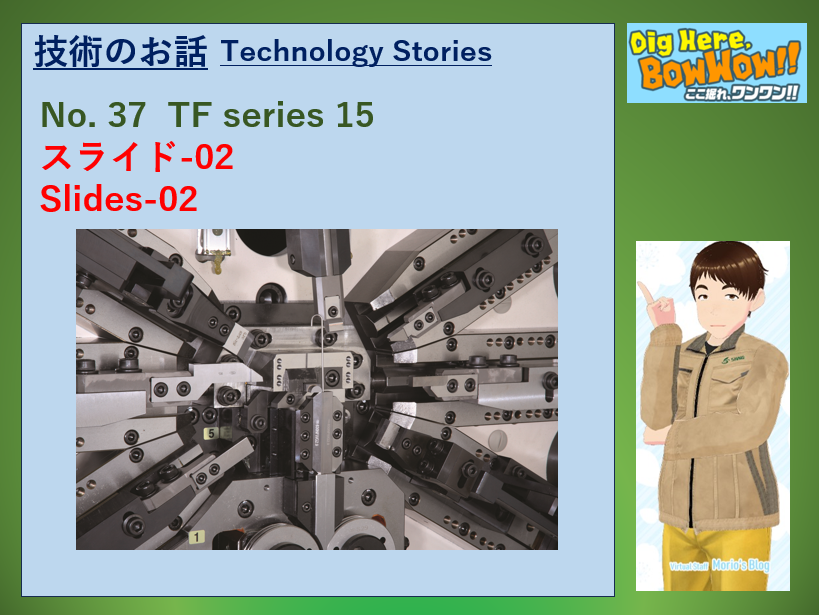
TF本体を正面から見ると、左右ナナメ方向にズラッと6本の滑りスライドが並んでいます!
この6本、1軸制御で、同じサーボモーターで一気に動く構造なんです💡
どうして分けないの?って聞かれることもありますが、
機械も大きく高くなってしまううえに、
切断やフック起こしは、ばねによってタイミングが大きく変わる訳じゃないので、
ここは、カム式1軸スライドを継承しているんです。
動きのしくみはこんな感じ👇
-
サーボモーターが回転!(これが動力源)
-
回転はカム軸(ギヤ)へ伝達
-
カムがスライドレバーのカムローラを押し上げる!
-
スライドレバーの反対側につながった連結ボルトに動力が伝達!
-
連結ボルトが滑りスライドを押し出し、回転運動が前後の直線運動に変換される!
🧩 構造は?3つの主要部品!
6本の滑りスライドは、基本は同じ構造でできていて、以下の3つの主要パーツで構成されています!
| パーツ名 | 役割 |
|---|---|
| 🪵 スライドベース | スライド台+スライド押えのセット |
| 📏 平面スライド | 先端にツールホルダー+加工ツールを取り付ける部分 |
| 🔁 バネ&シャフト | バネでスライドを後退!シャフトはバネの座屈防止! |
加工方向(前方)には、さっき紹介したカム機構でググッと押し出し、
戻り動作は、シャフトに巻かれたバネの力で戻るというシンプルだけど確実な仕組みです!
🧠 工夫ポイント①:省スペース!
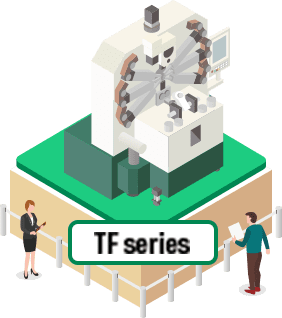
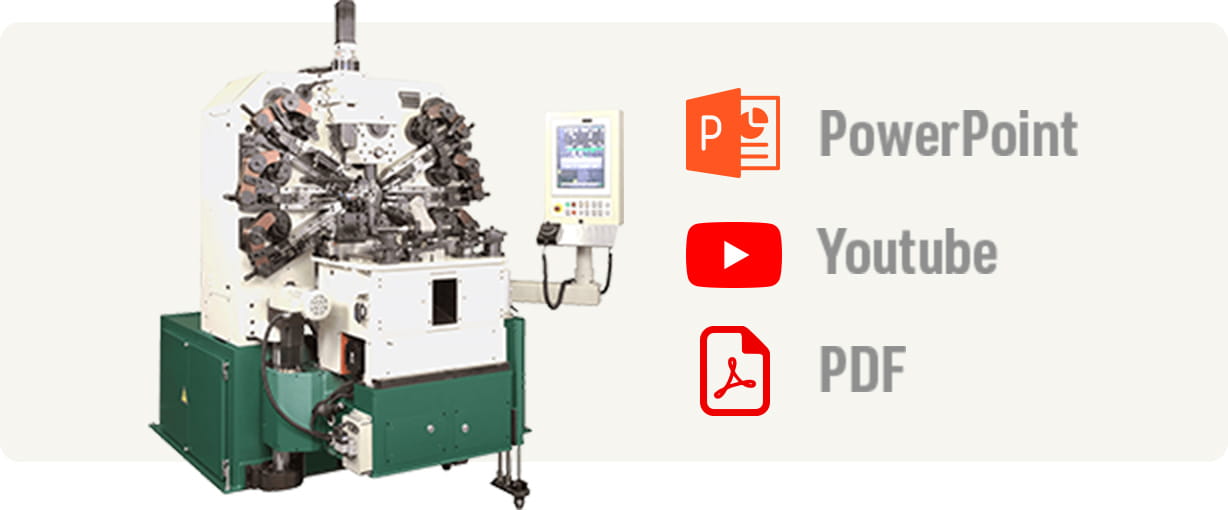
サムネイルにあるTFの正面をじっくり見てください。実はけっこうキチキチなんです!
中央部には「芯金ユニット」や「ピッチ機構」
上には「トーションアタッチメント」(フックやボディー成形用)
下には「送りユニット」もズラリ!
さらには各ユニットをフレームに装着するためのブラケットもあるので、
「もっとスライドのスペースを取りたい!」と思っても、設計は常にスペースとの戦い⚔️
この限られた空間に、6本分のスライドを高精度で収める。まさに職人技+設計力の融合です!
❓6本も必要なの?
よく聞かれるのがコレ。
「滑りスライドって、全部で6本も必要なの?」
答えは…YES!!!(断言)
たとえば…
🔁 右巻きバネ加工なら:
左上&右下でフック起こし!
左右で切断!
🔁 左巻きバネ加工なら:
右上&左下でフック起こし!
さらに…
スライドを他のスライドの支えに使ったり、
斜めから切断したり、
バネ形状によってノウハウ満載の組合せがあるので…
このスライドいらないんじゃ?」と外すのはNG!
🧑🏭 設計者の腕の見せどころ!
まとめると…
💪 強度をしっかり保ちつつ
🧠 必要な動作をすべて満たし
🏗️ 限られたスペースに収める!
この3つを両立するのが、シンコー設計陣の腕の見せどころなんです!
次回から、もっと深掘りしていきますのでお楽しみに〜!
それではまた、「ここ掘れ、ワンワン!!」でお会いしましょう🐾
※本ブログは生成AIを活用して作成しています。
No.37 TF-15 Slide-02
Hi everyone, it’s Morio here! 🐾
From this post, we’re diving into one of TF’s most iconic mechanical units — the sliding mechanism! Let’s spotlight the “Slippery Slides”! ✨
🔧 Where Are the Slides in the TF Series?
First up — let’s talk about their placement.
Take a look at the front of a TF machine:
You’ll see six slide units arranged diagonally left and right.
These six slides are controlled by a single axis, all driven together by one servo motor 💡
You might wonder:
“Why not control them separately?”
Well, if we separated them, the machine would become much larger and more expensive.
But for operations like cutting or hook forming, the timing doesn’t need to vary much spring by spring.
So we proudly continue using the cam-driven single-axis sliding system inherited from VF800MFT series!
Here’s how the movement works 👇
The servo motor rotates (this is the power source!)
That rotation is transferred to the camshaft (via gears)
The cam pushes up the cam roller on the slide lever
The opposite side of the lever is connected to a link bolt, which transmits the force
The link bolt pushes the slide, converting rotary motion into precise back-and-forth linear movement!
🧩 Structure: 3 Key Components!
All six slide units share the same core structure, built from these three major components:
Part Name Function
🪵 Slide Base: A set of the slide table and slide clamp
📏 Flat Slide: The tip holds the tool holder and processing tool
🔁 Spring & Shaft: Spring returns the slide; shaft prevents the spring buckling!
The movement:
Forward → powered by the cam mechanism we just saw
Backward → pulled back reliably by spring tension wrapped around the shaft.
Simple, but highly reliable!
🧠 Design Insight #1: Compact Space Mastery!
Take a closer look at the front view of the TF machine shown in the thumbnail).
You’ll see — things are really packed in tight! 😳
In the center:
“Mandrel Unit” and “Pitch Mechanism”
Above:
“Torsion Attachment” for hook forming and body coiling
Below:
“Feed Unit” lined up neatly
Not to mention all the brackets and mounting elements needed to attach these units to the frame…
Even if we wanted more space for the slides — the design is always fighting a battle with tight clearances ⚔️
Fitting six sliding units with precision into this limited space…
Now that is the perfect fusion of craftsmanship and design skill!
❓Do We Really Need All Six Slides?
This is a super common question:
“Do you really need all six slides?”
The answer is…
YES!!! (no hesitation!)
For example:
🔁 When forming right-wound tension springs:
Left-upper & right-lower slides → hook forming
Left & right slides → cutting
🔁 When forming left-wound springs:
Right-upper & left-lower → hook forming
And that’s not all…
Sometimes slides support each other,
or are used for angled cuts for short end hooks
depending on the spring shape.
So yeah — removing even one slide would break the magic. Each one plays a role in the choreography!
🧑🏭 Where Design Meets Artistry!
Let’s wrap it up. The designer’s challenge is all about balancing these three:
💪 Maintain strength and durabili
🧠 Enable all the necessary operations
🏗️ Fit everything within extremely tight spacety
Pulling all that off?
That’s where Shinko’s design team truly shines 💫
Next time, we’ll go even deeper into the material choices, shapes, and lubrication structures that make these slides so effective!
Until then —
See you again on “Dig Here, Bowwow!!” 🐾
This blog was created using generative AI technology.