









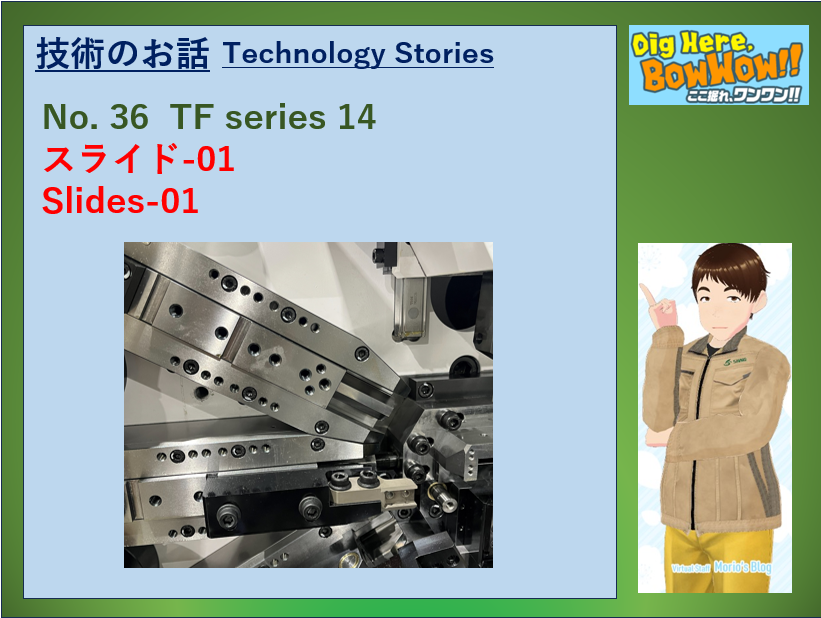
No.36 TF-14 スライド-01
もりおです🐾
関西万博も終わり、やっと秋らしく涼しくなってきましたね〜🍁
お久しぶりの「ここ掘れ、ワンワン!!」更新です!
これまでTF編では、
✅「構造」
✅「ベッド」
✅「フレーム」
と見てきましたが…
今回から【スライド編】がスタートします🎉
実はこの「スライド」、シンコーらしさがぎゅっと詰まったパートなんです✨
🛠️ スライドってなに?
工作機械における「スライド」とは、ズバリ直線運動を実現するメカです💨
つまり、「前に動く」「後ろに戻る」「上下に動く」…そんな動きを支えてる、大事な大事な働き者!
スライド機構には大きく3つの種類があります。
| 種類 | 特徴 |
|---|---|
| 🧊 静圧スライド | 油や空気で浮かせて滑らせる超高精度タイプ(超精密MCなどに使用) |
| 🔩 転がりスライド | レールの上をボールやローラーで転がす方式 |
| 🔧 滑りスライド | 金属同士が摺動して滑る方式 |
TFシリーズでは、このうち【転がりスライド】と【滑りスライド】を使い分けています!
🔧 滑りスライドってどんなの?
「滑りスライド」は、スライドベース(土台)の上をスライド部品が摺動する仕組み。
面同士が当たって動くため…
✨ メリット
・衝撃に強い!
・重いものでも動かせる!
・設計の自由度が高い!
⚠️ デメリット
・設計・部品加工・組立の精度が悪いと、「かじり」(表面が焼き付いて剥がれる現象)が発生😢
・潤滑や調整が大事!
よく「滑りスライドは安い」なんて聞きますが、当社では高精度な部品と職人技の組立が必要なので、決して安価ではありません!
協力企業さんや組立て現場との連携&ノウハウが光るポイントです💡
🔩 転がりスライド(リニアスライド)ってどんなの?
お次は、「転がりスライド」!
ボールネジ+直線レールの組合せが典型的ですね。コロコロ動きます💨
✨ メリット
・スライドユニットとしての精度・動作・潤滑性をメーカーが保証!
・精密な位置決めに最適!
⚠️ デメリット
・レールやブロックのサイズが決まってるから設計の自由度が低い
・点接触なので、剛性をしっかり設計しないとダメ!
🦾 TFシリーズではどう使ってるの?
🔧 滑りスライド
フレーム上に放射状に6本配置!
✂️ 切断スライド(受け刃/切断)
🪝 フック起こしスライド(オコシ/オサエ)
で使われています。特に切断は、強い力や衝撃がかかる場所ですね!
🔩 リニアスライド
・**トーションアタッチメントの上下移動(Y軸)**に使用!
→ フックの曲げやボディー径を決める、大事な部分です!
🌟 今回は「滑りスライド」に注目!
今回は「滑りスライド」を取り上げていきます!
1サイクル1往復の単純な動きですが、
省スペース&高耐久性&繰返し精度の実現を両立させるために、こんな工夫がされています👇
・平行度、直角度がものすごく重要で、個々の部品の精度と仕上げ、組立ての技術を駆使しています!
・潤滑構造もとても大切✨
じつは、この部分、アフターサービスでの交換が少ないんです。品質の何よりの証拠ですよね。
ぼくも自慢したいポイントのひとつです😎
🐾 もりおのひとこと
スライドの動きって、簡単そうに見えて、奥が深いんです。
設計、加工、組立、そして使用現場での安定性…。すべてが繋がって、あの「気持ちいい動き」が生まれているんですね。
次回は、この滑りスライドの構造やしくみをもっともっと深掘りしていきます!
ではまた、「ここ掘れ、ワンワン!!」でお会いしましょう〜🐾
※本ブログは、生成AIを活用して作成しています。
No.36 TF-14 Slide-01
Hi, it’s Morio here! 🐾
The Kansai Expo has wrapped up, and finally, we’re getting that refreshing autumn breeze 🍁
It’s been a while since our last update of “Dig Here, Bowwow!!” — thanks for waiting!
So far in the TF Series, we’ve explored:
✅ Machine structure
✅ The bed
✅ The frame
And now…
🎉 It’s time to start the Slide Mechanism Series!
Believe it or not, the slide part is packed with all kinds of Shinko originality and craftsmanship✨
Let’s dig in!
🛠️ So… What is a Slide?
In a nutshell, a slide mechanism is what makes linear motion possible in a machine tool 💨
Whether it’s “move forward,” “pull back,” or “go up and down,” slides are the unsung heroes that make it all happen.
There are 3 main types of slide mechanisms:
| Type | Features |
|---|---|
| 🧊 Hydrostatic Slide | Uses oil or air pressure to float the slide for ultra-high precision (used in ultra-precision machining centers) |
| 🔩 Rolling Slide | Moves using balls or rollers along a rail |
| 🔧 Sliding Slide | Metal-on-metal sliding (aka plain guide) |
For our TF Series, we use both 🔧 Sliding Slides and 🔩 Rolling (Linear) Slides depending on the purpose!
🔧 What’s a Sliding Slide?
The sliding slide system works by having the slide component glide across the base surface through friction. It’s a surface-on-surface type of motion.
✨ Advantages:
– Handles strong impact really well
– Can move heavy loads without issue
– Offers design flexibility
⚠️ Challenges:
– If your design, machining, or assembly precision is off, you risk “seizing” (where parts scrape and fuse due to heat/friction) 😢
– Requires good lubrication and careful adjustment
Some people say, “Sliding slides are cheap,” but at Shinko, we use high-precision components and expert assembly, so trust me — it’s far from cheap!
This is where teamwork with our machine designrs, partner manufacturers and skilled assemblers really shines💡
🔩 What’s a Rolling Slide (Linear Slide)?
Next up: rolling slides!
These typically use a ball screw + linear rail setup. Think: smooth, precise, gliding motion 💨
✨ Advantages:
– Accuracy, performance, and lubrication are manufacturer-guaranteed
– Perfect for precise positioning
⚠️ Challenges:
– Rail and block sizes are fixed → less design freedom
– It’s point contact, so rigidity needs careful design
🦾 How We Use Slides in the TF Series
🔧 Sliding Slides:
We place 6 of these in a radial pattern on the machine frame.
They handle:
✂️ Cutting Slide (for cutting blades)
🪝 Hook Forming Slides (for life-up and support actions)
These slides take on strong forces and shocks — especially during the cutting cycle!
🔩 Linear Slides:
Used for vertical movement (Y-axis) of the torsion attachment.
This is the part that determines the hooks and body diameter, so accuracy matters!
🌟 Spotlight: Sliding Slides!
In this “Slide” series, we’ll focus on the sliding slide.
Each cycle involves a simple back-and-forth motion.
But achieving space-saving and high durability? That takes serious design smarts 💡
Here are some of the behind-the-scenes efforts:
– We ensure parallelism and squareness with incredible precision
– The finish quality of each component and assembly technique is top-notch
– Lubrication design is crucial for long-term performance
And guess what?
This part of the machine rarely needs replacement — that’s a solid sign of quality, right?
It’s one of the things I’m proudest of 😎
🐾 Morio’s Final Bark
Slides might seem simple at first glance…
But their movement is the result of careful design, precise machining, expert assembly, and real-world reliability.
That smooth, satisfying motion? It’s no accident — it’s engineering love in action.
Next time, I’ll dig deeper into how these sliding slides are built and how they work!
Until then, see you in the next “Dig Here, Bowwow!!” 🐾
This blog post was created with help of generative AI! 🤖✨