







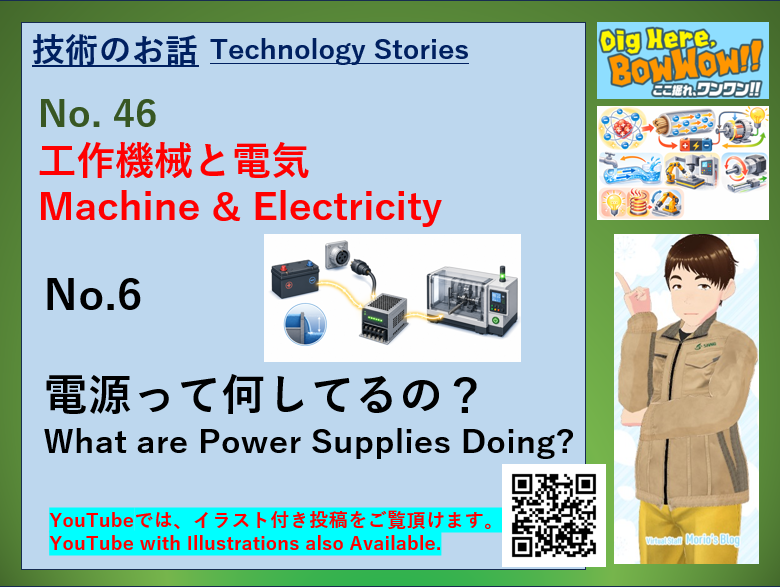
工作機械と電気 No.6 電源って何してるの?
わかば:
やっほー!わかばだよ!
前回は「電池」の話だったよね。
亜鉛が電子を出して、その電子が流れるってやつ!
今回のテーマは、電源だけど、どう違うの?
もりお:
電池も電源のひとつなんだけど、
電源はもっと広い意味なんだ。
わかば:
広い意味?
コンセントも電源って言うよね?
もりお:
うん。
電池、コンセント、機械の制御盤の中にある装置。
電気を使えるようにする元になるものを、ざっくり「電源」って呼ぶんだ。
わかば:
なるほど!
電気のスタート地点みたいな感じ?
もりお:
そうそう。
電気を動かすスタート地点。
もう少し言うと、電子を動かすための「押す力」を作るところだね。
わかば:
押す力?
プラスとマイナスがあれば、電子って勝手に流れるんじゃないの?
もりお:
いいところに気づいたね。
プラスとマイナスの差があって、さらに電気の通り道がつながると、電子は流れようとするんだ。
電子が動きたくなるような「差」を作ってあげる役目が電源なんだよ。
この「差」がすごく大切。
わかば:
道がつながると流れるんだ。
電子にも「行き先」がいるんだね。
でも、「差」がちょっと難しいな。もっと教えてよ。
もりお:
電気の世界でいうと、電位の差。
いきなり言うとハードル高いよね。
水で考えてみよう。
高いところにある水は、低いところへ流れるよね。
わかば:
うんうん。
山の上から川が流れる感じ!
もりお:
それと似ていて、電気も「高いところ」と「低いところ」の差があると流れやすくなる。
電源は、その差を作っているんだ。
電子が動くための高さの差を作る装置、ってイメージだね。
わかば:
じゃあ、電池は小さな山を作ってるの?
もりお:
そう。
電池の中では化学反応で、その差を作っている。
前回の亜鉛みたいに、電子を出しやすい材料の性質を使っているんだ。
わかば:
そうだった、そうだった!
じゃあコンセントは?
もりお:
コンセントは、発電所や送電のしくみとつながっている。
家や工場まで、電気を使える状態で届けてくれているんだ。
わかば:
スケールでかっ!
電池は手のひらサイズ、コンセントは社会全体って感じだね。
工作機械はどうなってるの?
コンセントにつなぐけど、
中にも電源装置や電池が使われてるよね。
もりお:
おっ、なかなかよく見てるね。
工作機械って、いろんなものが電気で動いてるよね。
サーボモーター、制御装置、センサー、操作画面。
こういうものは全部、電気がないと動かない。
わかば:
電気って、機械の血液みたいだね。
もりお:
うん。
そして電源は、血液を送り出す心臓みたいな存在とも言えるね。
わかば:
なるほど!
じゃあ電源ボタンを押すって、心臓を動かすスイッチみたいな感じ?
もりお:
イメージとしては近いね。
ただし工作機械では、電源を入れたあと、すぐ全部が動くわけじゃない。
わかば:
え、そうなの?
スイッチオン!はい動いた!じゃないの?
もりお:
そこがポイント。
機械には、安全確認や制御装置の立ち上がりがある。
電気が来て、制御装置が準備して、モーターが動ける状態になる。
わかば:
なるほど。
朝起きて、すぐ全力ダッシュできない感じ?
もりお:
まさにそれ。
目が覚めて、体を起こして、準備運動してから動く感じだね。
わかば:
機械も朝はぼーっとしてるんだ。
何か親近感感じるなぁ。
もりお:
ぼーっとはしてないけどね。
でも、順番に準備しているのは本当だよ。
わかば:
電源って、ただ電気を入れるだけじゃなくて、機械が安全に動く準備にも関係してるんだね。
もりお:
そう。
だから工作機械では、電源の入り方、切り方、非常停止、安全回路もすごく大事なんだ。
わかば:
安全回路って?
もりお:
危ない状態のときに、機械が勝手に動かないようにするしくみ。
たとえばカバーが開いていると動かない、とかね。
わかば:
それ、めっちゃ大事!
ばね加工機って、線材も工具も動くもんね。
使っている人がけがをしないようにしないとね。
もりお:
そう。
だから「正しく入れる」「正しく止める」が大切なんだ。
わかば:
じゃあ、電源って力の入口でもあり、安全の入口でもあるんだ。
もりお:
いいまとめだね。
電源は、機械を動かすための入口。
そして、安全に動かすための最初のステップでもある。
わかば:
ところで、さっき言ってた「差」ってやつ。
あれ、なんか気になる。
もりお:
そこが次回のテーマにつながるんだ。
電気を流そうとする差のことを「電圧」っていう。
わかば:
出た!電圧!
よく使うけど、何って説明しろって言われたら結構難しいよね。
もりお:
大丈夫。
次回は、電圧を水の高さや押す力のイメージで説明するよ。
わかば:
楽しみ!
じゃあ今回は、電源は電子を動かすための差を作るもの、って覚えたらいい?
もりお:
まずはそれでOK。
電源は、電気を使える状態にする元になるもの。
電子を動かすきっかけを作っているんだ。
わかば:
電池も、コンセントも、工作機械の中の電源装置も、ぜんぶ仲間なんだね。
もりお:
そうだね。
そして、このあと「電圧」「電流」「直流と交流」と進んでいくと、工作機械の電気がもっと見えてくるよ。
わかば:
おおー!
直流と交流って、なんか手強そう!
ま、いいや。
よーし、今回はここまで!
電源は、機械を動かすスタート地点!
そして、電子を動かすための差を作るもの!
今回は、工作機械に入った感があったね。
もりお:
うん。
次回は、その「差」の正体。
電圧について、やさしく掘っていこう。
※本ブログは、生成AIを活用して作成しています。
Machine & Electricity No.6 What are Power Supplies doing?
Wakaba:
Ciao, it’s Wakaba!
Last time, we talked about batteries, right?
You know, the part where zinc releases electrons, and those electrons start flowing!
This time, the theme is “power supplies,” but how are they different from batteries?
Morio:
A battery is one type of power supply,
but “power supply” has a much broader meaning.
Wakaba:
A broader meaning?
We also say an electrical outlet is a power supply, right?
Morio:
Right.
Batteries, electrical outlets, and devices inside a machine’s control panel.
The thing that acts as the source for making electricity usable is generally called a “power supply.”
Wakaba:
I see!
So it’s kind of like the starting point of electricity?
Morio:
Exactly.
It’s the starting point that gets electricity moving.
To put it another way, it creates the “pushing force” that moves electrons.
Wakaba:
Pushing force?
If there’s a plus and a minus, don’t electrons just flow on their own?
Morio:
Good point.
When there is a difference between plus and minus, and the path for electricity is connected, electrons try to flow.
The role of a power supply is to create that “difference” that makes electrons want to move.
This “difference” is really important.
Wakaba:
So they flow when the path is connected.
Electrons need a “destination,” too, huh?
But this “difference” thing is a little hard to understand. Tell me more.
Morio:
In the world of electricity, it’s called a difference in electric potential.
But that sounds pretty tough right away, doesn’t it?
So let’s think about water.
Water in a high place flows down to a lower place, right?
Wakaba:
Yeah, yeah.
Like a river flowing down from a mountain!
Morio:
Electricity is similar.
When there is a difference between a “high place” and a “low place,” electricity becomes easier to flow.
A power supply creates that difference.
You can imagine it as a device that creates a height difference so electrons can move.
Wakaba:
So, does a battery make a small mountain?
Morio:
Yes.
Inside a battery, chemical reactions create that difference.
Like we talked about last time with zinc, it uses the properties of materials that easily release electrons.
Wakaba:
Oh yeah, that’s right!
Then what about an electrical outlet?
Morio:
An electrical outlet is connected to the systems of power plants and power transmission.
It delivers electricity to homes and factories in a usable state.
Wakaba:
That’s huge!
A battery is palm-sized, but an outlet feels like it’s connected to society as a whole.
Then what about MACHINES?
They connect to an electrical outlet,
but there are power supply devices and batteries inside them too, right?
Morio:
Oh, you’re noticing some good details.
MACHINES have many parts that move with electricity.
Servo motors, control devices, sensors, operation screens.
All of these need electricity to work.
Wakaba:
Electricity is kind of like the blood of a machine.
Morio:
Yes.
And you could say the power supply is like the heart that sends that blood out.
Wakaba:
I get it!
So pressing the power button is kind of like switching on the heart?
Morio:
As an image, that’s pretty close.
But in MACHINES, even after turning on the power, not everything starts moving right away.
Wakaba:
Wait, really?
It’s not just, “Switch on! Okay, it’s moving!”?
Morio:
That’s the key point.
MACHINE has safety checks and control devices that need to start up.
Electricity comes in, the control devices get ready, and then the motors become ready to move.
Wakaba:
I see.
So it’s like waking up in the morning and not being able to sprint at full speed right away?
Morio:
Exactly.
It’s like waking up, getting your body up, warming up, and then moving.
Wakaba:
So machines are kind of groggy in the morning too.
That makes me feel close to them somehow.
Morio:
Well, they’re not exactly groggy.
But it’s true that they get ready step by step.
Wakaba:
So a power supply isn’t just about turning electricity on.
It’s also connected to preparing the machine to move safely.
Morio:
That’s right.
That’s why, in MACHINES, how to turn the power on, how to turn it off, emergency stops, and safety circuits are all really important.
Wakaba:
Safety circuits?
Morio:
They are systems that prevent the machine from moving on its own when something is dangerous.
For example, the machine won’t move when a cover is open.
Wakaba:
That’s super important!
In a spring-making machine, the wire and tools both move.
We have to make sure the person using it doesn’t get hurt.
Morio:
Exactly.
That’s why “turning it on correctly” and “stopping it correctly” are so important.
Wakaba:
So the power supply is both the entrance for power and the entrance for safety.
Morio:
That’s a great summary.
The power supply is the entrance that allows the machine to move.
And it’s also the first step in making the machine move safely.
Wakaba:
By the way, that “difference” you mentioned earlier.
I’m kind of curious about it.
Morio:
That connects to our next theme.
The difference that tries to make electricity flow is called “voltage.”
Wakaba:
There it is! Voltage!
We use that word a lot, but when someone asks what it means, it’s actually pretty hard to explain.
Morio:
Don’t worry.
Next time, we’ll explain voltage using images like water height and pushing force.
Wakaba:
Sounds fun!
So for today, is it okay to remember that a power supply creates the difference that moves electrons?
Morio:
Yes, that’s enough for now.
A power supply is the source that makes electricity usable.
It creates the trigger that gets electrons moving.
Wakaba:
So batteries, electrical outlets, and power supply devices inside MACHINES are all in the same family.
Morio:
That’s right.
And as we go on to “voltage,” “current,” and “direct current and alternating current,” the electricity inside MACHINES will start to make even more sense.
Wakaba:
Wow!
Direct current and alternating current sound kind of tough!
Well, whatever.
Okay, that’s it for today!
A power supply is the starting point that moves a machine!
And it creates the difference that makes electrons move!
This time, it felt like we really stepped into the world of MACHINES.
Morio:
Yes.
Next time, we’ll look at the true identity of that “difference.”
Let’s gently dig into voltage.
Note: This blog was created with the hepl of generative AI.