







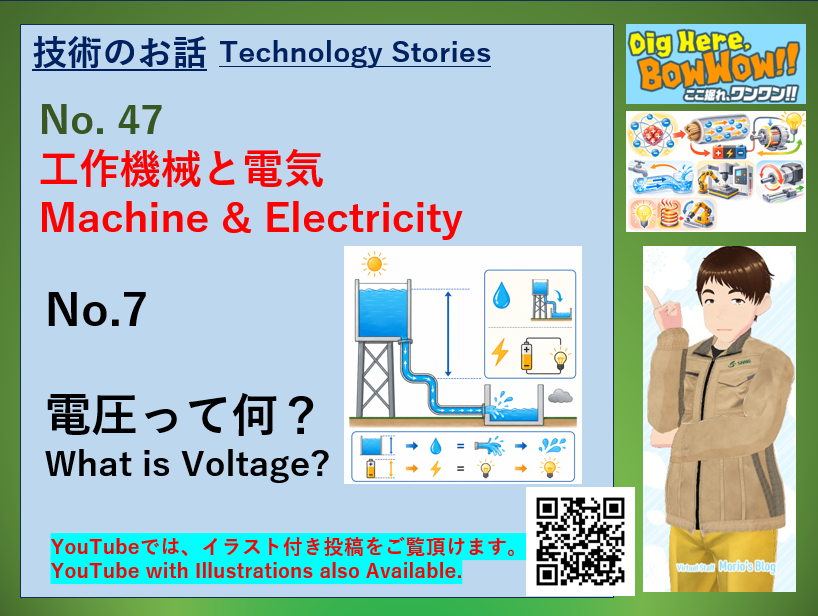
工作機械と電気 No.7 電圧って何?
わかば:
やっほー!わかばだよ!
今回のテーマは、電圧!
もりお:
前回は電池の話をしたよね。
電池の中で化学反応が起きて、プラス側とマイナス側に「差」ができる。
その差があるから、電気が流れようとするんだ。
わかば:
うんうん。
でも、その「差」っていうのが、まだちょっとフワッとしてる。
電圧って、結局なに?
もりお:
電圧は、ざっくり言うと、
「電気を流そうとする差」
のことだよ。
水で考えるとわかりやすいよ。
高いところにある水は、低いところへ流れようとするよね。
わかば:
そりゃそうだ。
もりお:
その「高い」と「低い」の差が大きいほど、
水は勢いよく流れようとする。
電気でも、それに近いことが起きるんだ。
わかば:
つまり、電圧は水の高低差みたいなもの?
もりお:
そう。
電圧は、電気の世界での「高低差」みたいなもの。
この差があるから、電気が流れようとする。
わかば:
じゃあ、24Vとか100Vとか200Vって、
その高低差の大きさが違うってこと?
もりお:
そういうイメージでOK。
24Vより100V、100Vより200Vのほうが、
電気を流そうとする差が大きい。
わかば:
でもさ、例えば、100Vと200Vって、どうやって生まれるの?
生み出す物質が違うってこと?
もりお:
物質が違うというより、
「どの線とどの線の間の差を使うか」
で変わることが多いんだ。
わかば:
線の選び方?
もりお:
そう。
たとえば家庭や小型設備で使われる単相3線式では、
真ん中の線を基準にして、片側との間を使うと100V。
両端どうしを使うと200Vになる。
わかば:
えっ、同じところから100Vも200Vも取り出せるの?
もりお:
そういう配線方式があるんだ。
水で言うと、中間地点から見ると100mの高低差。
上から下まで全部使うと200mの高低差、みたいな感じ。
わかば:
なるほど!
100Vと200Vは、使う高低差の範囲が違うんだね。
もりお:
そう。
ただし、うちの機械では、三相200Vという、モーターを回すのに向いた電源が使われてる。
だから200Vといっても、家庭用の200Vと工作機械の200Vでは、
使われ方や配線の考え方が違うこともあるんだ。
わかば:
なるほど!複雑だね。
100Vと200Vは、使う高低差ってことはわかったけど
実際はどうやって差を作ってるの?
もりお:
実際には、発電所から来た電気を変電所や変圧器で使いやすい電圧にして、
家庭や工場に届けている。
そのうえで、配線の取り出し方によって100Vや200Vを使い分けるんだ。
わかば:
変圧器って、電圧を変える装置だよね?
海外のお客様で電圧が違うから使ってるやつね。
もりお:
そう。
遠くへ電気を送るときは高い電圧で送り、
使う場所の近くで100Vや200Vに下げる。
高い電圧で運んで、近くで使いやすくするイメージだね。
わかば:
うちの機械は、200Vだよね?
もりお:
うん。
工作機械では、サーボモーター、インバータみたいに、
大きな力を出す機器に200V系の電源がよく使われる。
わかば:
うちは多軸制御もしてるから、モーターはたくさん使うよね。
もりお:
そう。
そういう動きにはモーターの力が必要になる。
200Vは、機械を効率よく安定して動かしやすいんだ。
わかば:
100Vじゃダメなの?
もりお:
同じ仕事をさせるなら、電圧が高いほうが、
流す電流を小さくしやすい。
電流が大きすぎると配線や機器への負担が増えるから、
大きな機械では200Vが使いやすいんだ。
わかば:
電流……。次回のテーマが登場したね。
もりお:
ここでは、200Vはパワー担当と覚えておけば大丈夫。
わかば:
じゃあ100Vは?
もりお:
100Vは、家庭用コンセントでおなじみだね。
照明、パソコン、モニター、充電器、小型機器なんかに使いやすい。
工作機械でも、補助機器で使うことがあるよ。
わかば:
そうだね。機械本体をガンガン動かすだけじゃないもんね。
もりお:
そして24Vは、工作機械の制御用によく使われる。
わかば:
制御用って、ボタンとかセンサーとか?
もりお:
そう。
操作ボタン、センサー、ランプ、リレー、PLCの入出力なんかだね。
PLCは、機械に指令を出す頭脳みたいな制御装置だよ。
わかば:
24Vは、どうやって作るの?
もりお:
多くの場合、機械に入ってきた200Vなどを、
制御盤の中の電源装置で24Vに変換して作る。
わかば:
外から入った電気を、機械の中で使いやすく変えるんだ。
サーボパックには個別に電池も付いてるよね。
もりお:
あれは多くの場合、3.6Vくらいの小さな電池で、
エンコーダの位置情報を保持するためのバックアップ用途だね。
エンコーダっていうのは、モーターの位置を読み取るセンサーみたいなものだよ。
わかば:
そう言えば、電池交換すると原点がどうのこうのとか言ってるね。
整理すると、こんな感じ?
200V:
工作機械の主電源としてよく使われる。
サーボモーター、インバータなど、力を出す機器向け。
100V:
小型機器や補助機器用。
照明、パソコン、モニター、充電器など。
24V:
制御用。センサー、スイッチ、ランプ、PLC入出力など。
制御盤の中で作られることが多い。
電池(3.6V):
位置情報のバックアップ用。
もりお:
完璧。
ただし、実際の機械では仕様によって違うから、
必ず図面や取扱説明書で確認することが大事だよ。
わかば:
わかった気になって制御盤を触るのは絶対ダメなやつだね。
もりお:
その通り。
電圧を知ることは、機械を安全に理解する第一歩。
でも電気作業は、必ず専門知識のある人が行う必要があるよ。
わかば:
ところで、さっき、電流の話が出たよね。
もりお:
電圧は「流そうとする差」。
でも、実際に流れるには通り道が必要なんだ。
わかば:
通り道って、回路?
もりお:
そう。
水も、高低差があっても水路がなければ流れない。
電気も、回路がつながって初めて流れる。
わかば:
そこで次回の「電流」につながるんだね。
もりお:
そう。
電圧は、流そうとする差。
電流は、実際に流れる電気の量。
次回はそこを見ていこう。
わかば:
さらにその先に、抵抗とか、直流と交流も出てくるんだよね?
もりお:
うん。
流れにくさを表す「抵抗」。
電気の流れ方の違いである「直流と交流」。
ここも工作機械には深く関係してくるよ。
わかば:
電池、電源、電圧、電流、抵抗、直流と交流。
だんだん電気の地図ができてきた感じ!
もりお:
今日のまとめに入ろうか。
わかば:
今日のまとめ!
電圧は、電気を流そうとする「差」。
水で言うと、高低差みたいなもの。
100Vと200Vは、使う線の組み合わせで生まれることがある。
工作機械では、200Vはパワー担当、100Vは補助担当、24Vは制御担当。
サーボパックの小さな電池は、位置情報のバックアップ用。
もりお:
そして、電圧があるだけでは電気は流れない。
回路がつながって、初めて電気が流れる。
その「流れ」が、次回のテーマ「電流」だね。
わかば:
よし!
次回は電流!
工作機械と電気、まだまだ続くよー!
※本ブログは、生成AIを活用して作成しています。
Machine & Electricity No.7 What is Voltage?
Wakaba:
Ciao, it’s Wakaba!
This time, our theme is voltage!
Morio:
Last time, we talked about batteries, right?
Inside a battery, a chemical reaction creates a “difference” between the positive side and the negative side.
Because that difference exists, electricity tries to flow.
Wakaba:
Right, right.
But that “difference” still feels a little vague to me.
So what exactly is voltage?
Morio:
To put it simply, voltage is
“the difference that tries to make electricity flow.”
It’s easier to understand if we think about water.
Water in a high place naturally tries to flow down to a lower place, right?
Wakaba:
Well, yeah. That makes sense.
Morio:
The bigger the difference between “high” and “low,”
the more strongly the water tries to flow.
Something similar happens with electricity.
Wakaba:
So voltage is kind of like the height difference of water?
Morio:
Exactly.
Voltage is like a “height difference” in the world of electricity.
Because that difference exists, electricity tries to flow.
Wakaba:
Then does that mean 24 V, 100 V, and 200 V are different sizes of that height difference?
Morio:
That’s the right image.
Compared with 24 V, 100 V has a larger difference.
And compared with 100 V, 200 V has an even larger difference that tries to make electricity flow.
Wakaba:
But, for example, how are 100 V and 200 V created?
Does it mean they’re made from different materials?
Morio:
It’s usually not about different materials.
In many cases, it depends on
“which two wires you use and the difference between them.”
Wakaba:
Choosing the wires?
Morio:
Yes.
For example, in a single-phase three-wire system used in homes and small facilities,
if you use the center wire as the reference and connect to one side, you get 100 V.
If you use the two outer wires, you get 200 V.
Wakaba:
Wait, so you can get both 100 V and 200 V from the same place?
Morio:
There is a wiring system that works that way.
Using water as an example, it’s like seeing a 100-meter height difference from the middle point,
but a 200-meter height difference if you use the entire distance from top to bottom.
Wakaba:
I see!
So 100 V and 200 V use different ranges of the height difference.
Morio:
Exactly.
However, in our machines, we use three-phase 200 V, which is suitable for rotating motors.
So even though both are called 200 V,
household 200 V and Machine 200 V can differ in how they are used and how the wiring is designed.
Wakaba:
I see! It’s kind of complicated.
I understand that 100 V and 200 V are about the height difference being used,
but how is that difference actually created?
Morio:
In practice, electricity from the power plant is adjusted to a usable voltage by substations and transformers,
then delivered to homes and factories.
After that, 100 V and 200 V are used differently depending on how the wiring is taken out.
Wakaba:
A transformer is a device that changes voltage, right?
It’s the thing we use when overseas customers have different voltages.
Morio:
That’s right.
When electricity is sent over long distances, it is transmitted at a high voltage.
Then, near the place where it will be used, it is stepped down to 100 V or 200 V.
The image is: carry it at a high voltage, then make it easier to use near the destination.
Wakaba:
Our machines use 200 V, right?
Morio:
Yes.
In Machines, 200 V-class power is often used for devices that produce large force,
such as servo motors and inverters.
Wakaba:
Our machines use multi-axis control, so we use a lot of motors, right?
Morio:
Exactly.
Those movements require motor power.
200 V makes it easier to operate the machine efficiently and stably.
Wakaba:
Why not 100 V?
Morio:
For the same amount of work, a higher voltage makes it easier to reduce the current.
If the current becomes too large, the load on wires and devices increases.
That’s why 200 V is more convenient for large machines.
Wakaba:
Current…
The next theme just showed up.
Morio:
For now, it’s enough to remember that 200 V is in charge of power.
Wakaba:
Then what about 100 V?
Morio:
100 V is familiar from household outlets.
It’s easy to use for lighting, PCs, monitors, chargers, and small devices.
In machine tools too, it may be used for auxiliary equipment.
Wakaba:
Right.
Machine isn’t only about driving the main body with lots of power.
Morio:
And 24 V is often used for control in machine tools.
Wakaba:
Control, like buttons and sensors?
Morio:
Exactly.
Things like operation buttons, sensors, lamps, relays, and PLC inputs and outputs.
A PLC is a control device, kind of like the brain that gives commands to the machine.
Wakaba:
How is 24 V created?
Morio:
In many cases, the 200 V or other power coming into the machine
is converted to 24 V by a power supply unit inside the control panel.
Wakaba:
So the electricity that comes in from outside is changed inside the machine into a form that’s easier to use.
Servo packs also have their own batteries, right?
Morio:
In many cases, those are small batteries of around 3.6 V,
used as backup power to retain the encoder’s position information.
An encoder is like a sensor that reads the position of the motor.
Wakaba:
Oh yeah, when the battery is replaced, our staff talk about the origin position and stuff like that.
So, can I organize it like this?
200 V:
Often used as the main power supply for machine tools.
For devices that produce force, such as servo motors and inverters.
100 V:
For small devices and auxiliary equipment.
Lighting, PCs, monitors, chargers, and so on.
24 V:
For control. Sensors, switches, lamps, PLC inputs and outputs, and so on.
Often created inside the control panel.
Battery, 3.6 V:
For backing up position information.
Morio:
Perfect.
However, actual specifications differ depending on the machine,
so it is important to always check the drawings and instruction manual.
Wakaba:
So it’s definitely not something where you think, “I kind of get it now,” and then touch the control panel.
Morio:
Exactly.
Understanding voltage is the first step toward understanding Machines safely.
But electrical work must always be done by people with proper technical knowledge.
Wakaba:
By the way, you mentioned current earlier.
Morio:
Voltage is the “difference that tries to make electricity flow.”
But for electricity to actually flow, it needs a path.
Wakaba:
A path?
You mean a circuit?
Morio:
Yes.
Even if water has a height difference, it won’t flow without a water channel.
Electricity also flows only when the circuit is connected.
Wakaba:
And that leads to the next theme, “current,” right?
Morio:
Exactly.
Voltage is the difference that tries to make electricity flow.
Current is the amount of electricity that actually flows.
Next time, we’ll look at that.
Wakaba:
And after that, resistance, direct current, and alternating current will come up too, right?
Morio:
Yes.
Resistance shows how difficult it is for electricity to flow.
Direct current and alternating current show different ways electricity flows.
These are also deeply connected to machine tools.
Wakaba:
Batteries, power supplies, voltage, current, resistance, direct current, and alternating current.
It feels like the map of electricity is gradually coming together!
Morio:
Let’s move into today’s summary.
Wakaba:
Today’s summary!
Voltage is the “difference” that tries to make electricity flow.
In terms of water, it’s like a height difference.
100 V and 200 V can be created by the combination of wires used.
In Machines, 200 V often handles power, 100 V handles auxiliary equipment, and 24 V handles control.
The small battery in a servo pack is used to back up position information.
Morio:
And voltage alone does not make electricity flow.
Electricity flows only when the circuit is connected.
That “flow” is the next theme: current.
Wakaba:
All right!
Next time, current!
“Machine & Electricity” will keep going!
Note: This blog was created with the hepl of generative AI.