












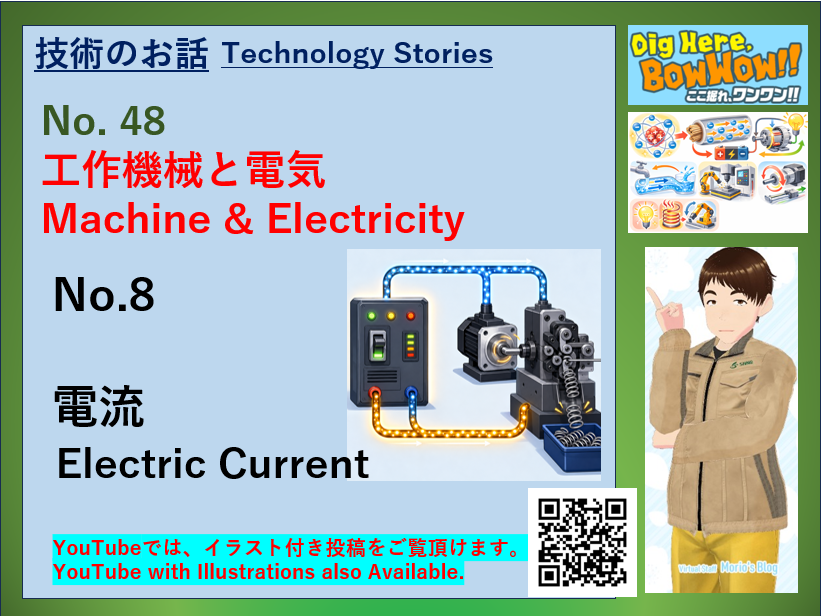
工作機械と電気 No.8 電流
わかば:
やっほー!わかばだよ!
「工作機械と電気」第8回!
今回のテーマは、電流!
もりお:
前回は「電圧」の話をしたよね。
電圧は、電気を流そうとする力。
水でいうと、高いところから低いところへ流れようとする“高低差”みたいなものだった。
わかば:
電圧は「押す力」って感じだったよね。
じゃあ、電流は?
もりお:
電流は、実際に流れている電気の量のことだよ。
わかば:
「流そうとする力」が電圧で、
「実際に流れている電気」が電流ってこと?
もりお:
そうそう。
電圧は、流れを生み出そうとする力。
電流は、その力を受けて、実際に流れて働いている電気なんだ。
わかば:
じゃあ、電圧があれば、電流は勝手に流れるの?
もりお:
そうとも限らない。
電圧があっても、流れる道がつながっていないと電流は流れないんだ。
わかば:
あー、ホースの蛇口を閉めてたら、水が出ないみたいな?
もりお:
まさにそれ。
電気も、回路がつながって、流れる道ができて、はじめて電流が流れるんだ。
わかば:
なるほど!
「電圧がある」だけじゃなくて、
「電流が流れる道がある」ことが必要なんだね。
もりお:
そういうこと。
だから、スイッチを入れるっていうのは、電気の流れる道をつなぐイメージでもあるんだ。
わかば:
なるほど。
じゃあ、電流が流れると、何が起こるの?
もりお:
いろいろ起こるよ。
ランプなら光る。
ヒーターなら熱が出る。
モーターなら回る。
つまり、電流が流れることで、電気が仕事をするんだ。
わかば:
働き者じゃん!
電気が実際に動いて、何かをしてる感じだね。
もりお:
うん。
工作機械でも、電流はめちゃくちゃ大事。
ばね加工機の中では、サーボモーターを動かすために電流が使われている。
わかば:
サーボモーターって、送り軸とか加工ユニット軸とかを動かしてるやつだよね?
もりお:
そう。
線材を送る。
ツールを動かす。
切断する。
ピッチを作る。
スピンドルを回す。
こういう動きの裏で、モーターに電流が流れているんだ。
わかば:
機械が動いているとき、見えないところで電流がせっせと働いてるんだね。
もりお:
そうなんだ。
しかも、ただ流れればいいわけじゃない。
必要なところに、必要な分だけ、安定して流れることが大事。
わかば:
必要な分だけ?
電流って、多ければ多いほどパワーがあるんじゃないの?
もりお:
たしかに、強い力が必要なときは、大きな電流が必要になることがある。
たとえば、重いものを動かすときや、強く押すときは、モーターにしっかり電流が流れる。
わかば:
じゃあ、ばね加工機でも、強い動きのときは電流が増えることがあるんだ。
もりお:
そうだね。
でも、電流は多ければいいってものじゃない。
流れすぎると、熱が出たり、部品に負担がかかったりするんだ。
わかば:
出た、危ないパターン!
電流が多すぎると、故障につながるの?
もりお:
うん。
配線や部品が熱くなったり、最悪の場合は焼損につながることもある。
だから、電流をきちんと管理することが大事なんだ。
わかば:
そこでブレーカーとかヒューズが出てくるんだね?
もりお:
その通り。
ブレーカーやヒューズは、電流が流れすぎたときに回路を守るための安全装置なんだ。
わかば:
なるほど。
電流は機械を動かす力だけど、流れすぎると危険でもあるんだ。
もりお:
そう。
それに、危ないのは機械だけじゃない。
人の体に電流が流れることを「感電」っていうんだ。
わかば:
それそれ、怖いやつだよね。
電圧が高いと危ないってイメージだけど、電流も関係あるの?
もりお:
関係あるよ。
人にとって本当に怖いのは、体の中を電流が流れること。
だから、濡れた手で触らない。
電源を切ってから作業する。
カバーを開けたまま不用意に触らない。
こういう基本がめちゃくちゃ大事なんだ。
わかば:
電流は、機械には必要だけど、人に流れたら絶対ダメってことだね。
電気って便利だけど、なめたらダメだね。
もりお:
うん。
便利だからこそ、正しく使って、危ない流れ方をさせないことが大事なんだ。
だから制御盤の中では、電源、ブレーカー、サーボアンプ、リレー、配線なんかが、それぞれ役割を持って電流を扱っている。
わかば:
そっか。うちの電装見てても、いろんな部品が入ってるもんね。
ところで、電流の単位は、アンペアだったよね?
もりお:
そう。電流の単位は「アンペア」。
記号では「A」と書くよ。
わかば:
家のブレーカーでも「30A」とか「40A」とか書いてあるよね?
もりお:
そうそう。
あれは、流せる電流の大きさを表しているんだ。
30Aなら、ざっくり言うと、30アンペアまで流せるよ、という目安だね。
わかば:
じゃあ、アンペアは「どれくらい電気が流れているか」を見る数字なんだ。
もりお:
そのイメージでOK。
たとえば、モーターや電源装置にも、何Aまで使えるか、何A流れるか、という表示がある。
電流の大きさを見ることで、その機器にどれくらい負担がかかっているかも考えやすくなるんだ。
わかば:
へぇー。
アンペアって、ただの数字じゃなくて、機械の状態を見るヒントにもなるんだね。
もりお:
うん。
ただし、ここでひとつ注意。
電圧が高ければ、いつも電流が多い、とは限らないんだ。
わかば:
えっ、そうなの?
押す力が強ければ、いっぱい流れそうだけど。
もりお:
同じ条件なら、電圧が高いほど電流は流れやすくなる。
でも、実際にどれだけ流れるかは、つながっている部品や、電気の通り道によって変わるんだ。
わかば:
つまり、電圧だけでは決まらないってこと?
もりお:
そう。
この「流れにくさ」の話は、また別の回でしっかり見ていこう。
今回はまず、電流は「実際に流れて働く電気」ってところを押さえよう。
わかば:
了解!
電圧は流そうとする力。
電流は実際に流れて働く電気。
単位はアンペア、A!
もりお:
ばっちり。
そして工作機械では、電流がモーターを動かし、機械の動きを支えている。
でも、必要以上に流れると危ない。
だから、必要な分を安定して流すことが大切なんだ。
わかば:
電流、かなり大事じゃん!
見えないけど、機械を動かす実働部隊って感じ!
もりお:
いい表現だね。
電流は、電気の世界の実働部隊。
でも、その流れ方にも種類があるんだ。
わかば:
流れ方?直流とか交流とかのこと?
電池の電気とコンセントの電気の違い?
もりお:
その通り。
一方向に流れる電気もあれば、向きが入れ替わりながら流れる電気もある。
そこで次回はその「直流と交流」について見ていこう。
わかば:
電圧、電流、そして次は流れ方!
電気の世界、ちょっとずつつながってきたかも!
※本ブログは生成AIを活用して作成しています。
Machine & Electricity No.8 Electric Current
Wakaba:
Ciao! It’s Wakaba!
This is No.8 “Machine nd Electricity”!
Today’s theme is Electric Current!
Morio:
Last time, we talked about voltage, right?
Voltage is the force that tries to make electricity flow.
If we compare it to water, it’s like the “height difference” that makes water flow from a high place to a low place.
Wakaba:
So voltage is kind of like a “pushing force,” right?
Then what is electric current?
Morio:
Electric current is the amount of electricity that is actually flowing.
Wakaba:
So voltage is “the force that tries to make electricity flow,”
and current is “the electricity that is actually flowing”?
Morio:
Exactly.
Voltage is the force that tries to create the flow.
Current is the electricity that actually flows and does work because of that force.
Wakaba:
Then if there is voltage, does current just flow automatically?
Morio:
Not always.
Even if there is voltage, current won’t flow unless there is a connected path for it to flow through.
Wakaba:
Oh, like water not coming out if the faucet on a hose is closed?
Morio:
Exactly.
Electricity is the same.
Current flows only when the circuit is connected and a path for electricity is created.
Wakaba:
I see!
So it’s not enough just to “have voltage.”
You also need “a path for current to flow.”
Morio:
That’s right.
So turning on a switch is kind of like connecting a path for electricity to flow.
Wakaba:
Got it.
Then what happens when current flows?
Morio:
A lot of things can happen.
A lamp lights up.
A heater produces heat.
A motor rotates.
In other words, electricity does work when current flows.
Wakaba:
So current is really a hard worker!
It feels like electricity is actually moving and doing something.
Morio:
Yes.
Current is super important in Machines, too.
Inside a spring machine, current is used to run servo motors.
Wakaba:
Servo motors are the ones that move the feed axis and the processing unit axes, right?
Morio:
Right.
They feed wire.
They move tools.
They cut wire.
They create pitch.
They rotate spindles.
Behind all these movements, current is flowing into the motors.
Wakaba:
So when Machine is moving, current is quietly working hard behind the scenes.
Morio:
Exactly.
And it’s not just about having current flow.
It’s important for the right amount of current to flow stably to the right place.
Wakaba:
The right amount?
Isn’t more current always more powerful?
Morio:
It’s true that when strong force is needed, a larger current may be necessary.
For example, when moving something heavy or pushing strongly, a solid amount of current flows into the motor.
Wakaba:
So in a spring machine, current may increase during strong movements.
Morio:
That’s right.
But current is not something where more is always better.
If too much current flows, heat can be generated, and parts can be put under stress.
Wakaba:
Here comes the dangerous part!
Can too much current lead to failure?
Morio:
Yes.
Wiring and components can become hot, and in the worst case, they can burn out.
That’s why it’s important to manage current properly.
Wakaba:
So that’s where breakers and fuses come in, right?
Morio:
Exactly.
Breakers and fuses are safety devices that protect the circuit when too much current flows.
Wakaba:
I see.
Current is the power that moves the machine, but too much of it can also be dangerous.
Morio:
Right.
And machines are not the only thing at risk.
When current flows through the human body, it’s called an electric shock.
Wakaba:
Yeah, that’s the scary one.
I always thought high voltage was dangerous, but does current matter too?
Morio:
It does.
What is really dangerous for people is current flowing through the body.
So don’t touch electrical parts with wet hands.
Turn off the power before working.
Don’t carelessly touch inside the machine while the cover is open.
These basics are super important.
Wakaba:
So current is necessary for machines, but it must never flow through people.
Electricity is useful, but we definitely shouldn’t take it lightly.
Morio:
Exactly.
Because electricity is useful, we need to use it properly and prevent dangerous current flow.
That’s why, inside a control panel, components like power supplies, breakers, servo amplifiers, relays, and wiring each have their own role in handling current.
Wakaba:
I see. When I look at our electrical equipment, there really are many different parts inside.
By the way, the unit for current is ampere, right?
Morio:
Yes. The unit for electric current is “ampere.”
It is written with the symbol “A.”
Wakaba:
You see things like “30A” or “40A” on home breakers, right?
Morio:
Exactly.
That shows the amount of current that can flow.
Roughly speaking, 30A means it can handle up to 30 amperes.
Wakaba:
So ampere is the number that shows “how much electricity is flowing.”
Morio:
That’s a good way to think about it.
For example, motors and power supply devices also have ratings showing how many amperes they can use or how much current flows.
By looking at the size of the current, it becomes easier to think about how much load is being placed on the equipment.
Wakaba:
Wow.
So amperes are not just numbers.
They can also be clues for understanding the condition of a machine.
Morio:
Yes.
But here’s one important point.
Higher voltage does not always mean more current.
Wakaba:
Really?
If the pushing force is stronger, it feels like more electricity would flow.
Morio:
Under the same conditions, higher voltage makes current flow more easily.
But how much current actually flows depends on the connected components and the path the electricity takes.
Wakaba:
So current is not decided by voltage alone?
Morio:
Exactly.
We’ll take a closer look at this idea of “how easily electricity flows” in another episode.
For now, let’s remember that current is “electricity that actually flows and does work.”
Wakaba:
Got it!
Voltage is the force that tries to make electricity flow.
Current is the electricity that actually flows and does work.
And the unit is ampere, A!
Morio:
Perfect.
In machine tools, current moves the motors and supports the machine’s motion.
But if more current flows than necessary, it can be dangerous.
That’s why it’s important to let the right amount of current flow stably.
Wakaba:
Current is really important!
We can’t see it, but it feels like the real working force behind the machine!
Morio:
That’s a great way to put it.
Current is the working force in the world of electricity.
But there are also different ways that current can flow.
Wakaba:
Different ways?
You mean direct current and alternating current?
Like the difference between electricity from a battery and electricity from an outlet?
Morio:
Exactly.
Some electricity flows in one direction, while some electricity changes direction back and forth.
So next time, let’s look at “direct current and alternating current.”
Wakaba:
Voltage, current, and next, the way electricity flows!
I feel like the world of electricity is starting to connect little by little!
Note: This blog was created with the hepl of generative AI.