









工作機械と電気 No.16 電気が仕事をするってどういうこと?
わかば:
やっほー、わかばです♪
今回のテーマは、「電気が仕事をするってどういうこと?」だね。
もりお:
これまで電圧、電流、抵抗、オームの法則なんかを勉強してきたよね。
今回は、電気の仕事について見ていこう!
わかば:
「電気が仕事をする」って、
物を動かしたり、光らせたり、発熱させたりってことだよね。
もりお:
そうそう。
例えば工作機械では、
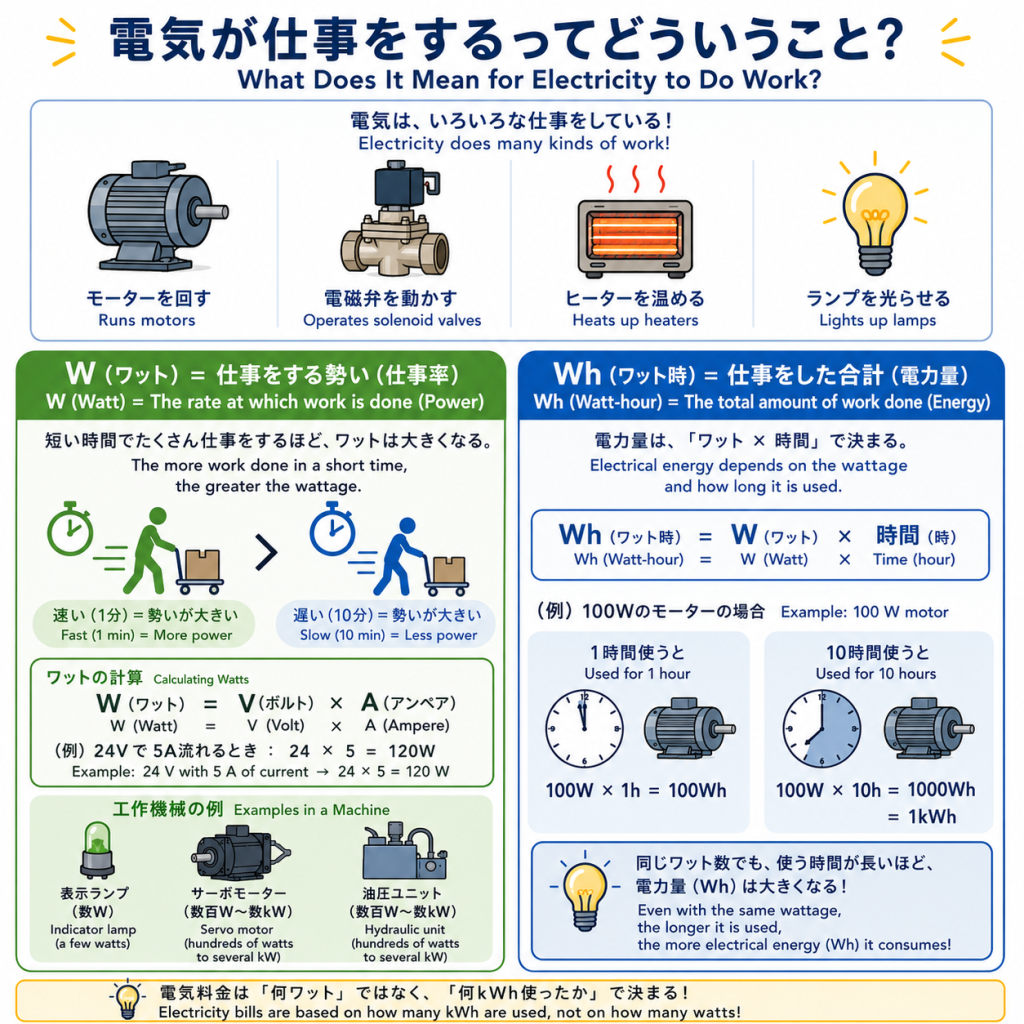
・モーターを回す
・電磁弁(電気で動くバルブ)を動かす
・ヒーターを温める
・ランプを光らせる
全部、電気が仕事をした結果なんだ。
わかば:
働き者だよね。
でも、その仕事の大きさって、どうやってわかるの?
もりお:
いい質問。そこで出てくるのが、
「ワット(W)」だよ。
わかば:
ワット君って、寅さんの20作目に出てくる中村雅俊が演じてた青年のことでしょ。
わたしは大好きだけど、マニアック過ぎて、今の若い人は絶対わからないよ。
もりお:
「男はつらいよ 寅次郎頑張れ!」だね。
平戸が舞台のやつ。
わかば:
わたしも行ったなあ。ほらっ、土産物屋さんとかあって・・・
もりお:
違うよ!
ワットは、
電気がどれくらいの勢いで仕事をしているかを表す単位なんだ。
わかば:
勢い?
もりお:
専門的には、仕事率っていうんだけど、
例えば同じ荷物を運ぶとき、
1分で運ぶ人と、10分かかる人では、
仕事の速さが違うよね。
電気も同じ。
短い時間でたくさん仕事をするほど、
ワットは大きくなるんだ。
わかば:
なるほど!
100Wは、
50Wより頑張ってるってことだ!
もりお:
そういうイメージでOK!
わかば:
前に電圧と電流を勉強したけど、
ワットとも関係あるの?
もりお:
もちろん!
ワットは、
電圧(V)×電流(A)
で求められるんだ。
例えば、
24Vで5A流れていたら、
24×5で120Wになる。
わかば:
計算は意外とシンプルだね!
電圧や電流が大きくなると、
同じ時間でできる仕事が大きくなるんだね!
もりお:
その通り!
工作機械では、
小さな表示ランプは数ワット、
サーボモーターや油圧ユニットは、
何百ワット、
場合によっては数キロワットになることもある。
わかば:
ワットは分かった!
でも、
電気料金を見ると、
「kWh」って書いてあるよね?
あれは何なの?
毎月支払い大変なんだけど。
もりお:
「kWh(キロワットアワー(時))」だね。
そこが今日のもう一つのポイント!
ワットは
「仕事をする勢い」。
でも、勢いだけでは、
実際にどれだけ働いたかは分からないよね。
わかば:
確かに!
100Wでも、
1秒しか動かないのと、
1時間動くのでは全然違う!
もりお:
その通り!
さっき、同じ時間なら、
ワットが大きいほど、仕事も大きいってことだったけど、
時間も計算して、仕事をした合計を表すのが「電力量」。
その単位が、Wh(ワットアワー(時))なんだ。
わかば:
「時」が付くんだね!
もりお:
例えば、
100Wのモーターを
1時間動かすと、
100Wh。
10時間動かすと、
1000Wh、つまり1kWh(1キロワット時)だね。
わかば:
そいつかぁ、毎月私を苦しめる奴は!
もりお:
そう!
家庭でも工場でも、
電気料金は、
何ワットだったかじゃなく、
何kWh使ったか
で計算されているんだ。
わかば:
なるほど!
仕事をする勢いじゃなくて、
どれだけ仕事をしたかを見てるんだね!
もりお:
その通り!
例えば工作機械でも、
500Wのモーターでも、
加工するときだけ動けば、
電力量はそれほど多くない。
でも、
100Wの小さなモーターでも、
一日中回り続ければ、
意外とたくさん電気を使うこともある。
わかば:
そりゃそうだね。
ワットが大きいだけじゃなくて、
動いている時間も大事なんだ!
もりお:
そうなんだ。
だから、W(ワット)は「仕事をする勢い」。
Wh(ワット時)は「仕事をした合計」。
この2つを覚えておけば、
工作機械の仕様や電気料金も、
ぐっと分かりやすくなるよ。
わかば:
今日はすごくスッキリした!
電気はただ流れてるんじゃなくて、
機械を動かすために働いていて、
その勢いがワット、
働いた合計がワット時なんだね!
もりお:
その理解でバッチリ!
これから工作機械を見るときも、
「このモーターはどれくらいの勢いで仕事をしているんだろう?」
って考えると、
電気がもっと身近に感じられるよ!
わかば:
よーし!
私も工作機械の中で働く電気に注目してみる!
もりお:
ちなみに工作機械に使っている部品の銘板を見ると、
モーターの出力(WやkW)が書かれていることが多いよ。
今度見つけたら、
「この数字が仕事をする勢いなんだな」
って思い出してみてね。
※このブログは、生成AIを活用して作成しています。
Machine & Electricity No. 16 Electricity Works?
Wakaba:
Ciao, it’s Wakaba!
Today’s topic is, “Electricity works?”
Morio:
So far, we’ve learned about voltage, current, resistance, Ohm’s law, and more.
Today, let’s take a look at the work electricity does!
Wakaba:
When we say that electricity “does work,”
we mean that it moves things, produces light, or generates heat, right?
Morio:
Exactly.
For example, in a Machine, electricity:
・Runs motors
・Operates solenoid valves—valves controlled by electricity
・Heats up heaters
・Lights up lamps
All of these happen because electricity is doing work.
Wakaba:
Electricity sure is a hard worker!
But how can we tell how much work it can do?
Morio:
Good question.
That’s where the watt, or W, comes in.
A watt is a unit that shows how powerfully electricity is doing work.
Wakaba:
Powerfully?
Morio:
The technical term is “power,”
which means the rate at which work is done.
Imagine two people carrying the same load.
If one person carries it in one minute and the other takes ten minutes,
they’re doing the work at different rates, right?
Electricity is the same.
The more work it does in a short amount of time,
the greater the wattage.
Wakaba:
I see!
So 100 W is working harder than 50 W!
Morio:
That’s a good way to picture it!
Wakaba:
We learned about voltage and current before.
Are they related to watts too?
Morio:
Of course!
Watts can be calculated as:
Voltage (V) × Current (A)
For example,
if 5 A of current flows at 24 V:
24 × 5 = 120 W.
Wakaba:
The calculation is surprisingly simple!
So when the voltage or current increases,
more work can be done in the same amount of time!
Morio:
Exactly!
In a Machine,
a small indicator lamp may use only a few watts.
Servo motors and hydraulic units,
on the other hand,
may use hundreds of watts
or even several kilowatts.
Wakaba:
Okay, I understand watts now!
But when I look at my electricity bill,
I see “kWh.”
What does that mean?
Paying that bill every month is tough, you know.
Morio:
That’s kilowatt-hour, or kWh.
And that’s today’s other important point!
Watts show
how powerfully electricity is doing work.
But power alone doesn’t tell us
how much work was done in total.
Wakaba:
That’s true!
Even if something uses 100 W,
running it for only one second
is completely different from running it for one hour!
Morio:
Exactly!
We just learned that,
over the same amount of time,
a higher wattage means more work is done.
When we also include how long the equipment operates,
we can calculate the total amount of electrical energy used.
This is called electrical energy,
and its unit is the watt-hour, or Wh.
Wakaba:
So that’s why it has “hour” in the name!
Morio:
For example,
if a 100 W motor runs for one hour,
it uses 100 Wh.
If it runs for ten hours,
it uses 1,000 Wh.
That is the same as 1 kWh,
or one kilowatt-hour.
Wakaba:
So that’s the culprit that makes me suffer every month!
Morio:
That’s right!
In both homes and factories,
electricity charges are calculated
not by how many watts the equipment is rated for,
but by how many kilowatt-hours are used.
Wakaba:
I see!
So the electricity bill isn’t based only on
how powerfully electricity is working.
It’s based on the total amount of work it has done!
Morio:
Exactly!
For example, in a Machine,
even a 500 W motor may not use much electrical energy
if it operates only during processing.
On the other hand,
even a small 100 W motor
may use a surprising amount of electricity
if it keeps running all day.
Wakaba:
That makes sense.
It’s not just the wattage that matters.
The amount of time it runs is important too!
Morio:
Exactly.
So remember:
W, or watts,
shows the rate at which electricity does work.
Wh, or watt-hours,
shows the total amount of electrical energy used.
If you remember these two,
the specifications of a Machine
and your electricity bill
will both become much easier to understand.
Wakaba:
Everything makes much more sense now!
Electricity doesn’t just flow.
It works to make a Machine operate.
Watts show how powerfully it works,
and watt-hours show the total amount of work it has done!
Morio:
That’s exactly right!
The next time you look at a Machine,
try asking yourself:
“How powerfully is this motor working?”
Thinking that way will make electricity
feel much more familiar.
Wakaba:
All right!
I’m going to pay more attention
to the electricity working inside a Machine!
Morio:
By the way,
if you look at the nameplates on components used in a Machine,
you’ll often find the motor output shown in W or kW.
The next time you see one,
remember:
“This number shows how powerfully it can do work.”
Note:This blog is created with the help of generative AI.