










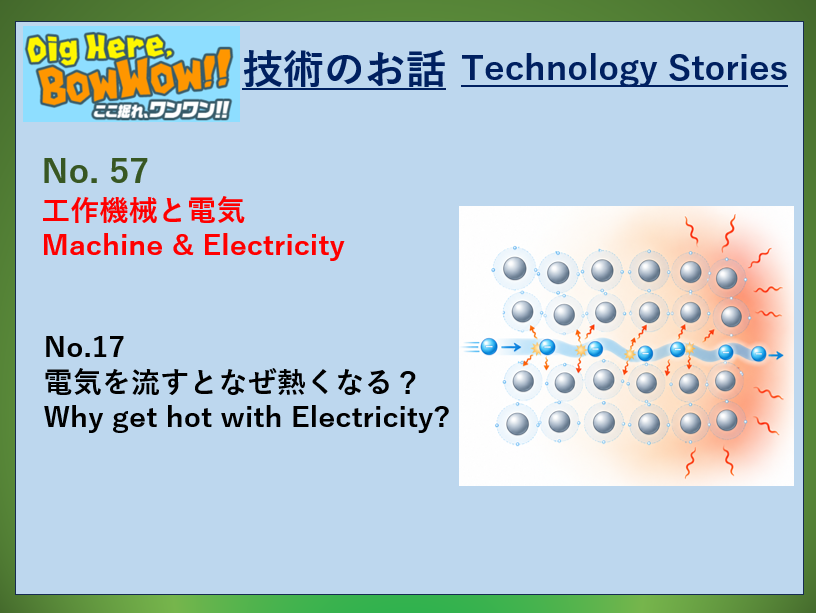
工作機械と電気 No.17 電気を流すとなぜ熱くなる?
わかば:
やっほー、わかばです♪
今回は、「電気を流すとなぜ熱くなる?」だね。
もりお:
そう!
前回は、電気がモーターを回したり、光らせたり、熱を出したりして、
いろいろな仕事をしているって話をしたよね。
今回は、その中の「熱」について見ていこう!
わかば:
電気で熱くなるっていうと、
ヒーターとかドライヤーとか?
もりお:
そうそう。
でも、熱くなるのはヒーターだけじゃないよ。
電線やモーター、スマホなんかも、
電気を使うと熱くなるよね。
わかば:
確かに!
スマホも使ってると、
「あれっ、熱っ!」ってなることある!
でも、なんで電気を流すと熱くなるの?
もりお:
ポイントは、
前に勉強した「抵抗」なんだ。
わかば:
電気の流れにくさを表すものだったよね。
もりお:
その通り!
金属の中では、
電気を運ぶ電子が動いている。
でも、電子は何にも邪魔されずに
スイスイ進んでいるわけじゃないんだ。
わかば:
えっ?
でも原子って、
実は中身がスカスカなんじゃなかった?
だったら電子も、
その隙間をスイスイ通れそうだけど。
もりお:
いいところに気付いたね!
確かに原子は、
中心に小さな原子核があって、
その周りに電子が存在している。
大きさだけで考えると、
かなり空間が多いんだ。
わかば:
ほら、そこを通ればいいじゃん!
もりお:
そう単純じゃないんだ。
空間があるからといって、
電子が何の影響も受けずに、
自由に通り抜けられるわけじゃない。
金属の中を電子が動くときには、
原子の並びや、その振動なんかの影響を受けるんだ。
わかば:
電子にも、いろいろ邪魔が入るんだ。
もりお:
そう。
その影響を受けながら電子が進むと、
電気のエネルギーの一部が、
熱のエネルギーに変わる。
これが、「ジュール熱」なんだ。
わかば:
なるほど。
電気が流れるときに、
エネルギーの一部が熱に変わるんだね。
ジュール熱かぁ……。難しそう。
Hey Joule, don’t make me cry♪
もりお:
……それ、何かに似てない?
ま、いいや。
どれくらい熱が出るかには、
「抵抗」と「電流」が大きく関係しているんだ。
わかば:
おっ、またまた電流と抵抗の登場。
今まで勉強したことが、
だんだんつながってきたね!
もりお:
ジュール熱は、
電流の大きさ、抵抗、
それに電気を流した時間に関係するんだ。
特に大事なのが電流。
発熱の勢いは、簡単に言えば
電流 × 電流 × 抵抗
に関係する。
わかば:
電流を2回掛けるの?
もりお:
そう。
同じ抵抗なら、電流が2倍になると、
発生する熱は4倍になる。
わかば:
4倍!?
2倍じゃないんだ!
もりお:
そこが大事!
だから大きな電流を流すところでは、
発熱に十分注意しないといけないんだ。
わかば:
ちょっと待って!
だったら逆に、
抵抗や流す電流をうまく調整したら、
必要な熱を狙って出せるってこと?
もりお:
おっ、鋭いね!
まさにヒーターなんかは、
その性質を利用しているんだ。
わかば:
わざと熱を出してるんだ!
もりお:
そう!
例えば電気ヒーターでは、
ニクロム線など、
電気を流すと適度に発熱する材料を使う。
材料や線の太さ、長さ、
流す電流などを考えて、
必要な熱が出るように設計しているんだ。
わかば:
へぇー!
抵抗って、
今までは電気の邪魔者みたいに思ってたけど、
役に立つこともあるんだ!
もりお:
そうなんだ。
電気ヒーターやトースターなら、
熱を出すこと自体が仕事。
でも、電線やモーターでは、
熱はできるだけ減らしたいことが多い。
わかば:
同じジュール熱でも、
「欲しい熱」と「困る熱」
があるんだね!
もりお:
その通り!
わかば:
じゃあさ、
スマホが熱くなるのはどうなの?
スマホは別に熱は必要ないんだから、
やっぱり故障の前兆?
もりお:
熱くなったからといって、
すぐに故障とは限らないよ。
スマホの中でも、
CPUやバッテリー、充電回路なんかで、
電気エネルギーの一部が熱になる。
わかば:
スマホが熱くなるのは、ジュール熱が犯人なんだね?
もりお:
細かく見ると、ジュール熱以外にも、
熱が出る仕組みはいろいろあるんだ。
でも今は、電気を使うと、
そのエネルギーの一部が熱になることがある、
くらいに覚えておけばOK!
スマホでいうと、たくさん処理をしたり、
充電したりしているときに、
ある程度温かくなるのは珍しくないよ。
大切なのは、「熱が出たかどうか」だけじゃなく、
「いつもと違う熱の出方をしていないか」
なんだ。
わかば:
いつもと違う?
もりお:
例えば、
何もしていないのに異常に熱い。
以前より明らかに熱くなる。
充電中に極端に熱くなる。
そんなときは、
何か異常が起きている可能性もあるよ。
わかば:
なるほど!
熱が出る=故障、
じゃないんだね。
もりお:
そう!
これは工作機械でも同じなんだ。
わかば:
そうそう、これは工作機械と電気の話だった!
もりお:
例えば、
モーターや電線、
制御盤の中の部品。
ある程度熱を持つこと自体は、
必ずしも異常じゃない。
でも、
「いつもより熱い」
「一部分だけ異常に熱い」
という場合は、注意が必要なんだ。
わかば:
一部分だけ熱くなるって、
どういうとき?
もりお:
例えば、
電線をつないでいる端子が緩んだり、
接触が悪くなったりすると、
その部分の抵抗が大きくなることがある。
すると、
そこだけ発熱が大きくなることがあるんだ。
わかば:
怖っ!
「ちょっと緩んでるだけ」
じゃ済まないこともあるんだね。
もりお:
そうなんだ。
だから工作機械では、
「ちゃんと動いているからOK!」
だけじゃなくて、
「いつもと違う熱の出方をしていないかな?」
という視点も大切なんだ。
わかば:
なるほど!
今日の話をまとめると、
電気を流す
↓
電子が金属の中を動く
↓
原子の並びや振動などの影響を受ける
↓
電気エネルギーの一部が熱に変わる
これがジュール熱ってことだね!
もりお:
バッチリ!
そして、
ヒーターでは、
その熱をわざと利用する。
電線やモーターでは、
できるだけ減らしたい熱になることが多い。
さらに、
電流が大きくなるほど、
発熱もグンと大きくなる。
わかば:
だから、
電線の太さや、
接続部分も大事なんだ!
もりお:
その通り!
そして今日、
もう一つ覚えておいてほしいのは、
「熱が出ること=異常」
ではないってこと。
大切なのは、
「いつもと違う熱の出方をしていないか?」
なんだ。
わかば:
なるほど!
電気って見えないけど、
熱を見ると、
どこでエネルギーが使われているのか、
ちょっと見えてくる気がする!
もりお:
いいところまで来たね!
工作機械を見るときも、
「ここ、なんで熱くなるんだろう?」
って考えてみると、
電気のことがもっと分かってくるよ。
わかば:
よーし!
今度は機械の「熱」にも注目してみる!
※このブログは、生成AIを活用して作成しています。
Machine & Electricity No. 17 Why do things get hot when electricity flows through them?
Wakaba:
Ciao, it’s Wakaba!
Today’s topic is, “Why do things get hot when electricity flows through them?”
Morio:
That’s right!
Last time, we talked about how electricity does all kinds of work—running motors,
producing light, generating heat, and more.
Today, let’s focus on “heat”!
Wakaba:
When I think about electricity producing heat,
things like heaters and hair dryers come to mind.
Morio:
Exactly.
But heaters aren’t the only things that get hot.
Wires, motors, and even smartphones can get warm
when they use electricity.
Wakaba:
That’s true!
Sometimes I’m using my smartphone and suddenly think,
“Whoa, that’s hot!”
But why does electricity make things hot?
Morio:
The key is something we learned about before:
“resistance.”
Wakaba:
That’s what tells us how difficult it is for electricity to flow, right?
Morio:
Exactly!
Inside a metal,
electrons that carry electricity are moving around.
But they don’t just move along smoothly
without anything getting in their way.
Wakaba:
Huh?
But aren’t atoms actually mostly empty space?
If so, couldn’t the electrons just zip through all that empty space?
Morio:
Good question!
It’s true that an atom has a tiny nucleus at its center,
with electrons around it.
In terms of size,
there really is a lot of empty space.
Wakaba:
See!
Then just go through there!
Morio:
It’s not quite that simple.
Just because there’s empty space
doesn’t mean electrons can pass through freely
without being affected by anything.
When electrons move through a metal,
they’re affected by things like
the arrangement and vibrations of the atoms.
Wakaba:
So even electrons have things getting in their way.
Morio:
Exactly.
As electrons move while being affected in this way,
some of the electrical energy
is converted into heat energy.
This is called “Joule heating.”
Wakaba:
I see.
So when electricity flows,
some of its energy is converted into heat.
Joule heating, huh… Sounds difficult.
“Hey Joule, don’t make me cry♪”
Morio:
…Doesn’t that sound a little familiar?
Anyway,
the amount of heat produced
is strongly related to two things:
“resistance” and “current.”
Wakaba:
Oh, here come current and resistance again!
All the things we’ve learned so far
are starting to connect!
Morio:
Joule heating depends on
the amount of current,
the resistance,
and how long the current flows.
Current is especially important.
Simply put, the rate of heat generation is related to:
Current × Current × Resistance
Wakaba:
You multiply the current twice?
Morio:
That’s right.
If the resistance stays the same
and the current doubles,
the heat generated becomes four times greater.
Wakaba:
Four times!?
Not just twice as much!?
Morio:
Exactly!
And that’s an important point.
That’s why we have to pay close attention to heat
wherever large currents are flowing.
Wakaba:
Wait a minute!
Then, if we control the resistance
and the amount of current,
can we produce just the amount of heat we need?
Morio:
Oh, sharp thinking!
That’s exactly the principle
used in things like electric heaters.
Wakaba:
So they produce heat on purpose!
Morio:
Exactly!
Electric heaters, for example,
use materials such as nichrome wire
that generate a suitable amount of heat
when electricity flows through them.
The material, wire thickness, wire length,
and amount of current are all considered
so that the required amount of heat is produced.
Wakaba:
Wow!
Until now,
I thought resistance was just something
that got in the way of electricity.
But it can actually be useful!
Morio:
That’s right.
With an electric heater or toaster,
producing heat is the job itself.
But with wires and motors,
heat is usually something
we want to reduce as much as possible.
Wakaba:
So even with the same Joule heating,
there’s “heat we want”
and “heat we don’t want”!
Morio:
Exactly!
Wakaba:
Then what about smartphones getting hot?
Smartphones don’t need heat,
so does that mean it’s a sign they’re about to break?
Morio:
Not necessarily.
Just because a smartphone gets hot
doesn’t mean it’s about to fail.
Inside a smartphone,
some of the electrical energy is converted into heat
in components such as the CPU,
battery, and charging circuits.
Wakaba:
So Joule heating is the culprit
when my smartphone gets hot?
Morio:
If we look more closely,
there are actually several different ways
heat can be generated,
not just Joule heating.
But for now,
it’s enough to remember that
when electricity is used,
some of its energy can become heat.
With a smartphone,
it’s not unusual for it to get somewhat warm
when it’s doing a lot of processing
or when it’s being charged.
What’s important isn’t simply
whether it gets hot.
It’s whether it’s getting hot
in a way that’s different from usual.
Wakaba:
Different from usual?
Morio:
For example:
It gets unusually hot even when you’re not doing anything.
It gets noticeably hotter than it used to.
It gets extremely hot while charging.
In cases like these,
there could be some kind of problem.
Wakaba:
I see!
So:
Heat = Failure
isn’t always true!
Morio:
Exactly!
And the same idea applies to a Machine.
Wakaba:
Oh, right!
This is supposed to be about Machines and electricity!
Morio:
Exactly!
Think about motors, wires,
and components inside a control panel.
The fact that they get somewhat warm
doesn’t necessarily mean something is wrong.
But if something is:
“Hotter than usual”
or
“Extremely hot in just one spot,”
then you need to pay attention.
Wakaba:
What would make just one spot get hot?
Morio:
For example,
if a terminal connecting wires becomes loose,
or if there’s poor electrical contact,
the resistance at that point can increase.
That can cause
a lot more heat to be generated
in that one spot.
Wakaba:
Scary!
So it might be more serious
than just saying,
“It’s only a little loose.”
Morio:
Exactly.
That’s why, with a Machine,
it’s not enough to think:
“It’s running, so everything must be OK!”
It’s also important to ask:
“Is anything getting hot in a way that’s different from usual?”
Wakaba:
I see!
So to sum up today’s lesson:
Electricity flows
↓
Electrons move through the metal
↓
They are affected by the arrangement and vibrations of atoms
↓
Some of the electrical energy is converted into heat
And that’s Joule heating!
Morio:
Perfect!
In a heater,
we intentionally make use of that heat.
But in wires and motors,
it’s often heat that we want to reduce
as much as possible.
And as the current increases,
the amount of heat generated
can increase dramatically.
Wakaba:
That’s why
the thickness of the wires
and the condition of the connections
are so important!
Morio:
Exactly!
And there’s one more thing
I want you to remember today.
“Heat = Something is wrong”
isn’t always true.
What really matters is asking:
“Is it getting hot in a way that’s different from usual?”
Wakaba:
I see!
We can’t see electricity itself,
but when we look at the heat it produces,
I feel like we can start to see
where the electrical energy is being used!
Morio:
Now you’re getting it!
When you look at a Machine,
try asking yourself:
“Why is this part getting hot?”
Thinking about it that way
will help you understand electricity even better.
Wakaba:
All right!
Next time I look at a Machine,
I’m going to pay more attention
to the “heat” too!
Note:This blog is created with the help of generative AI.