








工作機械と電気 No.18 電気でなぜ光る?
わかば:
やっほー、わかばです♪
前回は、電気が熱くなるしくみを勉強したよね。
ってことは、今回は「光」?
もりお:
そう。
今回は、電気がどうやって「光」になるのかを見ていこう。
わかば:
でも電気って見えないんだよね?
それなのに、スイッチを入れた瞬間に電球が光る。
よく考えたら不思議だね。
もりお:
そうだね。
ただ、「電気がそのまま光っている」わけじゃないんだ。
電気のエネルギーを別の形に変えることで、光を作っているんだよ。
わかば:
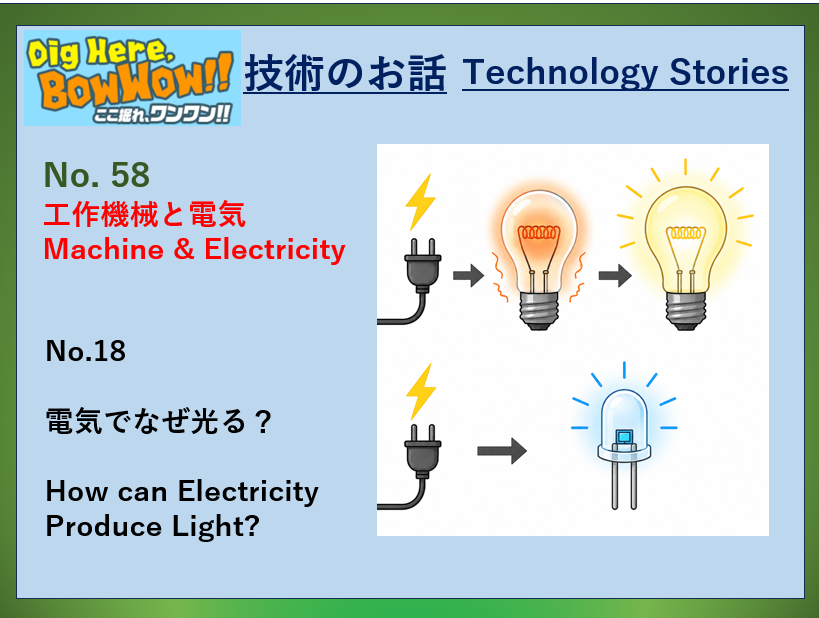
電気 → 光
もりお:
そう。
ただし、光の作り方にはいくつか方法があるんだ。
まずは昔ながらの「白熱電球」から見てみよう。
白熱電球の中には、「フィラメント」という、とても細い金属の線が入っている。
そこに電流を流すと、電気抵抗によってフィラメントがものすごく熱くなる。
わかば:
前回やった「ジュール熱」だ!
もりお:
その通り。
フィラメントの温度は非常に高くなって、熱くなった物体から光が出る。
だから白熱電球は、
電気 → 熱 → 光
という順番で光っているんだ。
わかば:
なるほど!
「電気で光らせる」というより、一度ものすごく熱くして、それで光っているんだね。
もりお:
そういうこと。
だから、白熱電球を長い時間点けていると、かなり熱くなるよね。
わかば:
そうそう。触ったら「あちっ!」って、火傷しそうになる。
もりお:
それだけ電気のエネルギーが熱にもなっているということなんだ。
わかば:
LEDは?
もりお:
LEDは、熱くして光らせているわけではない
そこが大きな違い。
LEDは、「発光ダイオード」と呼ばれる半導体なんだ。
英語では、
Light Emitting Diode
その頭文字を取ってLEDだね。
わかば:
ダイオードって、第11回「交流を直流に変えるしくみ」で出てきたよね。
半導体の性質を利用して、電気を一方向にだけ通りやすくしてるんだよね。
LEDは、「光を出すダイオード」ってこと?
もりお:
そう。
LEDの中には半導体が使われていて、
そこに電流を流すと、半導体の中で電子などが動き、
そのときのエネルギーが光として放出される。
わかば:
電子?
また小さな世界に入ってきたね……。
もりお:
今回は、難しい半導体のしくみまでは入らなくて大丈夫。
大切なのは、
白熱電球は、主に
電気 → 熱 → 光
LEDは、
電気 → 光
と、光を作るしくみが違う、くらいに考えておこう。
わかば:
LEDのほうが、ずいぶん直接的だね。
もりお:
そこがLEDの大きな特徴なんだ。
白熱電球では、電気のエネルギーのかなりの部分が熱になってしまう。
一方、LEDは白熱電球のようにフィラメントを高温にする必要がない。
そのため、少ない電力で効率よく光を作ることができるんだ。
わかば:
だから、LEDは省エネなんだ。
今の時代、省エネは大事だもんね。
もりお:
そうだね。
しかもLEDには、
・消費電力が少ない
・寿命が長い
・発熱が比較的少ない
・小型化しやすい
・いろいろな色を作りやすい
といった特徴がある。
わかば:
小さくて長持ちで省エネ。
なかなか優秀だね。
いろいろな色を作りやすいって、
そういえばLEDって、赤、緑、青、黄色とか、いろんな色があるよね。
あれはどうなってるの?
もりお:
電気そのものに「赤い電気」や「青い電気」があるわけじゃない。
LEDに使われる半導体の材料や構造によって、放出される光のエネルギーが違うんだ。
その違いが、光の色の違いとして見える。
わかば:
同じ電気を流しても、LEDの種類によって光る色が変わるんだ。
もりお:
そういうこと。
そして赤・緑・青などの光を組み合わせれば、いろいろな色を表現することもできる。
テレビやディスプレイも、この仕組みを利用しているんだよ。
わかば:
工作機械にもLEDはいっぱい使われてるの?
もりお:
もちろん。
例えば、
・操作盤の表示灯
・押しボタンスイッチのランプ
・機械の状態を知らせる表示灯
・照明
・ディスプレイ
などだね。
わかば:
そういえば、緑とか赤とか黄色に光っているランプがいっぱいあるね。
もりお:
例えば機械の状態を、
緑:運転中
黄:注意・待機
赤:異常・停止
など、色によって人に知らせることができる。
※実際の色の意味は、機械の仕様などによって異なる場合があります。
わかば:
光の色分けができたら便利だね。
もりお:
そう。
工作機械では、
「人に情報を伝える」
という、とても大切な役割も持っているんだ。
わかば:
こうやって考えると、電気って面白いね。
そのままでは見えないのに、いろんなものに変身する。
もりお:
そうだね。
これまで勉強してきたことを思い出すと、
電気 → モーターによる「動き」
電気 → ヒーターなどの「熱」
電気 → LEDなどの「光」
というように、電気のエネルギーはいろいろな形に変えることができる。
わかば:
なるほど。
「電気が仕事をする」って、こういうことなんだね。
もりお:
そういうこと!
そして工作機械は、電気を「動き」「熱」「光」などに変えながら動いている。
普段何気なく見ている小さなランプ1つにも、ちゃんと電気のしくみが隠れているんだ。
わかば:
じゃあ今度、機械を見たら、
「あ、このLEDの中でも電子が働いてるんだな」
って思ってみるよ。
もりお:
じゃあ、また次回も電気について学んでいこう!!
※このブログは、生成AIを活用して作成しています。
Machine & Electricity No. 18 How can Electricity Produce "Light"?
Wakaba:
Ciao, it’s Wakaba♪
Last time, we learned how electricity can produce heat, right?
So this time, is it about “light”?
Morio:
That’s right.
This time, let’s take a look at how electricity can produce “light.”
Wakaba:
But electricity itself is invisible, right?
And yet, the moment you flip a switch, a light bulb lights up.
When you think about it, that’s pretty mysterious.
Morio:
It is.
But electricity itself isn’t actually “glowing.”
Light is produced by converting electrical energy into another form.
Wakaba:
Electricity → Light
Morio:
Exactly.
But there are several different ways to produce light.
Let’s start with the traditional incandescent light bulb.
Inside an incandescent bulb is a very thin metal wire called a “filament.”
When electric current flows through it, electrical resistance causes the filament to become extremely hot.
Wakaba:
That’s the “Joule heating” we learned about last time!
Morio:
Exactly.
The filament reaches a very high temperature, and a hot object emits light.
So an incandescent light bulb works like this:
Electricity → Heat → Light
Wakaba:
I see!
So rather than electricity directly making the light,
the filament first gets extremely hot, and then that heat produces light.
Morio:
Exactly.
That’s why an incandescent bulb becomes very hot if you leave it on for a long time.
Wakaba:
Right!
If you touch one, you might go, “Ouch!” and almost burn yourself.
Morio:
That shows that part of the electrical energy is also being converted into heat.
Wakaba:
What about LEDs?
Morio:
LEDs don’t produce light by getting extremely hot.
That’s a major difference.
An LED is a type of semiconductor called a “light-emitting diode.”
In English, it is:
Light Emitting Diode
The initials give us the name “LED.”
Wakaba:
We learned about diodes in Episode 11, “AC to DC,” right?
They use the properties of semiconductors to allow electricity to flow more easily in one direction.
So an LED is basically a “diode that produces light”?
Morio:
Exactly.
An LED contains semiconductor material.
When electric current flows through it, electrons and other particles move inside the semiconductor,
and energy is released as light.
Wakaba:
Electrons?
We’re getting into the tiny world again…
Morio:
Don’t worry.
We don’t need to get into the complicated details of semiconductor physics this time.
The important thing is to understand the basic difference:
An incandescent light bulb mainly works like this:
Electricity → Heat → Light
An LED works more directly like this:
Electricity → Light
That’s enough for now.
Wakaba:
So LEDs are much more direct.
Morio:
That’s one of their biggest advantages.
In an incandescent bulb, a large portion of the electrical energy becomes heat.
An LED, on the other hand, doesn’t need to heat a filament to a very high temperature.
That means it can produce light efficiently using less electrical power.
Wakaba:
So that’s why LEDs are energy-efficient.
Energy saving is important these days.
Morio:
Exactly.
LEDs also have several other advantages:
・Low power consumption
・Long service life
・Relatively low heat generation
・Easy to make compact
・Easy to produce in many different colors
Wakaba:
Small, long-lasting, and energy-efficient.
That sounds pretty impressive.
And you said LEDs can produce lots of different colors.
Come to think of it, there are red, green, blue, yellow, and all kinds of LEDs.
How does that work?
Morio:
Electricity itself doesn’t come in “red electricity” or “blue electricity.”
The semiconductor materials and structures used inside LEDs determine the energy of the light they emit.
That difference appears to us as different colors of light.
Wakaba:
So even when electricity flows through them,
different types of LEDs can produce different colors.
Morio:
Exactly.
And by combining red, green, and blue light, we can create many different colors.
Televisions and displays also make use of this principle.
Wakaba:
Are LEDs used a lot in Machines too?
Morio:
Of course.
For example:
・Indicator lights on control panels
・Lamps in push-button switches
・Status indicator lights
・Lighting
・Displays
Wakaba:
Now that you mention it, Machines have lots of green, red, and yellow lights.
Morio:
For example, different colors can be used to tell people the Machine’s status:
Green: Running
Yellow: Caution / Standby
Red: Error / Stop
*The actual meaning of each color may vary depending on the Machine specifications and other conditions.
Wakaba:
It’s useful to be able to communicate different information with different colors.
Morio:
Exactly.
In Machines, light also has the very important role of
“communicating information to people.”
Wakaba:
When you look at it this way, electricity is really interesting.
You can’t see electricity itself,
but it can transform into all kinds of things.
Morio:
That’s right.
If we think back to what we’ve learned so far:
Electricity → “Motion” from motors
Electricity → “Heat” from heaters and other devices
Electricity → “Light” from LEDs and other devices
In this way, electrical energy can be converted into many different forms.
Wakaba:
I see.
So this is what it means when we say that “electricity does work.”
Morio:
Exactly!
And Machines operate by converting electricity into things like “motion,” “heat,” and “light.”
Even a tiny indicator lamp that you normally don’t think much about
has an electrical principle behind it.
Wakaba:
Then next time I look at a Machine,
I’ll think,
“Oh, electrons are working inside this LED too!”
Morio:
Then let’s keep learning more about electricity next time!!
Note:This blog is created with the help of generative AI.