










工作機械と電気 No. 23 磁界: 見えない世界の不思議
わかば:
やっほー、わかばです♪
前回は「電磁石」について勉強したよね。
電線に電流を流すと、そのまわりに磁力が生まれる。
でもさ、「そのまわり」って、どういうこと?
もりお:
いいところに気が付いたね。
前回は分かりやすく「磁力が生まれる」って言ったけど、
もう少し正確にいうと、電流のまわりに「磁界」ができるんだ。
今回は、その見えない世界、「磁界」について見ていこう!
わかば:
よし、頑張って勉強するぞ。
もりお:
磁界は、簡単にいうと、「磁力が働く空間」なんだ。
わかば:
磁力が働く空間?
もりお:
磁石にクリップを近づけていくと、
あるところからスッと吸い寄せられるよね。
磁石のまわりには、目には見えないけど磁力が働く空間が広がっているんだ。
わかば:
それが磁界かぁ。
もりお:
そう!
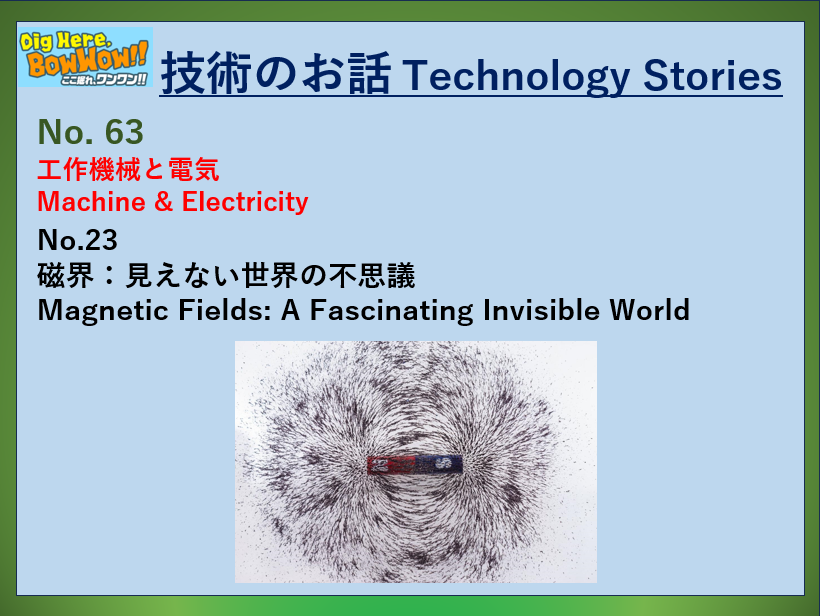
ところで、磁石のまわりに砂鉄をまくと、きれいな模様ができたの覚えてる?
わかば:
覚えてる、覚えてる!
あれ、不思議だったなぁ。
もりお:
磁界そのものが見えているわけじゃないけど、砂鉄の並び方から磁界の様子が分かるんだ。
わかば:
見えない世界を見えるようにする技だね。
ちょっと整理すると、
磁石は「物」。
磁力は「力」。
磁界は「その力が働く空間」。
こんな感じ?
もりお:
バッチリ!
わかば:
磁界って磁石のまわりにだけあるの?
もりお:
ここが面白いところ。
前回勉強したように、電線に電流を流しても、そのまわりに磁界ができるんだ。
わかば:
電磁石だ。
でも、やっぱり不思議。
なんで電気を流すと磁界ができるの?
もりお:
電気のもとになる電荷が動く、つまり電流が流れると、そのまわりに磁界ができる。
これは電気と磁気の基本的な性質なんだ。
わかば:
でも、なんで?
もりお:
そこを本気で掘っていくと、かなり深~い物理の世界に入っちゃう(笑)。
今は「電流が流れると、そのまわりに磁界ができる」だけでいいよ。
わかば:
わかった!
でも、その磁界って、どこまで広がってるの?
もりお:
遠くまで広がっているよ。
ただし、発生源から離れるほど磁界は弱くなるんだ。
わかば:
だからクリップは、磁石を近づけていくと、あるところから急に吸い寄せられるんだね。
もりお:
そういうこと。
わかば:
ところで、磁石にはN極とS極があったけど、
「N磁界」と「S磁界」もあるの?
もりお:
実は、「N磁界」と「S磁界」という2種類の磁界があるわけじゃないんだ。
磁界には「向き」があるんだよ。
わかば:
磁界に向き?
もりお:
例えば、磁石の近くに小さな方位磁針を置いてみる。
すると、針がクルッと動いて、ある方向を向くよね。
わかば:
あっ、方位磁針も磁石だったね!
もりお:
そう。
その方位磁針のN極が向く方向を、「磁界の向き」って決めているんだ。
わかば:
なるほど!
磁界に向きがあるって、そういうことね。
もりお:
棒磁石のまわりでは、方位磁針のN極が向く方向をたどっていくと、
磁石の外側ではN極から出て、S極へ向かうような流れになるんだ。
わかば:
あっ、砂鉄で見た、あの曲線みたいな形?
もりお:
そうそう!
砂鉄で磁界の「広がり方」がイメージできて、
方位磁針を使うと磁界の「向き」も分かるんだ。
わかば:
N磁界とS磁界があるんじゃなくて、
一つの磁界に「広がり」と「向き」があるんだね。
もりお:
バッチリ!
わかば:
あっ、そうそう。一つ思い出した。
前回、電線をグルグル巻いてコイルにすると、磁力が強くなるって言ってたよね。
あれも磁界と関係あるの?
もりお:
大あり!
一本一本の電線に電流が流れると、それぞれのまわりに磁界ができる。
コイルにすると、特にコイルの内側で、
それぞれの電線が作る磁界が同じ方向に重なって強くなるんだ。
わかば:
なるほど!
前回「グルグル巻くと強くなる」って言ってたのは、
磁界が重なってたからなんだ!
もりお:
そういうこと。
だから、基本的にはコイルの巻き数を増やしたり、流す電流を大きくしたりすると、磁界を強くできる。
さらに鉄芯を使えば、磁界を集めて、もっと強くすることができるんだ。
わかば:
へぇ~。
前回の電磁石のしくみが、だんだん見えてきた!
もりお:
そして、ここからがもっと面白い。
わかば:
なになに?
もりお:
永久磁石にも磁界がある。
そして、電流を流したコイルのまわりにも磁界ができる。
じゃあ、磁石が作る磁界の中に、電流が流れている電線を置いたらどうなると思う?
わかば:
そうだなぁ?
磁石どうしみたいに、引っ張ったり、押し返したりするの?
もりお:
いい感じ。
電気が磁界を作る。
その磁界の中を電流が流れると力が生まれる。
わかば:
電線に力が生まれる!?
ということは……動く?
もりお:
その調子、その調子!
そして、その力をうまく使って回転させているのが……
わかば:
もしかして、モーター!?
もりお:
その通り!
見えない電気が磁界を作って、磁界から力が生まれて、その力が「動き」になる。
いよいよ全部がつながってきたね。
わかば:
なんだかモーターと友達になれる気がしてきたぞ!
もりお:
次回はいよいよ、
「モーターはどうして回るの?」
を見ていこう!
わかば:
楽しみ~♪
それでは、またね~!
もりおのひとこと
磁界は目には見えません。
でも、モーターや電磁石など、工作機械のいろいろなところで働いています。
「見えない力が、目に見える動きを作っている」。
次に工作機械が動いているところを見たら、
その裏側にある磁界のこともちょっと思い出してみてください。
※このブログは、生成AIを活用して作成しています。
Machine & Electricity No. 23 Magnetic Fields: A Fascinating Invisible World
Wakaba:
Ciao, it’s Wakaba.♪
Last time, we learned about electromagnets.
We learned that when electric current flows through a wire, magnetic force is produced around it.
But what exactly does “around it” mean?
Morio:
Good question.
Last time, to keep things simple, I said that “magnetic force is produced.”
To be a little more precise, when electric current flows, a “magnetic field”” is created around it.
So this time, let’s explore that invisible world—the world of magnetic fields!
Wakaba:
All right! I’m ready to learn!
Morio:
Simply put, a magnetic field is “a region where magnetic force acts”.
Wakaba:
A region where magnetic force acts?
Morio:
Imagine bringing a paper clip closer and closer to a magnet.
At some point, it suddenly gets pulled toward the magnet, right?
Around the magnet, there is an invisible region where magnetic force acts.
Wakaba:
Ah, so that’s the magnetic field.
Morio:
Exactly!
And do you remember what happens when we sprinkle iron filings around a magnet?
They form those beautiful patterns.
Wakaba:
I remember, I remember!
That was pretty mysterious.
Morio:
We can’t actually see the magnetic field itself,
but the way the iron filings line up gives us an idea of what the magnetic field looks like.
Wakaba:
So it’s a way of making an invisible world visible!
Let me see if I’ve got this straight.
A magnet is an “Object””.
Magnetic force is a “Force”.
And a magnetic field is “the Region where that force acts”.
Is that right?
Morio:
Perfect!
Wakaba:
Do magnetic fields exist only around magnets?
Morio:
Now this is where things get interesting.
As we learned last time, when electric current flows through a wire,
a magnetic field is also created around the wire.
Wakaba:
Ah, electromagnets!
But it still seems strange.
Why does electric current create a magnetic field?
Morio:
When electric charges move—in other words,
when electric current flows—a magnetic field is created around them.
That’s one of the fundamental properties of electricity and magnetism.
Wakaba:
But… why?
Morio:
If we really dig into that question,
we’ll end up going very, very deep into the world of physics. (laughs)
For now, it’s enough to remember this:
“When electric current flows, a magnetic field is created around it.”
Wakaba:
Got it!
But how far does that magnetic field extend?
Morio:
It extends far beyond its source.
But the farther you move away from the source,
the weaker the magnetic field becomes.
Wakaba:
So that’s why, when you bring a magnet closer to a paper clip,
there comes a point where the paper clip suddenly gets pulled toward it.
Morio:
Exactly.
Wakaba:
By the way, magnets have N and S poles, right?
So are there also “N magnetic fields” and “S magnetic fields”?
Morio:
Actually, there aren’t two different kinds of magnetic fields called an “N magnetic field” and an “S magnetic field.”
Instead, a magnetic field has a “direction”.
Wakaba:
A magnetic field has a direction?
Morio:
For example, imagine placing a small compass near a magnet.
The compass needle turns and points in a certain direction, right?
Wakaba:
Oh, right! A compass needle is a magnet too!
Morio:
Exactly.
We define the direction in which the N pole of the compass needle points
as the “direction of the magnetic field”.
Wakaba:
I see!
So that’s what it means when we say a magnetic field has a direction.
Morio:
Around a bar magnet, if you follow the direction in which the N pole of a compass points,
you get a kind of flow that goes from the magnet’s N pole toward its S pole outside the magnet.
Wakaba:
Oh! Like those curved patterns we saw with the iron filings?
Morio:
Exactly!
Iron filings help us visualize how the magnetic field spreads out,
while a compass helps us understand its **direction**.
Wakaba:
So there aren’t separate N and S magnetic fields.
There’s one magnetic field, and it has both a **shape** and a **direction**.
Morio:
Perfect!
Wakaba:
Oh, that reminds me of something.
Last time, you said that winding a wire into a coil makes the magnetic force stronger.
Does that have something to do with magnetic fields too?
Morio:
Absolutely!
When current flows through each part of the wire, a magnetic field is created around it.
When the wire is wound into a coil, especially inside the coil,
the magnetic fields produced by each turn add together in the same direction,
making the overall magnetic field stronger.
Wakaba:
Now I get it!
Last time, you said winding the wire around and around makes it stronger.
That’s because the magnetic fields were adding together!
Morio:
Exactly.
So, in general, increasing the number of turns in the coil or increasing the current flowing through it
can make the magnetic field stronger.
And if we add an iron core, we can concentrate the magnetic field and make it even stronger.
Wakaba:
Wow.
I’m starting to understand how the electromagnet we learned about last time really works!
Morio:
And now it gets even more interesting.
Wakaba:
What, what?
Morio:
A permanent magnet has a magnetic field.
And a coil carrying electric current also creates a magnetic field.
So what do you think happens if we place a current-carrying wire inside the magnetic field created by a magnet?
Wakaba:
Hmm…
Does it get pulled or pushed, kind of like two magnets?
Morio:
You’re getting close.
Electric current creates a magnetic field.
And when electric current flows through a wire in a magnetic field, a “force acts on the wire”.
Wakaba:
A force acts on the wire!?
So… does that mean it moves?
Morio:
That’s it! You’ve got it!
And when we use that force in just the right way to create rotation, we get…
Wakaba:
Wait… a motor!?
Morio:
Exactly!
Invisible electricity creates a magnetic field.
The interaction between the magnetic field and electric current creates a force.
And that force becomes “Motion”.
Now everything is starting to connect!
Wakaba:
I’m starting to feel like I could actually become friends with motors!
Morio:
Next time, we’ll finally explore the big question:
“How Does a Motor Rotate?”
Wakaba:
I can’t wait!♪
See you next time~!
Magnetic fields are invisible.
But they are at work in many parts of a Machine,
including motors and electromagnets.
“Invisible forces create visible motion.”
Next time you see a Machine in motion,
take a moment to think about the magnetic fields working behind the scenes.
Note:This blog is created with the help of generative AI.