







工作機械と電気 No. 24 モーターはなぜ回る?
わかば:
やっほー、わかばです♪
いよいよ今回はモーターだね!
第20回で「工作機械の主役は動き」って勉強してから、
磁石、電磁石、磁界と寄り道してきたけど、ようやくここまで来たぞ!
もりお:
寄り道じゃないよ(笑)。
わかば:
冗談だよ!(笑)
「なぜモーターが回るのか?」早く教えてよ。
もりお:
「電気がどうやって回転を作るのか」だね。
大事だから、まず磁石の復習からしよう。
磁石のN極とS極を近づけると、どうなった?
わかば:
くっつく!
もりお:
じゃあ、N極とN極なら?
わかば:
反発する!
S極とS極でも反発するんだったね。
もりお:
そう。
つまり磁石には、相手を自分の方へ「引っ張る」働きや、
反対に「押し返す」働きがあるんだ。
こうやって物を押したり引いたりして、
動かそうとする働きを「力」っていうんだよ。
わかば:
なるほど。
「力」っていうと難しそうだけど、
「押す」「引っ張る」と考えれば分かりやすいね。
もりお:
そういうこと!
じゃあ、自由に回転できる磁石があるとしよう。
その磁石のN極の近くに、別の磁石のS極を持ってきたらどうなる?
わかば:
N極がS極の方へ引っ張られるから……磁石がクルッと回る?
もりお:
そう!
N極をS極の方へ動かそうとする力が働くから、
回転できるようにしておけば、そちらへクルッと回る。
わかば:
じゃあ、N極の近くに別の磁石のN極を持ってきたら?
もりお:
今度は反対。
N極どうしが反発して、お互いから離れる方向へ押し返そうとする力が働く。
わかば:
なるほど!
「引っ張る」と「押し返す」。
その力で磁石を動かせるんだね。
もりお:
そう。
だから、この「引っ張る」「押し返す」をうまく使えば、
回転するものを動かすこともできそうだよね。
わかば:
なるほど!
前から引っ張ったり、後ろから押したりすれば、回せそうな気がしてきた!
もりお:
いいイメージ。
でも、普通の磁石だけだと困ることがある。
わかば:
何?
もりお:
N極がS極に引っ張られて回ったとしよう。
そして、N極とS極がちょうど向かい合ったら?
わかば:
一番くっつきたいところまで来たんだから……
そこで止まる?
あれっ?
それじゃモーターにならないじゃん!
もりお:
そこで、これまで勉強してきた「電気」の出番なんだ。
わかば:
電気?
もりお:
前に勉強したよね。
電線に電流を流すと、そのまわりに磁界ができる。
さらに、電線をグルグル巻いてコイルにすれば、強い磁界を作ることができる。
わかば:
電磁石だ!
もりお:
そう。
電磁石なら、電流を流したり止めたりして、磁力をON/OFFできる。
それだけじゃない。
電流の向きを反対にすると、磁界の向きも反対になるんだ。
わかば:
ということは……N極とS極を入れ替えることができるの?
もりお:
そういうこと!
わかば:
あっ!
じゃあ、磁石がくっついて止まりそうになったら、
電気でN極とS極を入れ替えればいいんじゃない?
もりお:
その通り。
例えば、回転する磁石を前から引っ張って動かす。
その磁石が近づいてきたら、今度は磁気の状態を変えて、
また回転する方向へ動かそうとする。
そんなふうに磁気の状態をうまく変えていけば、
回転する方向へ力を働かせることができるんだ。
わかば:
前から「こっちへおいで!」って引っ張ったり、
後ろから「そっちへ行け!」って押したりする感じ?
もりお:
イメージとしては、そんな感じだね。
わかば:
なるほど~。
「力」って、回る方向へ押したり引っ張ったりしているんだね。
もりお:
そう考えると分かりやすいよ。
わかば:
なんだかモーターが回る感じが見えてきた!
もりお:
よしっ!
じゃあ、ここでもう一度、前回の「磁界」の話に戻ってみよう。
ここまでは、磁石の「引っ張る・押し返す」でイメージしてきたけど、
モーターの中で起きていることをもう少し詳しく見るには、
前回勉強した「磁界」と「電流」の関係が大事になるんだ。
わかば:
また磁界?
もりお:
そう。
前回、磁界の中に電流が流れる電線を置くと、その電線に力が働くって勉強したよね。
わかば:
したした。
でも、その「力」も、今の「押す」「引っ張る」と同じように考えていいの?
もりお:
そう。
ここでいう「力」は、電流が流れている電線を、ある方向へ動かそうとする力なんだ。
わかば:
電線そのものを動かそうとするの?
もりお:
そう!
例えば、磁界の中に電線を置いて電流を流すと、
電線を「こっちへ動かそう」と押すような力が働く。
わかば:
そっか。
電線はただ電気を通しているだけじゃなかったね。
もりお:
面白いよね。
そして、どちら向きに電線を動かそうとするかは、
「磁界の向き」と「電流の向き」で決まるんだ。
わかば:
なるほど。
「力の向き」っていうのは、
電線を「どっちへ動かそうとしているか」ってことなんだね。
もりお:
その通り!
そして、電流・磁界・力の3つの向きの関係を簡単に確認する方法があるんだ。
わかば:
何だろう?
もりお:
「フレミング左手の法則」!
わかば:
うわっ!
名前と、ほら何だか、左手の指のサインみたいな形は覚えてるけど、
何のことだかは、全く知らないやつだよね。
もりお:
名前はちょっと難しそうだけど、モーターのしくみを考えるうえでは大事な法則なんだ。
でも、大丈夫。
今回は3本の指を丸暗記することより、
「電線をどちらへ動かそうとするかにも決まりがある」
ということが分かればOK。
わかば:
了解!
もりお:
左手の形を復習してみよう。
左手の親指、人差し指、中指を、それぞれ直角になるように開いてみて。
人差し指が「磁界の向き」。
中指が「電流の向き」。
親指が「力の向き」。
わかば:
ん~、覚えにくい!
もりお:
じゃあ、「人が磁界を見て、中に電流、親が力持ち!」でどう?
特に、「力」の方向は大事だから、「親指で、こっちへ動け!」
って覚えよう。
わかば:
親指が力の方向で、「電線がどっちへ動こうとするか」を表しているんだね。
もりお:
そういうこと。
例えば磁界の向きが同じでも、電流の向きを反対にすると、電線を動かそうとする力の向きも反対になる。
わかば:
ちなみに、電流の向きは、この場合はプラスからマイナスでいいの?
もりお:
そう。ここでいう「電流の向き」は、プラスからマイナスへ流れる向きで考えればいいよ。
わかば:
電子が動く向きとは反対だったよね。
もりお:
そうそう。今回は「電流の向き」で考えよう。
わかば:
了解。
力の向きに戻ると、
右へ動かそうとしていたものが、今度は左へ動かそうとする感じ?
もりお:
そう。
だから電流や磁界の向きを変えることで、動かそうとする方向も変えることができるんだ。
わかば:
でもさ、電線が右や左へ動くだけなら、まだ「回転」じゃないよね?
もりお:
その通り。
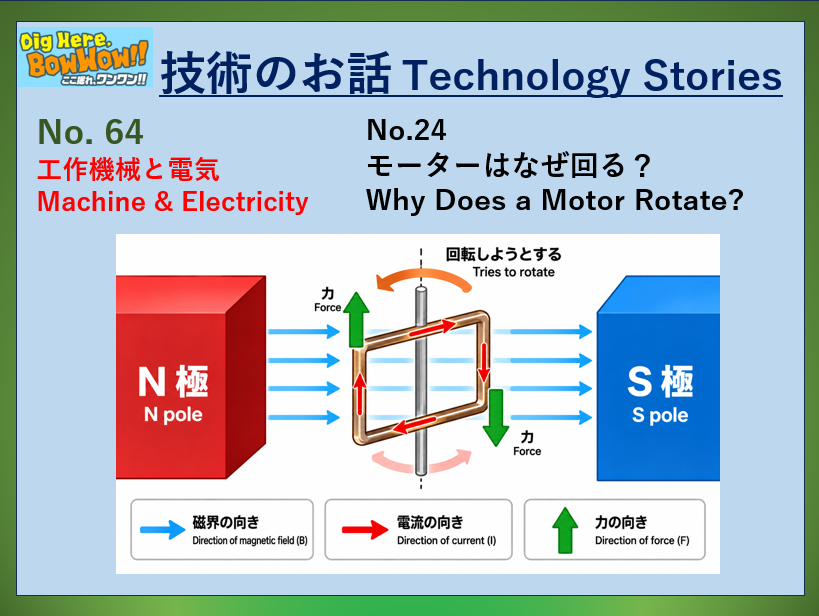
じゃあ、一本の電線じゃなくて、電線を輪っかにして、回転できるようにしてみよう。
わかば:
輪っか?
もりお:
四角い輪っかをイメージすると分かりやすいかな。
その輪っかを磁界の中に置いて、電流を流す。
わかば:
どうなるの?
もりお:
輪っかの片側の電線には、例えば上へ動かそうとする力が働く。
反対側の電線には、逆に下へ動かそうとする力が働くんだ。
わかば:
片方は上、反対側は下?
もりお:
そう。
ちょっとハンドルを回すところを想像してみて。
片側を上へ押して、反対側を下へ押したらどうなる?
わかば:
あっ、そうか!回った、回った!
もりお:
そうなんだ。
二つの反対向きの力によって、
輪っか全体をクルッと回そうとする働きが生まれる。
わかば:
なるほど!
「力」と「回転」がつながった!
もりお:
これがモーターが回転する基本的な考え方なんだ。
わかば:
ちょっと整理させて。
磁石には、引き合ったり反発したりして、物を動かそうとする力がある。
電流を流すと磁界ができる。
磁界の中を電流が流れると、その電線をある方向へ動かそうとする力が働く。
そして、その力が回転するように工夫すれば、モーターが回る。
もりお:
バッチリ!
わかば:
ということは、モーターって、
「電気」と「磁気」を使って、「押す・引っ張る」という力を作って、それを「回転」に変えているんだね。
もりお:
そう。
細かなしくみはモーターの種類によって違うけど、
まずはそのイメージを持っておけばいいよ。
わかば:
第20回で「工作機械の主役は動き」って言ってたけど、
ようやく電気から「動き」が生まれるところまで来たんだね。
もりお:
そうなんだ。
工作機械では、いろいろなところでモーターが使われている。
材料を送ったり、工具を動かしたり、軸を回転させたり。
モーターが作る回転が、いろいろな「動き」の出発点になっているんだ。
わかば:
よしっ、これでモーターと友達になれること間違いなし!
もりお:
でも、まだ一つ大きな謎が残っているよ。
わかば:
えっ、何?
もりお:
さっき、N極とS極が向かい合ったら止まるって言ったよね。
わかば:
あっ、そうだった!
一回クルッと回るのは分かったけど、
実際のモーターはスイッチを入れている間、グルグル回り続けるよね。
もりお:
そう。
「回ろうとする力を作る」ことと、
「その力を作り続けて、ずっと回転させる」ことは別なんだ。
わかば:
じゃあ、どうして止まらずに回り続けるの?
もりお:
それが次回のテーマ!
わかば:
またいいところで終わるなぁ(笑)。
もりお:
次回は、
「モーターはどうして回り続けるの?」
モーターが回転を続けるためのしくみを見ていこう!
わかば:
楽しみ~♪
それでは、またね~!
もりおのひとこと:
「力」というと、少し難しく聞こえるかもしれません。
でも、「押す」「引っ張る」「動かそうとする」と考えると分かりやすくなります。
モーターでは、電気と磁気の関係から生まれる力を、回転する方向へうまく働かせています。
その力がモーターの軸を回し、機械のいろいろな「動き」につながっていきます。
次に工作機械が動いているところを見たら、
「この動きを作っている力は、どこから来ているんだろう?」と考えてみてくださいね。
※このブログは、生成AIを活用して作成しています。
Machine & Electricity No. 24 Why Does a Motor Rotate?
Wakaba:
Ciao, it’s Wakaba.♪
We’re finally getting to motors!
Ever since Episode 20, when we learned that “motion is the star of a Machine,”
we’ve taken a little detour through magnets, electromagnets, and magnetic fields.
And now, we’ve finally made it here!
Morio:
It wasn’t a detour! (laughs)
Wakaba:
I’m just kidding! (laughs)
Come on, tell me—why does a motor rotate?
Morio:
In other words, “How does electricity create rotation?”
It’s an important question, so let’s start with a quick review of magnets.
What happens when you bring the N pole and S pole of two magnets close together?
Wakaba:
They attract!
Morio:
And what about N and N?
Wakaba:
They repel!
And S and S repel each other too.
Morio:
Exactly.
So magnets can “pull” something toward them or “push” it away.
When something pushes or pulls an object and tries to move it, we call that a “force.”
Wakaba:
I see.
“Force” sounds a little difficult, but if I think of it as “pushing” and “pulling,” it’s much easier to understand.
Morio:
Exactly!
Now imagine a magnet that is free to rotate.
What would happen if you brought the S pole of another magnet close to its N pole?
Wakaba:
The N pole would be pulled toward the S pole…
So the magnet would turn?
Morio:
Exactly!
A force pulls the N pole toward the S pole.
So if the magnet is free to rotate, it will turn in that direction.
Wakaba:
Then what if I bring another N pole close to the N pole?
Morio:
The opposite happens.
The two N poles repel each other, creating a force that pushes them apart.
Wakaba:
I see!
“Pull” and “push.”
Those forces can make the magnet move.
Morio:
Right.
So if we use this “pulling” and “pushing” cleverly, it seems like we should be able to make something rotate too.
Wakaba:
I get it!
If we pull it from the front and push it from behind, it feels like we could make it turn!
Morio:
That’s a good way to picture it.
But there’s a problem if we use ordinary magnets alone.
Wakaba:
What problem?
Morio:
Suppose the N pole is pulled toward an S pole and starts to rotate.
What happens when the N pole and S pole end up directly facing each other?
Wakaba:
They’ve reached the position where they want to stick together the most…
So it stops there?
Wait a minute…
That won’t make a motor!
Morio:
And that’s where the “electricity” we’ve been studying comes in.
Wakaba:
Electricity?
Morio:
Remember what we learned?
When electric current flows through a wire, it creates a magnetic field around the wire.
And if we wind that wire into a coil, we can create a stronger magnetic field.
Wakaba:
An electromagnet!
Morio:
Exactly.
With an electromagnet, we can turn the magnetic force ON and OFF by switching the current on and off.
And that’s not all.
If we reverse the direction of the current, the direction of the magnetic field also reverses.
Wakaba:
So…we can switch the N and S poles?
Morio:
Exactly!
Wakaba:
Ah!
Then, just before the magnets stick together and stop, couldn’t we use electricity to switch the N and S poles?
Morio:
Exactly.
For example, imagine pulling a rotating magnet forward.
As it gets closer, we change the magnetic state
so that another force keeps trying to move it in the direction of rotation.
By changing the magnetic state at the right times,
we can keep applying force in the direction we want it to rotate.
Wakaba:
So it’s kind of like pulling from the front and saying, “Come this way!”
and then pushing from behind and saying, “Keep going!”
Morio:
That’s a good way to picture it.
Wakaba:
I see.
So we’re using those pushing and pulling forces
to make it move in the direction we want it to rotate.
Morio:
Exactly. That’s a good way to think about it.
Wakaba:
I’m starting to see how a motor can rotate!
Morio:
All right!
Now let’s go back once more to the “magnetic field” we learned about last time.
So far, we’ve pictured things in terms of magnets “pulling” and “pushing.”
But to understand a little more precisely what happens inside a motor,
the relationship between a magnetic field and electric current becomes very important.
Wakaba:
The magnetic field again?
Morio:
Yes.
Last time, we learned that
when a current-carrying wire is placed in a magnetic field, a force acts on that wire.
Wakaba:
Right, right.
But can I think of that “force” in the same way—as something that pushes or pulls?
Morio:
Yes.
Here, “force” means something that tries to move the current-carrying wire in a certain direction.
Wakaba:
It actually tries to move the wire itself?
Morio:
Exactly!
For example, place a wire in a magnetic field and let current flow through it.
A force acts on the wire, pushing it in a certain direction.
Wakaba:
I see.
So the wire isn’t just carrying electricity.
Morio:
Interesting, isn’t it?
And the direction in which the wire is pushed depends on two things:
the direction of the magnetic field and the direction of the current.
Wakaba:
I see.
So the “direction of the force” means the direction in which the wire is being pushed.
Morio:
Exactly!
And there’s a simple way to check the relationship between these three directions—current, magnetic field, and force.
Wakaba:
What is it?
Morio:
Fleming’s Left-Hand Rule!
Wakaba:
Whoa!
I remember the name, and that strange sign you make with the fingers of your left hand…
but I have absolutely no idea what it means!
Morio:
The name may sound a little intimidating, but it’s an important rule for understanding how motors work.
Don’t worry, though.
For now, you don’t need to memorize all three fingers.
The important thing is to understand that there’s a rule that determines which way the wire will be pushed.
Wakaba:
Got it!
Morio:
Let’s review the shape of the left hand.
Hold out your left thumb, index finger, and middle finger
so that they are at right angles to one another.
Your index finger shows the direction of the magnetic field.
Your middle finger shows the direction of the current.
And your thumb shows the direction of the force.
Wakaba:
Hmm…that’s not easy to remember!
Morio:
Then start with just one:
“Thumb = Force.”
Think of your thumb as pointing and saying,
“Move this way!”
Wakaba:
Ah, that’s easier!
So my thumb shows the direction of the force—the direction the wire is being pushed.
Morio:
Exactly.
For example, if the magnetic field stays in the same direction but we reverse the current,
the force on the wire also reverses direction.
Wakaba:
By the way, when we talk about the direction of current here,
we mean from positive to negative, right?
Morio:
Right.
Here, we use the conventional direction of current—from positive to negative.
Wakaba:
And that’s opposite to the direction the electrons actually move, right?
Morio:
Exactly.
For now, let’s think in terms of the conventional direction of current.
Wakaba:
Got it.
So, back to the direction of force:
if the wire was being pushed to the right before,
reversing the current could make it push to the left instead?
Morio:
Exactly.
By changing the direction of the current or the magnetic field,
we can change the direction of the force.
Wakaba:
But if the wire just moves left or right, that still isn’t “rotation,” is it?
Morio:
Exactly.
So instead of using a single straight wire,
let’s make the wire into a loop and allow it to rotate.
Wakaba:
A loop?
Morio:
It may be easier to imagine a rectangular loop of wire.
Place that loop in a magnetic field and let current flow through it.
Wakaba:
What happens?
Morio:
On one side of the loop, a force acts in one direction—let’s say upward.
On the opposite side, a force acts in the opposite direction—downward.
Wakaba:
One side goes up and the other side goes down?
Morio:
Right.
Imagine turning a handle.
What happens if you push one side upward and the opposite side downward?
Wakaba:
Oh, I get it!
It turns!
Morio:
Exactly.
Those two forces acting in opposite directions create a turning effect on the whole loop.
Wakaba:
Now I get it!
“Force” and “rotation” finally connect!
Morio:
And that’s the basic idea behind why a motor rotates.
Wakaba:
Let me make sure I’ve got this.
Magnets have forces that can attract or repel and make things move.
When electric current flows, it creates a magnetic field.
When current flows through a wire in a magnetic field,
a force acts on that wire in a certain direction.
And if we arrange those forces so that they create rotation,
we can make a motor turn.
Morio:
Perfect!
Wakaba:
So a motor uses “electricity” and “magnetism” to create pushing and pulling forces,
and then turns those forces into “rotation.”
Morio:
Exactly.
The details vary depending on the type of motor,
but that’s the basic picture I want you to remember.
Wakaba:
Back in Episode 20, you said that “motion is the star of a Machine.”
And now we’ve finally reached the point where electricity becomes “motion”!
Morio:
Exactly.
Motors are used in all kinds of places in a Machine.
They feed material, move tools, rotate shafts, and much more.
The rotation created by motors is the starting point for many different kinds of motion.
Wakaba:
All right!
Now there’s no doubt—I’m going to become friends with motors!
Morio:
But there’s still one big mystery left.
Wakaba:
What?
Morio:
Remember when we said that the motion would stop once the N and S poles were directly facing each other?
Wakaba:
Oh, right!
Now I understand how it can turn once,
but a real motor keeps spinning as long as it’s switched on.
Morio:
Exactly.
“Creating a force that makes something turn” and
“continuing to create that force so it keeps rotating”
are two different things.
Wakaba:
Then how does a motor keep spinning without stopping?
Morio:
That’s our topic for next time!
Wakaba:
You always stop just when it gets interesting! (laughs)
Morio:
Next time:
“How Does a Motor Keep Rotating?”
We’ll look at the mechanism that allows a motor to keep spinning continuously.
Wakaba:
I can’t wait!♪
See you next time!
The word “force” may sound a little difficult.
But it becomes easier to understand if you think of it
as “pushing,” “pulling,” or “trying to make something move.”
In a motor, forces created by the interaction between electricity and magnetism
are used in just the right way to produce rotation.
Those forces turn the motor shaft,
and that rotation leads to all kinds of motion in a Machine.
The next time you see a Machine moving,
try asking yourself:
“Where does the force that creates this motion come from?”
Note:This blog is created with the help of generative AI.