











工作機械と電気 No. 25 モーターはどうやって回り続ける?
わかば:
やっほー、わかばです♪
前回は、モーターが回るしくみを勉強したよね。
磁界の中に電流が流れる電線を置くと、その電線に力が働く。
四角い輪っかにした電線でわかりやすくしたけど、
片側は上へ、反対側は下へ押されて、クルッと回るんだったね!
もりお:
そうそう。その理解。
わかば:
これでモーターと友達になれたと思ったのに、
最後にまた謎を残したよね。
一回クルッと回るのは分かったけど、どうしてモーターはグルグル回り続けるの?
ここがわからないと、まだ一緒に飲みに行く気にはなれないな(笑)
もりお:
今回のテーマはそこだね!
まず、前回の四角い輪っかを思い出してみて。
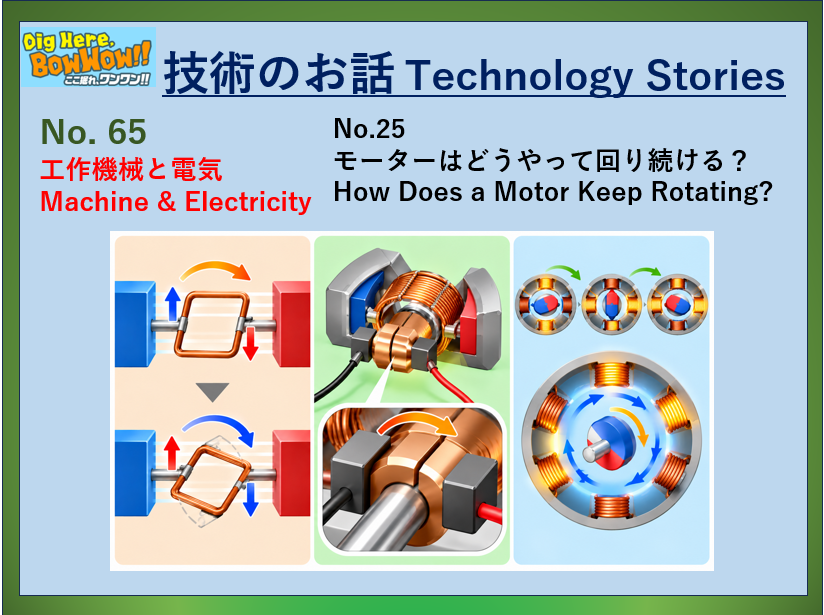
輪っかの片側を上へ、反対側を下へ押す力が働くと、輪っかは回り始めるよね。
わかば:
うん。ハンドルを回すような感じだったね。
もりお:
でも、そのまま回って、輪っかが半回転したらどうなると思う?
わかば:
半回転?
さっき上へ押されていた電線が、今度は反対側に来るね。
もりお:
その通り。
ここで、磁界の向きも、輪っかに流れる電流の向きも、そのままだとしよう。
すると、回転する途中で輪っかを回そうとする力が弱くなり、
ある位置を越えると、今度は逆向きに回そうとする力が働くようになるんだ。
わかば:
えっ!
せっかく回っていたのに、今度は逆向きに回そうとするの?
もりお:
そうなんだ。
だから、電流を流しっぱなしにしただけでは、
同じ方向に回し続けることはできないんだよ。
わかば:
それじゃ、前回の磁石と同じだね。
回ったところで止まっちゃう!
もりお:
そこで大事なのが、「回転する方向へ力が働き続けるようにすること」なんだ。
わかば:
なるほど。
どうすればいいの?
もりお:
「フレミング左手の法則」覚えてる?
わかば:
親指が「力」!
「こっちへ動け!」だったね(笑)。
もりお:
そうそう(笑)。
それから、磁界の向きが同じでも、
電流の向きを反対にすると、力の向きも反対になるんだったね。
わかば:
ん?あっ!
ということは、輪っかが半回転したところで電流の向きを反対にすれば……。
もりお:
ピンポーン!
輪っかの同じ側の電線に働く力も反対になる。
でも、その電線は半回転して反対側に移っているから、
「輪っか全体を回そうとする向きは、前と同じにできる」んだ。
わかば:
ん~、ちょっとややこしい(笑)。
電流も反対、力も反対なのに、回る向きは同じ?
もりお:
例えば、自転車のペダルを想像してみて。
右足でペダルを下へ押すと、自転車を進める方向に回るよね。
ペダルが半回転したら、今度は反対側に来たペダルを下へ押す。
押す場所をうまく切り替えれば、同じ方向に回し続けられる。
わかば:
ああ、なるほど!
回転する位置に合わせて、力の働き方を切り替えるんだね。
もりお:
その通り!
四角い輪っかでも、回転する位置に合わせて電流の向きを切り替えれば、
同じ方向へ回す力を作り続けられるんだ。
わかば:
でもさ、回るたびに誰かが電流の向きを切り替えるわけじゃないよね?
もりお:
もちろん(笑)。
そこで登場するのが、「整流子(せいりゅうし)」と「ブラシ」なんだ。
わかば:
整流子?
もりお:
整流子は、回転する輪っかと一緒に回る、金属製の接点なんだ。
簡単な直流モーターでは、円筒を二つに分けたような形をしているよ。
わかば:
輪っかと一緒にクルクル回るんだね。
ブラシは?
針みたいなのが、たくさん生えてるの?
もりお:
そうじゃないんだ。
モーターのブラシは、黒鉛(カーボン)などでできた、小さな四角いブロックのような部品なんだよ。
わかば:
えっ、ブラシなのに毛がないの!?
もりお:
そう(笑)。
そのブラシを、ばねなどで整流子の表面に押し当てているんだ。
整流子は輪っかと一緒に回るけど、ブラシは回らずに、整流子の表面に触れ続ける。
こうして、外側から回転する輪っかへ電気を流しているんだよ。
わかば:
なるほど!
ばねも使われてるのか。よしよし。
そうやって、回っているものに、外から電気を渡しているんだね!
もりお:
その通り。
そして、整流子が半回転すると、ブラシが接する相手が入れ替わる。
その結果、輪っかに流れる電流の向きも反対になるんだ。
わかば:
なるほど!
輪っかが半回転するたびに、自動で電流の向きが切り替わるんだね!
もりお:
その通り。
こうして、輪っかが回転する位置に合わせて電流の向きを切り替え、
同じ方向へ回す力を作り続けることができるんだ。
わかば:
整流子とブラシが、回転を続けるための切替え係なんだね。
もりお:
うまい表現だね。
ただし、これは「ブラシ付き直流モーター」の基本的なしくみなんだ。
わかば:
えっ?やっと、モーターと親しくなった気がしたのに。
モーターって、みんなブラシと整流子が入っているんじゃないの?
もりお:
実は、そうじゃないんだ。
モーターにはいろいろな種類があって、ブラシや整流子を使わないものもあるよ。
わかば:
じゃあ、そういうモーターはどうやって回り続けるの?
もりお:
例えば、「磁界そのものを回転させる」という方法があるんだ。
わかば:
磁界そのものが回る!?
目に見えない磁界が、グルグル回るってこと?
想像つかない。
もりお:
まず、机の上に、自由に回転できる磁石を置いたところを想像してみて。
わかば:
うん。
もりお:
その磁石の近くに、別の磁石を持ってきて、ゆっくり動かしてみる。
すると、机の上の磁石はどうなると思う?
わかば:
引っ張られて、手に持った磁石の方を向くかな?
もりお:
そうだね。
じゃあ、手に持った磁石を、机の上の磁石の周りでグルグル動かしたら?
わかば:
あっ!
机の上の磁石も、追いかけるように回るんじゃない?
もりお:
その通り!
今度は、手に持った磁石を動かす代わりに、電気を使って同じようなことをするんだ。
わかば:
電気で磁石を動かすの?
もりお:
磁石そのものを動かすんじゃなくて、電磁石を使って、磁界の向きを次々と変えるんだ。
例えば、回転する部分の周りにいくつかのコイルを置いて、
電流を流すタイミングを順番に変えていく。
わかば:
あっ!
電磁石のN極とS極が、次々と場所を変えていくような感じ?
もりお:
そういうイメージだね。
すると、回転する部分から見ると、引っ張られる方向が次々と先へ移動していく。
これが「回転する磁界」のイメージなんだ。
わかば:
なるほど!
電磁石そのものは動かないけど、
電気の流し方を順番に変えることで、
N極とS極がグルグル移動しているような状態を作るんだね!
もりお:
その通り!
こうして、電磁石そのものを動かさずに、磁界を回転させることができるんだ。
これを「回転磁界」というんだよ。
この回転磁界を利用して、モーターを回し続ける方法もあるんだ。
わかば:
さっきのブラシ付き直流モーターは、回る輪っかの電流を切り替えていたけど、
今度は周りの磁界を回すんだね。
考えた人、頭いいなぁ。
もりお:
本当だね(笑)。
ただし、モーターの種類によって、回転する部分に力が生まれる詳しいしくみは違うんだ。
今日は、いろいろな方法があることを知っておけば十分だよ。
わかば:
了解!
でも、ブラシを使わないモーターなら、ブラシがすり減る心配もないよね?
もりお:
鋭い!
ブラシと整流子は接触しながら動くから、使っているうちに摩耗するんだ。
ブラシを使わないモーターには、その部分の摩耗がないという利点があるよ。
わかば:
それなら、工作機械にもブラシを使わないモーターが使われているの?
もりお:
もちろん。
例えば、工作機械で使われる交流サーボモーターには、ブラシを使わないものがあるんだ。
電流をうまく制御して回転する磁界を作り、モーターを回しているんだよ。
わかば:
サーボモーター登場だ!
うちの機械でもおなじみだね。
もりお:
そうだね。
ただ、サーボモーターのすごいところは、回るだけじゃないんだ。
「どれだけ回ったか」「どのくらいの速さで回っているか」を確かめながら、
思い通りに動かせるところにあるんだよ。
わかば:
おおっ!
でも、それはまた新しい謎が増えそう(笑)。
もりお:
その話は、もう少し先のお楽しみにしておこう。
まずは今日の話を整理してみて。
わかば:
よしっ!
前回は、電流と磁界の関係から力が生まれて、モーターが回ることを勉強した。
でも、ただ力を作るだけでは、ずっと同じ方向に回り続けることはできない。
だから、回転する位置に合わせて電流を切り替えたり、磁界そのものを回したりして、
回転する方向へ力が働き続けるようにしているんだね!
もりお:
バッチリ!
わかば:
ちょっと難しかったけど、何だか視界が広がった感じがする!
モーターって、電気を流したら勝手にグルグル回るものだと思っていたけど、
回り続けるための工夫があったんだね。
もりお:
そうなんだ。
そして、その工夫を実現するために、モーターの中にはいろいろな部品が入っているんだよ。
わかば:
そういえば、今日出てきた整流子とブラシ以外にも、磁石やコイルも入っているんだよね。
回転する軸もあるし……。
もりお:
その通り。
じゃあ次回は、モーターの中をのぞいてみよう!
わかば:
おっ、技術者の基本、分解だね。
楽しみ~♪
もりお:
次回は、「モーターの中はどうなっているの?」
モーターを作っている部品と、それぞれの働きを見ていこう!
わかば:
それでは、またね~!
もりおのひとこと
モーターが回り続けるためには、回転する方向へ力が働き続けるようにする必要があります。
ブラシ付き直流モーターでは、整流子とブラシによって電流の向きを切り替えます。
一方、交流サーボモーターなどには、電流を制御して回転する磁界を作るものがあります。
方法は違っても、電気と磁気を利用して、
回転する方向へ力を働かせるという基本的な考え方は共通しています。
次に工作機械のモーターが回っているところを見たら、
「このモーターは、どんなしくみで回り続けているんだろう?」と考えてみてくださいね。
※このブログは、生成AIを活用して作成しています。
Machine & Electricity No. 25 How Does a Motor Keep Rotating?
Wakaba:
Ciao, it’s Wakaba.♪
Last time, we learned how a motor rotates.
When a current-carrying wire is placed in a magnetic field, a force acts on the wire.
We used a rectangular loop of wire to make it easier to understand.
One side is pushed upward, while the other side is pushed downward, making the loop turn!
Morio:
Exactly! You’ve got it.
Wakaba:
I thought I’d finally become friends with motors,
but you left me with another mystery at the end!
I understand how a motor can make one turn,
but how does it keep spinning and spinning?
Until I figure that out, I don’t think we cannot go for a drink together! (laughs)
Morio:
And that’s exactly what we’re going to explore today!
First, remember the rectangular loop from last time.
When one side is pushed upward and the other side is pushed downward,
the loop starts to rotate, right?
Wakaba:
Right. It was like turning a handle.
Morio:
But what do you think happens when the loop keeps turning and makes half a revolution?
Wakaba:
Half a revolution?
The side of the wire that was being pushed upward is now on the opposite side.
Morio:
Exactly.
Now, let’s suppose that the direction of the magnetic field and the direction of the current flowing through the loop stay the same.
As the loop rotates, the turning force becomes weaker.
Once it passes a certain position, the force starts trying to turn the loop in the opposite direction.
Wakaba:
What!?
It was turning so nicely, and now the force is trying to make it turn backward?
Morio:
That’s right.
So simply keeping the current flowing isn’t enough
to make the loop continue rotating in the same direction.
Wakaba:
Then it’s just like the magnets we talked about last time.
It turns for a while and then stops!
Morio:
Exactly.
That’s why the important thing is
to “keep producing a force that makes the loop turn in the same direction.”
Wakaba:
I see.
So how do we do that?
Morio:
Remember Fleming’s Left-Hand Rule?
Wakaba:
Thumb means “force”!
“Move this way!” (laughs)
Morio:
Exactly! (laughs)
And remember, even if the magnetic field stays in the same direction,
reversing the current also reverses the direction of the force.
Wakaba:
Hmm? Oh!
So if we reverse the current when the loop has made half a revolution…
Morio:
Bingo!
The force acting on the same section of wire also reverses direction.
But because that section of wire has moved to the opposite side after half a revolution,
“the loop as a whole can keep turning in the same direction!”
Wakaba:
Hmm…that’s a little tricky! (laughs)
The current reverses, the force reverses, but the direction of rotation stays the same?
Morio:
Imagine the pedals on a bicycle.
When you push down on the right pedal,
it turns the pedals in the direction that moves the bicycle forward.
After half a revolution, you push down on the pedal that has come around to the other side.
By switching where you apply the force at the right time,
you can keep the pedals turning in the same direction.
Wakaba:
Ah, now I get it!
You change how the force is applied depending on the position of the rotating part.
Morio:
Exactly!
The same idea applies to our rectangular loop.
If we reverse the current at the right point in its rotation,
we can keep producing a force that turns it in the same direction.
Wakaba:
But someone isn’t standing there reversing the current every time the loop turns, right?
Morio:
Of course not! (laughs)
That’s where the **commutator and brushes** come in.
Wakaba:
A commutator?
Morio:
A commutator is a set of metal contacts that rotates together with the loop of wire.
In a simple DC motor, it looks like a cylinder divided into two sections.
Wakaba:
So it spins together with the loop.
What about the brushes?
Do they have lots of little bristles sticking out, like a cleaning brush?
Morio:
Not quite.
Motor brushes are usually small, rectangular blocks made of graphite, a form of carbon, or similar materials.
Wakaba:
What!? A brush without any bristles!?
Morio:
That’s right! (laughs)
The brushes are pressed against the surface of the commutator by springs or similar mechanisms.
The commutator rotates together with the loop,
but the brushes stay in place and remain in contact with its surface.
That’s how electricity is supplied from the outside to the rotating loop.
Wakaba:
I see!
So springs are used in motors too. Nice, nice!
And that’s how electricity is passed from the stationary part to the rotating part!
Morio:
Exactly.
And when the commutator makes half a revolution,
the sections touching the brushes switch places.
As a result, the direction of the current flowing through the loop is reversed.
Wakaba:
Now I get it!
Every time the loop makes half a revolution,
the direction of the current switches automatically!
Morio:
Exactly.
By reversing the current according to the position of the rotating loop,
the motor can keep producing a force that makes it turn in the same direction.
Wakaba:
So the commutator and brushes are like the switching team that keeps the motor spinning!
Morio:
That’s a good way to put it.
But remember, this is the basic operating principle of a **brushed DC motor**.
Wakaba:
What!? I was just starting to feel like I really understood motors!
Don’t all motors have brushes and commutators?
Morio:
Actually, no.
There are many different types of motors, and some don’t use brushes or commutators at all.
Wakaba:
Then how do those motors keep rotating?
Morio:
One method is to “make the magnetic field itself rotate.”
Wakaba:
The magnetic field itself rotates!?
You mean an invisible magnetic field can spin around and around?
I can’t even imagine that!
Morio:
First, imagine placing a magnet on a table so that it can rotate freely.
Wakaba:
Okay.
Morio:
Now bring another magnet close to it and slowly move that magnet around.
What do you think will happen to the magnet on the table?
Wakaba:
It might be pulled toward the magnet you’re holding and turn to face it.
Morio:
That’s right.
Now, what if you move the magnet in your hand all the way around the magnet on the table?
Wakaba:
Oh!
Wouldn’t the magnet on the table rotate too, as if it were following the other magnet?
Morio:
Exactly!
Now imagine using electricity to do something similar, instead of moving a magnet by hand.
Wakaba:
You mean using electricity to move a magnet?
Morio:
Not moving the magnet itself.
Instead, we use electromagnets to change the direction of the magnetic field in sequence.
For example, we can place several coils around the rotating part
and change the timing of the current flowing through them, one after another.
Wakaba:
Oh!
So it’s as if the N and S poles of the electromagnets are moving from one position to the next?
Morio:
That’s a good way to picture it.
From the rotating part’s point of view,
the direction in which it is being pulled keeps moving ahead of it.
That’s the basic idea of a rotating magnetic field.
Wakaba:
I see!
The electromagnets themselves don’t move,
but by changing how electricity flows through them in sequence,
we can make it seem as though the N and S poles are moving around in a circle!
Morio:
Exactly!
That way, we can make the magnetic field rotate without physically moving the electromagnets.
This is called a “rotating magnetic field”.
Some motors use this rotating magnetic field to keep spinning.
Wakaba:
So in the brushed DC motor, we switched the current flowing through the rotating loop.
But in this type of motor, we make the magnetic field around the rotating part rotate instead.
Whoever came up with that must have been really clever!
Morio:
They certainly were! (laughs)
Of course, the details of how the force is produced in the rotating part differ depending on the type of motor.
For today, it’s enough to know that there are different ways to keep a motor rotating.
Wakaba:
Got it!
But if a motor doesn’t use brushes,
there’s no need to worry about the brushes wearing out, right?
Morio:
Good observation!
Brushes and commutators rub against each other while the motor runs, so they gradually wear down.
A motor without brushes has the advantage of avoiding wear at those contact points.
Wakaba:
Then are brushless motors used in Machines too?
Morio:
Of course.
For example, AC servo motors used in Machines can operate without brushes.
They control the electric current to create a rotating magnetic field that drives the motor.
Wakaba:
Here come the servo motors!
We use those in our Machines all the time!
Morio:
That’s right.
But the remarkable thing about a servo motor isn’t just that it rotates.
It can check “how far it has rotated” and “how fast it is rotating”, allowing us to control its motion precisely.
Wakaba:
Wow!
But I have a feeling that’s going to lead to even more mysteries! (laughs)
Morio:
We’ll save that discussion for another time.
First, why don’t you sum up what we learned today?
Wakaba:
All right!
Last time, we learned that the interaction between electric current a
nd a magnetic field creates a force that makes a motor rotate.
But simply producing a force isn’t enough to keep a motor rotating in the same direction.
So motors use different methods,
such as switching the current according to the position of the rotating part or making the magnetic field itself rotate,
to keep producing a force in the direction of rotation!
Morio:
Perfect!
Wakaba:
It was a little difficult, but I feel like a whole new world has opened up!
I used to think that a motor just spins when you supply electricity.
But now I understand that there are clever mechanisms that keep it rotating!
Morio:
Exactly.
And to make those mechanisms work, there are all kinds of components inside a motor.
Wakaba:
Come to think of it, besides the commutator and brushes we learned about today,
there are magnets and coils inside too, right?
And there’s a rotating shaft…
Morio:
Exactly.
So next time, let’s take a look inside a motor!
Wakaba:
Oh! Taking things apart—the first step for any engineer!
I can’t wait!♪
Morio:
Next time: “What’re Inside a Motor?”
We’ll explore the components that make up a motor and what each one does.
Wakaba:
See you next time!
For a motor to keep rotating, it needs to keep producing a force in the direction of rotation.
In a brushed DC motor, the commutator and brushes reverse the direction of the current.
On the other hand, motors such as AC servo motors can control the current to create a rotating magnetic field.
Although the methods differ, the basic idea is the same:
“using electricity and magnetism to produce a force that keeps the motor rotating”.
The next time you see a motor running in a Machine, try asking yourself:
“What mechanism keeps this motor spinning?”
Note:This blog is created with the help of generative AI.