






工作機械と電気 No. 27 モーターの役割はどう変わったの?
わかば:
やっほー、わかばです♪
前回は、モーターの中に、どんな部品が入っているのかを勉強したよね。
もりお:
そうそう。
磁石やコイルのほかに、軸やベアリングなんかもあって、
電気の力で生まれた回転を、実際の「動き」として取り出していることが分かったね。
わかば:
ここまで来ると、モーターのことはかなり分かってきた気がするなぁ。
でもさ、工作機械のモーターって、
ずっと同じ速さで、同じ方向に回っているわけじゃないよね?
もりお:
その通り。
実際の工作機械では、速く回したり、ゆっくり回したり、止めたり、反対方向に回したりしている。
それだけじゃなくて、
「ここまで動いて止まる」
「この軸と同じタイミングで動く」
といった、もっと細かい動きもしてるよね。
こうした動きを作るうえで、モーターの役割も時代とともに変わっていったんだ。
わかば:
確かに!
ばねを加工するときには、
材料を送ったり、ツールを動かしたり、切断したり、
いろんな動きを組み合わせているよね。
うちらのばね加工機って、たくさんのモーターを使っているよね。
ZF-40なんか20軸もあるもんね。
あれって全部、モーターが考えて動いているの?
もりお:
いやいや、モーターが自分で考えているわけじゃないよ(笑)。
実はここが今日のポイント。
じゃあ、昔の工作機械から順番に見てみよう。
わかば:
昔はどんなだったの?
もりお:
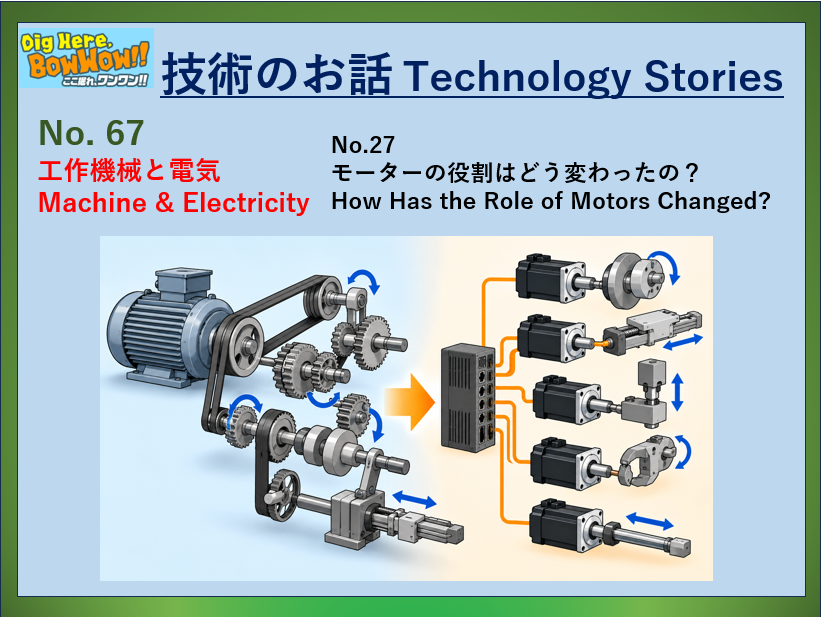
昔のばね加工機には、1つのモーターを回して、
その回転をベルトやギアなどを使って、
工作機械のいろいろなところへ伝えるものが多かったんだ。
わかば:
1つのモーターで、いろんなところを動かしていたの?
もりお:
そう。
工作機械全体を動かす元になるから、
ここでは「原動モーター」と呼ぶことにしよう。
原動モーターは基本的には一定の速さで、同じ方向に回転を続けている。
だから、
「いつ動かすのか」
「どれくらい動かすのか」
「どんなタイミングで止めるのか」
といった複雑な動きは、ギアやカム、クラッチなどの機械的な仕組みを使って作っていたんだ。
わかば:
へぇ~!
モーターは「力を出す係」で、
動き方を作るのはギアやカムだったんだね。
もりお:
そんなイメージだね。
ばね加工機も同じで、
モーターの回転をいろいろな機構へ伝えて、
材料を送ったり、ツールを動かしたり、切断したりしていたんだ。
わかば:
確かに、動きとかタイミングがないと
ばねの形にならないよね。
モーターは1つなのに、そんな複雑な動きを作れるなんて不思議だなぁ。
どうやってたんだろう?
もりお:
昔の技術者は実にいろいろな工夫をしてたんだ。
わかば:
詳しく教えてもらっていい?
もりお:
まあまあ(笑)。
その話はいったん置いておいて、
一度、モーターに注目して整理してみよう。
さっきも言ったように、
現在では、昔とはモーターの使い方が大きく変わっているんだ。
わかば:
どう変わったの?
詳しく教えてよ。
もりお:
例えば、現在の工作機械では、
サーボモーターという、指令に合わせて動きを細かく制御できるモーターがたくさん使われている。
サーボモーターを制御することで、
「この速さで動く」
「反対方向へ動く」
「ここまで動く」
「ここで止まる」
といったことが細かくできるようになった。
わかば:
へぇー。
昔はモーターからギアやカムに動きを伝えていたけど、
今はモーターそのものに、細かく動いてもらえるってことだ。
もりお:
そういうこと。
しかも、モーターも1つじゃなくて、
材料を送るところ、ツールを動かすところなど、
動かしたい場所にそれぞれ個別にモーターを使うことができるんだ。
そして、それぞれのモーターに、
「いつ」
「どれだけ」
「どんな速さで」
動くのかを指令するんだ。
わかば:
つまり、昔はモーターの回転をギアやカムで加工の動きに変えていたけど、
今はモーター自身の動きを細かく制御するようになったんだね。
もりお:
そう、そんなイメージだね。
もちろん今のばね加工機にもギアなどの機械要素は使われているし、
実際にはもっといろいろな装置が間に入っている。
でも、昔は機械的な仕組みで作っていた動きの多くを、
今ではモーターと制御によって作れるようになったんだ。
わかば:
なるほど。
「どんな動きを作るか」の主役が変わってきたんだね。
もりお:
そういうこと。
モーターは「力を出す係」から、「動きを作る係」へと役割を広げてきたんだ。
わかば:
そう考えると、ばね加工機も、モーターの役割もずいぶん変わったんだね。
もりお:
そうだね。
現在のばね加工機は、
「機械」
「電気」
「制御」
そして「ソフトウェア」
が一緒になって動いている。
これから「工作機械と電気」を勉強していくうえでは、
この「制御」も大切なテーマになってくるよ。
わかば:
また勉強することが増えた(笑)。
でも、どうやってモーターの速さや回転方向を変えているの?
もりお:
そこには電気の種類や、電気の流し方を変える技術が関係しているんだ。
モーターにもいろいろな種類があるから、これから順番に勉強していこう。
わかば:
でも、さっきの話、まだ気になってるんだけど。
もりお:
さっきの話?
わかば:
昔のばね加工機だよ!
モーターは「力を出す係」で、
ギアやカムなんかで動きを作っていたんでしょ?
でも、それでどうやって複雑なばねが作れたの?
もりお:
覚えてたか(笑)。
ちょうどいい機械があるよ。
わかば:
なになに?
もりお:
VF-615FT。
ユニバーサルマシンって呼んでたばね加工機だよ。
わかば:
あっ、知ってる!!
日本ばね学会から「ばね技術遺産」に認定されて、
知立センターに展示してあるやつでしょ。
もりお:
そうそう、それそれ、その機械。
1970年(昭和45年)に開発・販売開始されたばね加工機で、
主な加工機構を動かす原動モーターは1つ。
わかば:
1つ?
もりお:
そう。
でも、材料を何回も送ったり、
送り長さを変えたり、
いろいろな加工ユニットを動かしたりして、
引張ばねやトーションばねなど、複雑な形のばねも加工していたんだ。
わかば:
えっ?
モーターはずっと回っているだけなんでしょ?
それなのに、材料を何回も送ったり、送る長さを変えたり、
いろんな加工ユニットを動かしたりできたの?
それって、今のサーボ制御でやっていることとちょっと似てない?
もりお:
おっ、なかなか鋭いね。
わかば:
えっへん! もっと褒めていいよ(笑)。
でも、どうやってたの?
もりお:
それを説明し始めると長くなるから、今日はここまで。
次回はVF-615FTを実際に見ながら、
「今のようなサーボ制御を使わずに、どうやって複雑な動きを作っていたのか」
を考えてみよう。
わかば:
面白そう!
ばね技術遺産に認定された加工機だもんね。
これは何かありそうだね(笑)。
<もりおのひとこと>
昔のばね加工機は、1つの原動モーターを中心に、
ギアやカム、クラッチなどを組み合わせて、複雑な動きを作っていました。
今ならサーボモーターで実現できる動きを、
当時の技術者たちは機械的な仕組みを工夫して実現していたんですね。
技術は進歩しましたが、
より複雑なばねを、より正確に、より効率よく作りたいという思いは、昔も今も変わりません。
次回は、そんな技術者たちの知恵が詰まったVF-615FTを紹介します。
※このブログは、生成AIを活用して作成しています。
Machine & Electricity No. 27 How Has the Role of Motors Changed?
Wakaba:
Ciao, it’s Wakaba♪
Last time, we learned about the different parts inside a motor, didn’t we?
Morio:
That’s right!
We learned that motors contain not only magnets and coils,
but also shafts, bearings, and other parts that turn the rotation generated by electrical energy into actual motion.
Wakaba:
I feel like I’m starting to understand motors pretty well now.
But you know, the motors in Machines don’t always rotate at the same speed and in the same direction, do they?
Morio:
Exactly.
In Machines, motors can rotate faster or slower, stop, or reverse direction.
And that’s not all.
They can also perform more precise movements, such as:
“Move to this position and stop.”
“Move in sync with this axis.”
Over time, the role of motors in creating these movements has changed quite a bit.
Wakaba:
That’s true!
When making springs, we combine all kinds of movements, like feeding wire, moving tools, and cutting.
Our spring forming Machines use lots of motors, don’t they?
The ZF-40 has as many as 20 axes!
Do all those motors think for themselves and decide how to move?
Morio:
No, no! Motors don’t think for themselves (laughs).
And that’s actually the key point today.
Let’s start by looking at how Machines worked in the past.
Wakaba:
What were they like back then?
Morio:
Many older Spring Machines used a single motor.
Its rotation was transmitted to different parts of the Machine through belts, gears, and other mechanical components.
Wakaba:
One motor moved all those different parts?
Morio:
That’s right.
Since it provided the power to drive the entire Machine, let’s call it the “main drive motor.”
The main drive motor basically kept rotating at a constant speed and in the same direction.
So complex movements, such as:
“When to move”
“How far to move”
“When to stop”
were created using mechanical systems made up of gears, cams, clutches, and other components.
Wakaba:
Wow!
So the motor’s job was to “provide the power,” while gears and cams determined how things moved.
Morio:
That’s a good way to think about it.
Spring forming Machines worked the same way.
The motor’s rotation was transmitted through various mechanisms to feed wire, move tools, and cut the material.
Wakaba:
That makes sense.
Without the right movements and timing, you couldn’t make the spring into the shape you wanted.
But it’s amazing that just one motor could produce such complicated movements.
How did they manage that?
Morio:
Engineers back then came up with all kinds of clever ideas.
Wakaba:
Can you tell me more?
Morio:
Hold on, hold on (laughs).
We’ll save that story for later.
For now, let’s focus on the motors themselves.
As I mentioned earlier, the way motors are used today is very different from the past.
Wakaba:
How has it changed?
Tell me more!
Morio:
Well, modern Machines often use servo motors.
These motors can be precisely controlled to move according to commands.
By controlling servo motors, we can make them:
“Move at this speed.”
“Rotate in the opposite direction.”
“Move to this position.”
“Stop right here.”
All with a high degree of precision.
Wakaba:
Wow!
In the past, motors transmitted their rotation through gears and cams.
But now, we can control the movements of the motors themselves much more precisely.
Morio:
Exactly.
And instead of relying on just one motor,
we can use separate motors for different parts of the Machine, such as wire feeding and tool movement.
Then we can tell each motor:
“When to move”
“How far to move”
“How fast to move”
Wakaba:
So in the past, gears and cams turned the motor’s rotation into the movements needed for spring forming.
But now, we can directly control the motor’s own movements.
Morio:
That’s right.
Of course, modern spring forming Machines still use mechanical components such as gears,
and there are various other devices involved as well.
But many of the movements that used to be created mechanically
can now be produced through motors and control systems.
Wakaba:
I see!
So the main role in determining how things move has shifted.
Morio:
Exactly.
Motors have expanded their role from simply “providing power” to also “creating precise movements.”
Wakaba:
When you think about it that way, both spring forming Machines and the role of motors have changed a lot!
Morio:
They certainly have.
Modern spring forming Machines bring together:
“Mechanics”
“Electricity”
“Control”
and “Software”
to work as one system.
As we continue learning about Machines and electricity, control will become another important topic.
Wakaba:
Oh, great! Even more things to learn (laughs).
But how do we actually change a motor’s speed or direction of rotation?
Morio:
That involves different types of electricity and technologies for controlling how electrical power is supplied.
There are also several types of motors, so we’ll explore them one by one in future episodes.
Wakaba:
But there’s something from earlier that I’m still curious about.
Morio:
What’s that?
Wakaba:
Those older spring forming Machines!
You said the motor’s job was to provide power, and gears and cams created the movements, right?
But how could they make such complicated springs that way?
Morio:
Ah, you remembered! (laughs)
I know just the Machine to show you.
Wakaba:
Really? What is it?
Morio:
“VF-615FT”
It’s a spring forming Machine we used to call the “Universal Machine.”
Wakaba:
Oh, I know that one!!
It was recognized as a “Spring Technology Heritage” machine by the Japan Society of Spring Engineers,
and it’s on display at our Chiryu Center, right?
Morio:
Yes, that’s the one!
It was developed and first sold in 1970.
And it had just one main drive motor powering its primary forming mechanisms.
Wakaba:
Just one?
Morio:
That’s right.
Yet it could feed wire multiple times, change the feed length, and operate various forming units.
That allowed it to produce complex spring shapes, including extension springs and torsion springs.
Wakaba:
Wait, what?
The motor just kept rotating, right?
And yet it could feed wire multiple times, change the feed length,
and move all those different forming units?
Isn’t that kind of similar to what modern servo control does?
Morio:
Hey, that’s a pretty sharp observation!
Wakaba:
Hehe! You can praise me some more if you like! (laughs)
But seriously, how did it work?
Morio:
Well, explaining all that would take quite a while, so let’s stop here for today.
Next time, we’ll take a closer look at the VF-615FT and explore this question:
“How did engineers create complex movements without using modern servo control?”
Wakaba:
Sounds interesting!
After all, it’s a Machine recognized as Spring Technology Heritage.
There must be some pretty amazing engineering behind it! (laughs)
<Morio’s Note>
Older Spring Machines used a single main drive motor, combined with gears, cams, clutches,
and other mechanical components, to create complex movements.</morio’s>
Engineers back then achieved through clever mechanical designs
many of the movements that we can now produce using servo motors.
Technology has advanced,
but the desire to make more complex springs with greater precision and efficiency remains the same, both then and now.
In the next episode, we’ll introduce the VF-615FT, a Machine filled with the ingenuity of those pioneering engineers.
Note:This blog is created with the help of generative AI.