











工作機械と電気 No. 26 モーターの中はどうなってるの?
わかば:
やっほー、わかばです♪
前回は、「モーターはなぜ回り続けるの?」を勉強したよね。
電流の向きを切り替えたり、磁界を回転させたりして、
回転する方向へ力が働き続けるようにしているんだったね!
もりお:
そうそう。
磁石から始まって、電磁石、磁界、モーターが回るしくみ、
そして前回は、回り続けるしくみまで来たね。
わかば:
だいぶ理解が進んだ気がするなぁ。
そして、今日はモーターを分解してみるんだよね!!
何が出てくるか楽しみだね。
もりお:
分解する気満々だね(笑)。
その前に一つだけ。
モーターにはいろいろな種類があって、
中のしくみや使われている部品も少しずつ違うんだ。
今日は、工作機械で使われているモーターをイメージしながら、
代表的な部品と、それぞれの働きを見ていこう。
わかば:
了解!
でも、部品の名前を覚えるだけじゃ、受験勉強みたいだから、
役割りをしっかり理解したいな。
もりお:
そうだね。
大きく分けると、
「回転を作る」
「回転を支えて、外へ伝える」
そして、
「回転を知る」
という3つの仕事に注目すると分かりやすいよ。
わかば:
作る、伝える、知る!
よし、順番に行ってみよう!
もりお:
まずは、「回転を作る」チームから。
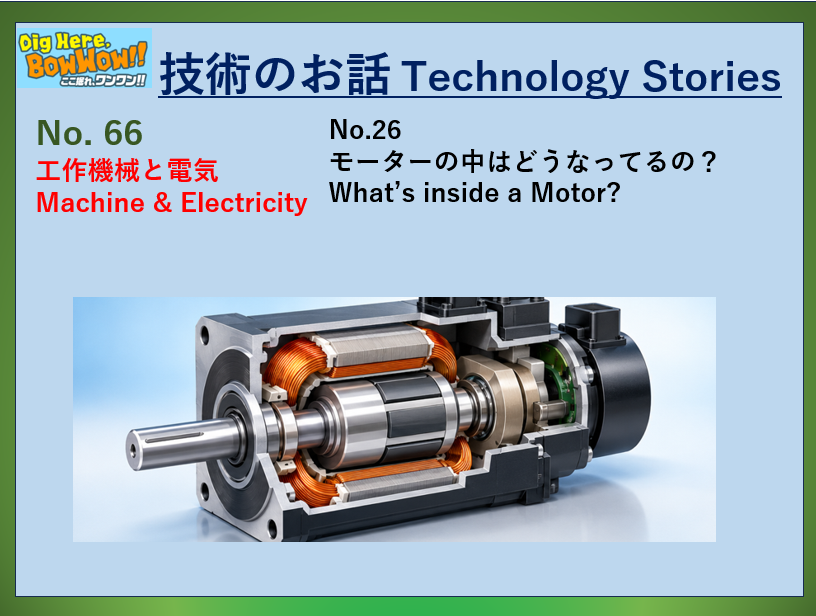
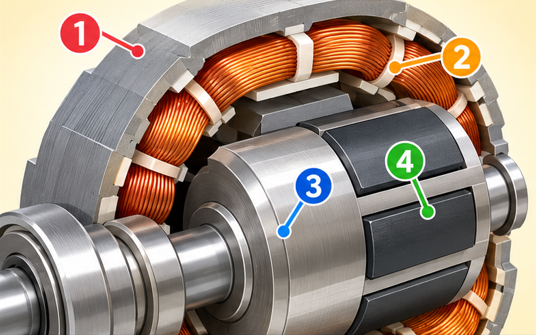
イラストの①を見てみよう。
これは「ステータ」、日本語では「固定子」というんだ。
わかば:
固定子?
名前からして、動かなさそう(笑)。
もりお:
その通り(笑)。
モーターの外側にあって、回転しない部分だよ。
そして③が「ロータ」、日本語では「回転子」。
こちらは名前の通り、モーターの中で回転する部分なんだ。
わかば:
なるほど!
①ステータは「回らない」。
③ロータは「回る」。
まず、この二つを覚えればいいんだね。
もりお:
そう。
そして①のステータには、②の「コイル(巻線)」がある。
わかば:
コイル!
ついに実物のモーターの中に登場だね!
電磁石の回で勉強したように、
電線をクルクル巻いて、電流を流すと磁界ができる!
もりお:
バッチリ。
前回勉強した「回転する磁界」も、
こうしたコイルに流す電流をうまく変化させることで作ることができるんだ。
わかば:
前回は「磁界を回す」と聞いても、
まだモーターの中が見えてなかったけど、
実際には、こういうコイルが働いているんだね。
もりお:
そういうこと。
そして④を見てみよう。
これは「永久磁石」。
回転するロータに永久磁石が使われているモーターもあるんだ。
わかば:
磁石、電磁石、磁界……。
これまで勉強してきたものが、全部出てきた!
もりお:
つながってきたでしょ?
コイルに電流を流して磁界を作る。
その磁界とロータ側の磁石との関係から力が生まれ、
ロータを回転させる。
細かなしくみはモーターの種類によって違うけれど、
まずは「電気と磁気を使って、回転する力を作っている」と考えればいいよ。
わかば:
なるほど!
①ステータには②コイル、
③ロータには④永久磁石。
このあたりが「回転を作るチーム」なんだね。
もりお:
そう考えると分かりやすいね。
わかば:
そして、次のチームは・・・
もりお:
「回転を支えて、外へ伝える」チームだ。
③のロータがモーターの中でグルグル回っただけじゃ、
工作機械は動かない。
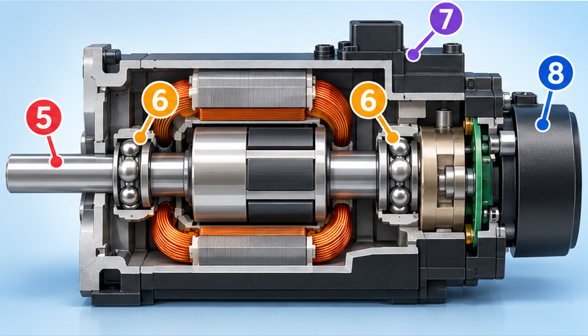
⑤を見てみよう。
これは「シャフト」、つまり「軸」だね。
わかば:
ロータの真ん中を通って、モーターの外まで出てる!
もりお:
そう。
ロータの回転をモーターの外へ取り出すのが、シャフトの大事な仕事なんだ。
モーターの中で作った回転を、
このシャフトから機械へ伝えていくんだよ。
わかば:
なるほど!
モーターの中で作った「回転」の出口みたいなものだね。
もりお:
いい表現だね。
わかば:
でも、このシャフトって、かなり速く回転するんでしょ?
ブレたらダメなんだよね?
もりお:
そこで登場するのが、⑥の「ベアリング」、日本語では「軸受」だ。
わかば:
ベアリングは聞いたことある!
以前のSPC50編(本ブログ第8回、第9回)でも、送り軸を支える大事な部品として取り上げたよね。
もりお:
おっ、覚えてたね。
第8回、第9回では、SPC50で使っているベアリングをかなり詳しく勉強したよね。
今回はモーターの中で、どんな仕事をしているのかを見てみよう。
ベアリングは、回転するシャフトを正しい位置に保ちながら、
できるだけ小さな摩擦で、滑らかに回転できるように支えているんだ。
わかば:
そうだった、そうだった。
磁石や電気だけじゃなくて、
「どうやって滑らかに回すか」も大事なんだね。
もりお:
もちろん。
いくら電気と磁気で回す力を作っても、
軸がガタガタだったり、滑らかに回らなかったりしたら困るよね。
わかば:
モーターって、小さな「機械」みたい。
シャフトが回って、それをベアリングで支える。
SPC50だけじゃないけど、ばね加工機のワイヤー送り機構にも似た考え方があるよね。
もりお:
その感覚、大事だよ。
モーターは電気で動く部品だけど、
回転を支えるところには、機械としての技術もしっかり入っているんだよ。
そして⑦が「フレーム」や「ケース」。
モーターの外側を覆っている部分だね。
わかば:
これは単なるカバーじゃないの?
もりお:
それだけじゃないよ。
中の部品を守ったり、
ステータなどをしっかり支えたり、
モーターを機械に取り付けたりする役目がある。
それに、モーターの中で発生した熱を外へ逃がすことも大切なんだ。
わかば:
へぇ、大きな役割を果たしてるんだね。
もりお:
そう。
モーターは、いろいろな部品がお互いの仕事をして、
初めてきちんと回るんだ。
わかば:
① から⑦まで、働きがよくわかったね。
あれっ?「回転を知る」っていうのもなかった?
もりお:
そう。
工作機械でモーターを使うことを考えると、
もう一つ、とても大切なものがあるんだ。
⑧を見てみて。
わかば:
モーターの後ろについてるやつ?
何これ?
もりお:
これは「エンコーダ」だよ。
わかば:
エンコーダー!
これも前に、第14回から第18回まで詳しく勉強したよね。
あのときはエンコーダーそのものを勉強したけど……。
ここでモーターにつながるんだ!
もりお:
そうなんだ。
前は「エンコーダーとは何か」を詳しく見たけど、
今回は「モーターの中で何のために使われているのか」を考えてみよう。
エンコーダーは、モーターが「どれだけ回ったか」などを知るためのものなんだ。
わかば:
なるほど!
モーターが自分で、
「私はこれだけ回りました」って分かるようにするんだね。
もりお:
そんなイメージだね(笑)。
工作機械では、
ただモーターがグルグル回ればいいわけじゃない。
「ここまで動かしたい」
「この速さで動かしたい」
という要求があるよね。
そのためには、
実際にどれだけ回ったのかを知ることがとても大切なんだ。
わかば:
なるほど!
「回す」だけじゃなくて、
「ちゃんと回ったか」を見るんだ。
もりお:
そう。
今日はエンコーダの名前と役割だけ覚えておけば十分。
どうやって回転を調べているのか、
そして、その情報をどう使ってモーターを思い通りに動かしているのかは、
もう少し先でじっくり勉強しよう。
わかば:
また謎を残したな(笑)。
もりお:
連載だからね(笑)。
じゃあ、今日の内容をまとめてみようか。
わかば:
よしっ!
まず、「回転を作る」チーム。
①ステータと②コイル、
③ロータと④永久磁石。
電気と磁気を使って、回転する力を作る!
次に、「回転を支えて、外へ伝える」チーム。
⑤シャフト、
⑥ベアリング、
⑦フレームやケース。
作った回転を、滑らかに、しっかりと機械へ伝える!
そして最後が、「回転を知る」。
⑧エンコーダ!
ちゃんと回ったかを確認する!
もりお:
バッチリ!
わかば:
最初はモーターって、
「電気を流したら回る電気部品」くらいに思ってたけど、
全然違ったなぁ。
電気があって、磁石があって、回転する軸があって、
それを支えるベアリングがあって、
さらに回転を調べるものまである。
もりお:
そうなんだ。
モーターは「電気部品」であると同時に、
精密な「機械」でもあるんだよ。
わかば:
電気と磁気と機械が、一つになってるんだね!
もりお:
その通り。
そして工作機械では、
そのモーターをただ回すだけじゃなく、
速くしたり、遅くしたり、
反対方向へ回したりしなきゃいけない。
わかば:
確かに!
そういえば、回転する速さって、
どうやって変えてるんだろう?
それに、右回りから左回りにするには?
もりお:
いい質問!!
次回は、
「モーターの速さや回転方向はどう変える?」
を見ていこう!
わかば:
またモーターと仲良くなれそうだね。
それでは、またね~!
もりおのひとこと
モーターというと、「電気の部品」というイメージが強いかもしれません。
でも、中を見てみると、
電流を流して磁界を作るコイル、
回転するロータ、
回転を外へ伝えるシャフト、
その回転を滑らかに支えるベアリングなど、
「機械」として大切な部品がたくさんあります。
そして工作機械では、
モーターがただ回ればいいわけではありません。
どれだけ回ったのかを知り、
必要な位置や速さで正確に動かすことも重要です。
モーターは、
「電気」「磁気」「機械」が一つになって、
工作機械の「動き」を作っているんですね。
過去の関連ブログで、もっと詳しく知りたい方はこちらをご覧ください。
カテゴリー:技術のお話
・ベアリングについて:第8回・第9回
・エンコーダーについて:第14回~第18回
※このブログは、生成AIを活用して作成しています。
Machine & Electricity No. 26 What's inside a Motor?
Wakaba:
Ciao, it’s Wakaba.♪
Last time, we learned about “How Does a Motor Keep Rotating?”
We learned that motors keep producing force in the direction of rotation
by switching the direction of the current or by creating a rotating magnetic field!
Morio:
That’s right.
We started with magnets, then moved on to electromagnets, magnetic fields, how motors rotate,
and finally, last time, how they keep rotating.
Wakaba:
I feel like I’m starting to understand motors pretty well.
And today, we’re finally going to take one apart, right?!
I can’t wait to see what’s inside!
Morio:
You’re really eager to take it apart, aren’t you? (laughs)
But before we do, there’s one thing to remember.
There are many different types of motors,
and their internal structures and components can vary.
Today, let’s picture the kinds of motors used in Machines
and look at some of their main components and what they do.
Wakaba:
Got it!
But just memorizing the names of the parts would feel like studying for an exam.
I want to really understand what each one does.
Morio:
That’s a good approach.
It’s easier to understand if we divide their jobs into three main groups:
“creating rotation,”
“supporting and transmitting rotation,”
and “detecting rotation.”
Wakaba:
Create, transmit, and detect!
All right, let’s take them one at a time!
Morio:
First, let’s look at the team that “creates rotation.”
Take a look at ① in the illustration.
This is the “stator,” the stationary part of the motor.
Wakaba:
Stationary?
Sounds like it doesn’t move. (laughs)
Morio:
Exactly! (laughs)
It’s located around the outside of the motor and stays still.
And ③ is the “rotor.”
Just as its name suggests, this is the part that rotates inside the motor.
Wakaba:
I see!
①, the stator, “stays still.”
③, the rotor, “rotates.”
Those are the first two things to remember!
Morio:
Exactly.
And ①, the stator, contains ②, the “coils,” or “windings.”
Wakaba:
Coils!
They’ve finally appeared inside an actual motor!
Just like we learned in the episode about electromagnets,
when electric current flows through coils of wire, it creates a magnetic field!
Morio:
Perfect.
The “rotating magnetic field” we learned about last time can also be created
by carefully controlling the current flowing through these coils.
Wakaba:
Last time, when you said “make the magnetic field rotate,”
I still couldn’t really picture what was happening inside the motor.
But now I can see that these coils are actually doing the work.
Morio:
Exactly.
Now take a look at ④.
These are “permanent magnets.”
Some motors use permanent magnets in the rotating rotor.
Wakaba:
Magnets, electromagnets, magnetic fields…
Everything we’ve learned so far is showing up here!
Morio:
It’s all starting to connect, isn’t it?
Electric current flows through the coils and creates a magnetic field.
The interaction between that magnetic field and the magnets on the rotor
creates a force that makes the rotor turn.
The details differ depending on the type of motor,
but for now, just remember that motors use electricity and magnetism
to create a force that produces rotation.
Wakaba:
I see!
①, the stator, contains ②, the coils,
and ③, the rotor, has ④, the permanent magnets.
Together, they’re the team that “creates rotation.”
Morio:
That’s a good way to think about it.
Wakaba:
And what’s the next team?
Morio:
The team that “supports and transmits rotation.”
If ③, the rotor, just spun around inside the motor, the Machine wouldn’t move.
Take a look at ⑤.
This is the “shaft.”
Wakaba:
It runs right through the center of the rotor and sticks out of the motor!
Morio:
Exactly.
An important job of the shaft is to take the rotor’s rotation and transmit it outside the motor.
The rotation created inside the motor is transmitted to the Machine through this shaft.
Wakaba:
I see!
It’s like the “exit” for the rotation created inside the motor.
Morio:
That’s a good way to put it.
Wakaba:
But this shaft can rotate pretty fast, right?
It can’t be allowed to wobble, can it?
Morio:
Exactly.
And that brings us to ⑥, the “bearings.”
Wakaba:
I’ve heard of bearings!
We also talked about them in the SPC50 series,
in Episodes 8 and 9 of this blog, as important components that support the feed shaft.
Morio:
Oh, you remembered!
In Episodes 8 and 9, we took a fairly detailed look at the bearings used in the SPC50.
This time, let’s look at what they do inside a motor.
Bearings keep the rotating shaft in the correct position
while allowing it to rotate smoothly with as little friction as possible.
Wakaba:
Right, right!
So it’s not just about magnets and electricity.
How smoothly everything rotates is important too.
Morio:
Of course.
No matter how well electricity and magnetism create a turning force,
it wouldn’t be much good if the shaft wobbled or couldn’t rotate smoothly.
Wakaba:
A motor is almost like a little “machine” of its own.
The shaft rotates, and the bearings support it.
It’s not just the SPC50, but the idea is similar to the wire-feeding mechanisms
in spring-making Machines too.
Morio:
That’s an important connection.
A motor is powered electrically,
but the parts that support its rotation also depend on solid mechanical engineering.
And ⑦ is the “frame” or “housing.”
It surrounds the outside of the motor.
Wakaba:
Isn’t that just a cover?
Morio:
It does much more than that.
It protects the components inside,
holds parts such as the stator firmly in place,
and provides a way to mount the motor to the Machine.
It also plays an important role in releasing heat generated inside the motor.
Wakaba:
Wow, it has some pretty important jobs too!
Morio:
It does.
A motor can only rotate properly when all of its different components do their jobs together.
Wakaba:
Now I understand what ① through ⑦ do.
Wait a minute…wasn’t there also something about “detecting rotation”?
Morio:
That’s right.
When we think about using motors in Machines,
there’s one more very important component.
Take a look at ⑧.
Wakaba:
The thing at the back of the motor?
What’s that?
Morio:
That’s the “encoder.”
Wakaba:
The encoder!
We studied that in detail before, from Episodes 14 through 18.
Back then, we learned about the encoder itself…
So this is where it connects to the motor!
Morio:
Exactly.
Before, we looked closely at “what an encoder is.”
This time, let’s think about why it is used with a motor.
An encoder lets us know things such as how far the motor has rotated.
Wakaba:
I see!
So it lets the motor know,
“I’ve rotated this far!”
Morio:
That’s a good way to picture it. (laughs)
In a Machine, it isn’t enough for a motor simply to spin around.
We need to tell it things like,
“Move this far,”
or
“Move at this speed.”
To do that, it’s very important to know how far the motor has actually rotated.
Wakaba:
I see!
So it’s not just about “making it rotate.”
We also need to know whether it “actually rotated as intended.”
Morio:
Exactly.
For today, it’s enough to remember the name “encoder” and its basic role.
We’ll take a closer look later at how it detects rotation
and how that information is used to make a motor move exactly as we want.
Wakaba:
You’ve left us with another mystery! (laughs)
Morio:
That’s what a series is for! (laughs)
All right, why don’t you sum up what we learned today?
Wakaba:
Okay!
First, the team that “creates rotation.”
① the stator and ② the coils,
③ the rotor and ④ the permanent magnets.
They use electricity and magnetism to create the force that produces rotation!
Next, the team that “supports and transmits rotation.”
⑤ the shaft,
⑥ the bearings,
and ⑦ the frame or housing.
They support the rotation smoothly and transmit it securely to the Machine!
And finally, the team that “detects rotation.”
⑧ the encoder!
It checks how far the motor has actually rotated!
Morio:
Perfect!
Wakaba:
At first, I thought a motor was just an electrical component that spins when you supply electricity.
But there’s so much more to it!
There’s electricity, magnets, a rotating shaft, bearings that support it,
and even a device that detects the rotation.
Morio:
Exactly.
A motor is an “electrical component,” but at the same time, it’s also a precision “machine.”
Wakaba:
So electricity, magnetism, and mechanics all come together in one place!
Morio:
Exactly.
And in a Machine, it isn’t enough simply to make the motor rotate.
We also need to make it rotate faster or slower,
and sometimes make it rotate in the opposite direction.
Wakaba:
That’s true!
Come to think of it, how do we change the speed of a motor?
And how do we switch it from one direction to the other?
Morio:
Great questions!
Next time, we’ll explore:
“How Do We Change a Motor’s Speed and Direction?”
Wakaba:
Looks like I’m going to become even better friends with motors!
See you next time!
<Morio’s Note>
When we think of a motor, we may picture it mainly as an “electrical component.”
But when we look inside,
we find coils that create magnetic fields
when current flows through them, a rotor that turns, a shaft that transmits that rotation outside the motor,
bearings that support the shaft and allow it to rotate smoothly,
and many other components that are essential from a mechanical point of view.
And in a Machine, simply making the motor rotate is not enough.
It is also important to know
how far it has rotated and to control its motion accurately to the required position and speed.
A motor brings together electricity, magnetism, and mechanics to create the “motion” of a Machine.</morio’s>
If you’d like to learn more about some of the components introduced in this episode,
please take a look at these related posts from our Technical Topics series:
・Bearings: Episodes 8 and 9
・Encoders: Episodes 14–18
Note:This blog is created with the help of generative AI.