











工作機械と電気 No. 31 モーターの回転速度はどうやって変えるの?
工作機械と電気 No.31 モーターの回転速度はどうやって変えるの?
~変速機からインバーターへ、速度制御の進歩~
わかば:
やっほー、わかばです♪
前回は、モーターにもいろいろな種類があって、それぞれ得意なことが違うって勉強したよね。
インダクションモーター、ステッピングモーター、サーボモーター……。
名前を覚えるだけでも大変(笑)。
もりお:
そうだね。
でも、モーターの種類や特徴だけでなく、どうやって動かすかも大切なんだ。
今日は、モーターの回転速度を変える仕組みについて勉強しよう。
わかば:
前回、SHINKOの昔のばね加工機では、変速機を使っていたって言ってたよね。
もりお:
そうなんだ。
まずは、昔の機械でどのように速度を変えていたのかを見てみよう。
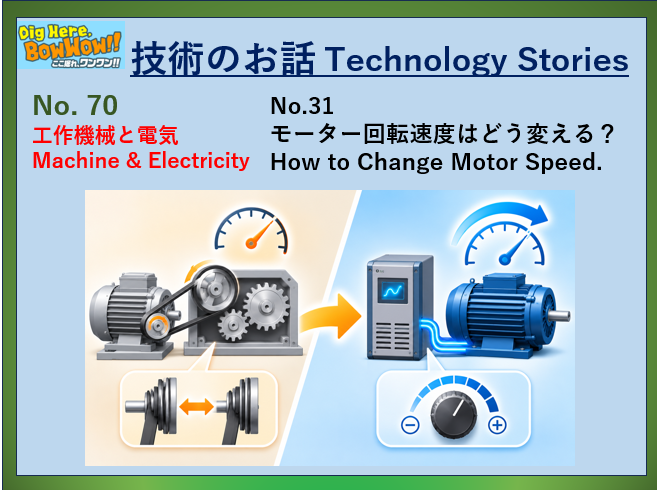
① モーターの回転速度を変えるには?
わかば:
そもそも、どうしてモーターの回転速度を変える必要があるの?
もりお:
ばね材料の線径や送る長さ、加工するばねの形状によって、適した加工速度が違うんだ。
わかば:
確かに!
いつでも全速力で動けばいいわけじゃないんだね。
もりお:
そういうこと。
だから、必要に応じて回転速度を調整する仕組みが必要なんだ。
大きく分けると、機械的に速度を変える方法と、電気的に速度を変える方法があるんだよ。
② 変速機 ~機械の仕組みで速度を変える~
もりお:
まずは、機械的に速度を変える方法から。
昔の工作機械では、歯車やプーリー、ベルトなどを使って回転速度を変えていたんだ。
こうした仕組みを利用する装置を、変速機というんだよ。
わかば:
自転車のギアチェンジみたいなもの?
チェーンが外れると、手や服が汚れて大変だったよね。
もりお:
そうそう! 爪の間とかね。
じゃなくて、自転車も、ギアを変えることで、ペダルを回す速さと車輪の回転速度の関係が変わるよね。
工作機械でも同じように、モーターの回転を機械的に変えて利用していたんだ。
わかば:
なるほど!
モーターの回転速度を変えなくても、機械の動く速さを変えられるんだね。
もりお:
そのとおり。
SHINKOの初期の700STでは、インダクションモーターの回転を
ギアやベルトなどの機械的な仕組みで速度を調整していたんだよ。
わかば:
へぇ~!
モーターと機械をギアやベルトでつないでいたんだね。
もりお:
そうなんだ。
モーターが生み出した回転を、機械的な仕組みで加工に適した速度に変えていたんだ。
わかば:
昔の機械って、機械的な工夫がたくさん詰まっているんだね。
③ インバーター ~電気で回転速度を変える~
わかば:
でも、その後はインバーターが使われるようになったんだよね?
もりお:
そうなんだ。
インバーターは、交流の周波数などを変えて、モーターの回転速度を調整する装置なんだ。
わかば:
周波数って、50Hzとか60Hzのことだったよね。
もりお:
そうそう。
インダクションモーターの回転速度は、交流の周波数と深い関係があるんだ。
だから、周波数を変えることで、回転速度を調整できるんだよ。
わかば:
へぇ~!
でも、周波数って、50Hzか60Hzで決まっているんじゃないの?
もりお:
その通り。
そこで活躍するのがインバーターなんだ。
一般的なインバーター装置では、入力された交流をいったん直流に変えてから、
モーターに必要な周波数の交流を作り出しているんだよ。
わかば:
えっ!
交流を直流にして、また交流に戻す?
何でそんな面倒なことするの?
もりお:
少し遠回りに感じるかもしれないけど、
こうすることで、周波数や電圧を調整した交流を作ることができるんだ。
わかば:
へぇ~!
電気を作り直して、モーターの回転速度を変えているんだね。
もりお:
そのとおり。
ちなみに、周波数を変えるだけでなく、モーターの特性に合わせて電圧なども調整するんだよ。
④ 周波数が変わると、回転速度はどうなる?
わかば:
周波数を変えると、モーターの回転速度はどれくらい変わるの?
もりお:
例えば、4極のインダクションモーターで考えてみよう。
周波数が60Hzのとき、磁界が回転する速さは毎分1,800回転になるんだ。
これを30Hzにすると、毎分900回転になるんだよ。
わかば:
周波数が半分になると、回転速度も半分になるんだね!
もりお:
そうだね。
ただし、インダクションモーターの回転子は、磁界の回転より少し遅れて回るんだ。
だから、実際のモーターの回転速度は、この数字より少し低くなるんだよ。
わかば:
へぇ~、ぴったり同じじゃないんだ。
もりお:
この回転速度の差を「すべり」というんだ。
実は、インダクションモーターは、
このすべりがあることで回転する力を生み出しているんだよ。
わかば:
なるほど。
でも、周波数を変えることで、回転速度を調整できることはよくわかったよ!
⑤ SHINKOの700STはどう変わった?
もりお:
ここで、SHINKOの700STに戻ってみよう。
初期の700STでは、先ほど説明したベルトやギアによる機械式変速を採用していたんだ。
わかば:
モーターそのものの回転速度を変えるのではなく、回転を伝える仕組みで速度を調整していたんだよね。
もりお:
そうなんだ。
その後、インバーターを採用することで、
モーターそのものの回転速度を電気的に調整できるようになったんだ。
わかば:
それって、どんなメリットがあったの?
もりお:
例えば、それまで機械的な仕組みで行っていた速度調整を、
電気的な制御に置き換えられるようになったことが大きな進歩だったんだ。
わかば:
なるほど!
でも、昔の変速機にも良いところがあったんでしょ?
もりお:
もちろん。
変速機には、回転速度とトルクの関係を機械的に変えられるという特徴があるんだ。
一方、インバーターにも、低速でのトルクやモーターの冷却など、
使い方によって注意すべき点があるんだよ。
だから、現在でも用途に応じて減速機や変速機が使われているんだ。
⑥ 速度調整ボリューム ~操作も変わった~
わかば:
インバーターを使うと、実際の機械の操作も変わるの?
もりお:
そうなんだ。
SHINKOの700STの取扱説明書には、「インバータ無段変速」「速度調整ボリューム」という説明があるんだよ。
わかば:
速度調整ボリューム?
もりお:
簡単にいえば、つまみを回して速度を調整する装置なんだ。
ボリュームの設定に応じてインバーターへの速度指令が変わり、
モーターの回転速度を調整できるんだよ。
昔のテレビも、音量を変えるときに「ボリュームを回す」って言ってたよね。
わかば:
へぇ~!
つまみを回すだけで、モーターの速さを変えられるんだね。
でも、「ボリュームを回す」っていう表現自体が、もうレトロだね(笑)。
もりお:
初期の700STでは、ベルトやギアを使った機械的な仕組みで変速していたけど、
インバーターを採用した700STでは、電気信号によってモーターの速度を調整できるようになったんだ。
わかば:
操作する人にとっても、便利になったんだね。
もりお:
そうだね。
ただし、つまみを回して速度を調整するという操作自体は、
機械式の変速機でもできる場合があるんだ。
大きな違いは、つまみの操作が機械的な変速ではなく、
電気的な速度制御につながることなんだよ。
わかば:
なるほど!
同じように速度を調整していても、中の仕組みが変わったんだね。
もりお:
そのとおり。
そして、電気的に速度を調整できるようになったことが、その後の制御技術の発展にもつながっていくんだ。
⑦ 速度を変えることと、位置を決めることは違う
わかば:
インバーターって便利だね!
じゃあ、インバーターがあれば、モーターを自由自在に動かせるの?
もりお:
実は、そこが次の大切なポイントなんだ。
インバーターで回転速度を調整できても、
それだけで、モーターを狙った位置に正確に止められるとは限らないんだよ。
わかば:
えっ、そうなの?
もりお:
例えば、ワイヤーを100mmだけ送って、ぴったり止めたいとしよう。
回転速度を調整するだけでは、実際に何回転したのかを正確に把握できない場合があるんだ。
わかば:
あっ!
速さがわかっても、どこまで動いたかは別なんだね。
もりお:
そのとおり。
そこで、エンコーダーなどを使って実際の動きを検出し、
位置や速度を精密に制御するサーボシステムが重要になるんだ。
わかば:
前回勉強した、フィードバック制御だね!
もりお:
そうそう。
もちろん、インバーターにも高度な制御ができるものはあるけど、
ここでは基本的な速度制御と、精密な位置制御の違いを覚えておこう。
わかば:
なるほど!
モーターを速く回すことと、思いどおりの位置に動かすことは、違う技術なんだね。
⑧ 速度制御から、さらに複雑な動きへ
もりお:
SHINKOのばね加工機も、こうした電気制御の進歩とともに発展してきたんだ。
700STでは、機械的な変速からインバーターによる速度制御へ。
その後の700ELでは、ワイヤー送りにサーボモーターが採用されたんだ。
わかば:
ワイヤーを長く、決まった長さだけ送れるようになったんだよね。
もりお:
そうだね。
ただし、700ELでは、ワイヤーを送っている間に、
コイル径やピッチを変えるような加工には制約があったんだ。
さらにSEでは、カム軸もサーボ化され、複数の軸を同時に動かすことができるようになったんだよ。
わかば:
へぇ~!
単にモーターが変わっただけじゃなくて、加工の自由度も高まったんだね。
もりお:
そのとおり。
機械的に回転速度を変えるところから、
モーターの位置や複数の軸の動きまで制御するようになったんだ。
でも、一度に全部覚えなくても大丈夫。
まずは、モーターの回転速度を変える方法と、位置を精密に制御する方法は違う、
ということを理解しておこう。
わかば:
うん!
少しずつ、工作機械の電気制御がわかってきた気がするなぁ。
もりお:
次回は、サーボモーターがどのように位置や速度を制御しているのか、
もう少し詳しく勉強してみよう。
SHINKOの700ELで、ワイヤー送りがどのように進歩したのかも紹介するよ。
わかば:
いよいよサーボモーターの登場だね!
楽しみだなぁ♪
それじゃあ、また次回ね!
もりおのひとこと
あっ、もりおです。
昔の工作機械には、ギアやカム、変速機など、
機械的な工夫がたくさん詰まっていました。
モーターは回転する力を生み出し、その回転をどう利用するかは、
機械の仕組みが担っていたんですね。
そこにインバーターが登場し、モーターの回転速度を電気的に調整できるようになりました。
SHINKOの700STでも、機械的な変速から「インバータ無段変速」へと進化しました。
速度調整ボリュームを使って回転速度を設定できるようになり、
操作方法も変わっていったんです。
さらにサーボモーターと制御装置の進歩によって、
速度だけでなく、位置や複数の軸の動きまで精密に制御できるようになりました。
こうして振り返ると、工作機械の進歩は、機械技術が担っていた役割の一部を、
電気制御が担うようになってきた歴史ともいえそうです。
でも、機械の技術が不要になったわけではありません。
どれだけ電気制御が進歩しても、その動きを正確に伝える機械構造が必要なんです。
機械と電気、それぞれの技術を組み合わせて、より良い加工を実現する。
そんな技術者たちの工夫の積み重ねが、現在のSHINKOのばね加工機につながっているんですね。
これからも、一緒に勉強していきましょう!
※このブログは、生成AIを活用して作成しています。
Machine & Electricity No. 31 How Do We Change a Motor’s Rotational Speed?
Machine Tools and Electricity No. 31: How Do We Change a Motor’s Rotational Speed?
~From Mechanical Transmissions to Inverters: The Evolution of Speed Control~
Wakaba:
Ciao, it’s Wakaba♪
Last time, we learned that there are different types of motors, each with its own strengths.
Induction motors, stepper motors, servo motors…
Just remembering all those names is hard enough! (LOL)
Morio:
That’s true.
But besides understanding the different types of motors and their characteristics,
it’s also important to know how we control them.
Today, let’s learn how we change a motor’s rotational speed.
Wakaba:
Last time, you mentioned that older SHINKO spring-making machines used mechanical transmissions, right?
Morio:
That’s right.
Let’s start by looking at how machines controlled their speed in the past.
① Why Do We Need to Change a Motor’s Speed?
Wakaba:
First of all, why do we need to change a motor’s rotational speed?
Morio:
The appropriate processing speed depends on factors such as the wire diameter,
the length of wire being fed, and the shape of the spring being produced.
Wakaba:
That makes sense!
Running at full speed all the time isn’t necessarily the best approach.
Morio:
Exactly.
That’s why we need a way to adjust the rotational speed as required.
Broadly speaking, there are two methods: mechanical speed control and electrical speed control.
② Mechanical Transmissions: Changing Speed Mechanically
Morio:
Let’s start with mechanical speed control.
In the past, machine tools used gears, pulleys, belts, and other mechanical components to change rotational speed.
A device that uses these mechanisms to change speed is called a mechanical transmission.
Wakaba:
Like changing gears on a bicycle?
When the chain comes off, your hands and clothes get all dirty trying to put it back on!
Morio:
Exactly! Especially under your fingernails!
Wait, that’s not the point!
On a bicycle, changing gears changes the relationship
between how fast you pedal and how fast the wheels turn.
Machine used similar mechanical principles to change the speed transmitted from the motor.
Wakaba:
I see!
So you can change how fast the machine moves without changing the motor’s rotational speed.
Morio:
That’s right.
In SHINKO’s early 700ST machines, the speed of the induction motor
was adjusted mechanically using gears, belts, and other components.
Wakaba:
Wow!
So the motor and the machine were connected through gears and belts.
Morio:
Exactly.
The rotation produced by the motor was mechanically converted
into a speed suitable for the machining process.
Wakaba:
Older machines were really full of clever mechanical ideas!
③ Inverters: Changing Rotational Speed Electrically
Wakaba:
But later, inverters came into use, right?
Morio:
That’s right.
An inverter is a device that controls a motor’s rotational speed
by changing the frequency and other characteristics of the AC power supplied to it.
Wakaba:
Frequency… that’s the 50 Hz or 60 Hz we learned about before, right?
Morio:
Exactly.
The rotational speed of an induction motor is closely related to the frequency of the AC power supply.
So by changing the frequency, we can control the motor’s speed.
Wakaba:
Wow!
But isn’t the power supply frequency fixed at either 50 Hz or 60 Hz?
Morio:
That’s right.
And that’s where an inverter comes in.
In a typical inverter drive, the incoming AC power is first converted into DC.
Then it’s converted back into AC at the frequency needed by the motor.
Wakaba:
What?!
You turn AC into DC, and then back into AC?
Why go through all that trouble?
Morio:
It might seem like a roundabout process, but this allows us to generate AC power with the frequency and voltage we need.
Wakaba:
Wow!
So you’re essentially recreating the electrical power to change the motor’s speed.
Morio:
Exactly.
And by the way, an inverter doesn’t just change the frequency.
It also adjusts the voltage and other parameters to suit the motor’s characteristics.
④ What Happens to Motor Speed When the Frequency Changes?
Wakaba:
How much does the motor’s speed change when you change the frequency?
Morio:
Let’s take a four-pole induction motor as an example.
At 60 Hz, the motor’s rotating magnetic field turns at 1,800 revolutions per minute.
If we reduce the frequency to 30 Hz, that speed drops to 900 revolutions per minute.
Wakaba:
So if the frequency is cut in half, the rotational speed is cut in half too!
Morio:
That’s right.
However, in an induction motor,
the rotor actually turns slightly slower than the rotating magnetic field.
So the motor’s actual rotational speed is a little lower than those figures.
Wakaba:
Oh, so they don’t rotate at exactly the same speed.
Morio:
The difference between these rotational speeds is called “slip.”
In fact, an induction motor produces torque because of this slip.
Wakaba:
I see.
Anyway, now I understand how changing the frequency lets us control the motor’s speed!
⑤ How Did SHINKO’s 700ST Evolve?
Morio:
Now, let’s return to SHINKO’s 700ST.
Early 700ST machines used the mechanical speed-changing system
with belts and gears that we talked about earlier.
Wakaba:
Instead of changing the motor’s own rotational speed,
they adjusted the speed through the mechanism that transmitted its rotation, right?
Morio:
Exactly.
Later, with the introduction of inverters,
it became possible to control the motor’s rotational speed electrically.
Wakaba:
What were the advantages?
Morio:
For example, rotational speed could be adjusted electrically
without relying on a mechanical speed-changing mechanism.
It was a major step forward.
Wakaba:
I see!
But those old mechanical transmissions must have had their advantages too, right?
Morio:
Of course.
Mechanical transmissions can change the relationship
between rotational speed and torque through their gear ratios.
On the other hand, inverter-driven systems also require attention to factors
such as low-speed torque and motor cooling, depending on how they’re used.
That’s why gear reducers and mechanical transmissions are still used today
when the application calls for them.
⑥ Speed Control Knobs: The Way Operators Worked Changed Too
Wakaba:
Does using an inverter also change how people operate the machine?
Morio:
It certainly does.
SHINKO’s 700ST instruction manual
includes the terms “Inverter Variable Speed Control” and “Speed Adjustment Knob.”
Wakaba:
Speed adjustment knob?
Morio:
Simply put, it’s a knob you turn to adjust the speed.
As you turn it, the speed command sent to the inverter changes,
allowing the motor’s rotational speed to be adjusted.
Remember how people used to say “turn up the volume” on old televisions?
Wakaba:
Oh, I see!
So you can change the motor’s speed just by turning a knob.
But even the idea of “turning the volume knob” sounds pretty retro now! (LOL)
Morio:
Early 700ST machines changed speed mechanically using belts and gears.
But with the inverter-equipped 700ST,
motor speed could be adjusted using electrical signals.
Wakaba:
That must have made things more convenient for machine operators too.
Morio:
That’s right.
However, some mechanical transmissions can also be adjusted by turning a knob.
The important difference is that turning the knob now controls the speed electrically
rather than changing it through a mechanical transmission.
Wakaba:
I see!
Even if the operator adjusts the speed in a similar way,
the mechanism inside the machine is completely different.
Morio:
Exactly.
And the ability to control speed electrically helped pave the way
for further advances in control technology.
⑦ Changing Speed and Controlling Position Are Two Different Things
Wakaba:
Inverters are really useful!
So does that mean we can use an inverter to make a motor move exactly however we want?
Morio:
Actually, that brings us to another important point.
Even if an inverter can control a motor’s rotational speed,
that alone doesn’t necessarily mean it can stop the motor precisely at a desired position.
Wakaba:
Really?
Morio:
For example, imagine we want to feed exactly 100 mm of wire and then stop.
Simply controlling rotational speed doesn’t necessarily tell us precisely
how many revolutions the motor has made.
Wakaba:
Oh, I get it!
Knowing how fast something is moving is different from knowing how far it has moved.
Morio:
Exactly.
That’s why servo systems are so important.
They use devices such as encoders to detect actual movement and precisely control position and speed.
Wakaba:
That’s the feedback control we learned about last time!
Morio:
Exactly.
Of course, some advanced inverter systems can perform sophisticated control functions too.
But for now, let’s focus on the difference between basic speed control and precise position control.
Wakaba:
I see!
Making a motor spin at a certain speed and moving it
to exactly the position we want are two different kinds of control.
⑧ From Speed Control to More Complex Movements
Morio:
SHINKO’s spring-making machines have evolved alongside these advances in electrical control.
The 700ST progressed from mechanical speed adjustment to inverter-based speed control.
Later, the 700EL introduced a servo motor for wire feeding.
Wakaba:
That made it possible to feed longer lengths of wire and control the feed length precisely, right?
Morio:
That’s right.
However, the 700EL still had limitations
when it came to processes such as changing the coil diameter or pitch while the wire was being fed.
Later, with the SE series, the cam shaft was also servo-driven,
making it possible to move multiple axes simultaneously.
Wakaba:
Wow!
So it wasn’t just the motors that changed.
The machines also gained much greater flexibility in what they could produce!
Morio:
Exactly.
Machine evolved from mechanically changing rotational speed
to controlling motor positions and coordinating the movements of multiple axes.
But you don’t have to remember everything at once.
For now, the important thing is to understand
that changing a motor’s rotational speed and precisely controlling its position
are two different things.
Wakaba:
Got it!
I feel like I’m gradually starting to understand how electrical control works in machine tools.
Morio:
Next time, we’ll take a closer look at how servo motors control position and speed.
We’ll also explore how wire feeding evolved with SHINKO’s 700EL.
Wakaba:
So we’re finally getting into servo motors!
I can’t wait♪
See you next time!
<Morio’s Note>
It’s Morio here.
Older machines were packed with clever mechanical engineering,
including gears, cams, and mechanical transmissions.
Motors generated rotational power, while mechanical systems determined how that rotation would be used.
Then inverters came along, making it possible to control motor speed electrically.
SHINKO’s 700ST also evolved from mechanical speed adjustment to inverter-based stepless speed control.
Operators could set the rotational speed using a speed adjustment knob,
changing the way they operated the machine.
Later, advances in servo motors and control systems made it possible to precisely control not only speed,
but also position and the coordinated movement of multiple axes.
Looking back, the history of Machines development can also be seen
as a process in which electrical control gradually took over some of the functions
previously performed by mechanical systems.
But that doesn’t mean mechanical engineering has become unnecessary.
No matter how advanced electrical control becomes,
we still need mechanical structures that can transmit movement accurately.
Combining mechanical and electrical technologies
to achieve better machining performance—that’s what it’s all about.
The ingenuity and continuous efforts of engineers over the years
have shaped the SHINKO spring-making machines we have today.
Let’s keep learning together!
Note:This blog is created with the help of generative AI.